
Farm burning fuels smog risk as Bangkok’s PM2.5 levels rise ahead of winter
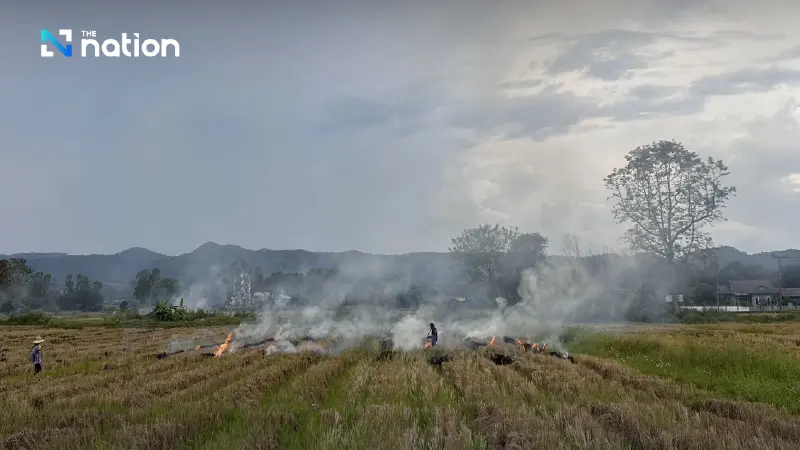


Open-field burning of farm waste continues to worsen air pollution across Thailand as Bangkok records rising PM2.5 levels, signalling another smog-heavy winter.
The open burning of agricultural residue remains a major contributor to Thailand’s air pollution problem. Despite public warnings, the practice continues widely because it is cheap, quick, and convenient for farmers.
Over the past decade, the onset of Thailand’s cool season has repeatedly brought smog across the country. Seasonal winds carry a mix of dust, PM10, and fine particulate matter (PM2.5) from upwind regions into Thailand’s airspace. When winds die down in the early months of the year, the pollutants become trapped in low-lying areas, worsening respiratory health conditions for millions.

Authorities have acknowledged that the burning problem persists across regions and shows no sign of easing. The scale of pollution, they say, has exceeded the reach of conventional control measures and will require regional cooperation to resolve.
Bangkok’s latest PM2.5 readings
According to the Bangkok Air Quality Information Centre, as of 7am on November 9, 2025, the city’s average PM2.5 level stood at 20.7 microgrammes per cubic metre (µg/m³), below the national safety threshold of 37.5 µg/m³.

However, several districts recorded significantly higher levels:
- Prawet: 35.5 µg/m³
- Lat Krabang: 35.1 µg/m³
- Bueng Kum: 33.4 µg/m³
- Bang Na: 29.2 µg/m³
- Pathumwan: 28.6 µg/m³
- Bang Rak: 28.5 µg/m³
- Ratchathewi: 28.4 µg/m³
- Khan Na Yao: 27.4 µg/m³
- Suan Serithai, Bueng Kum District: 26.5 µg/m³
- Bang Phlat: 26.0 µg/m³
- Wang Thonglang: 24.9 µg/m³
- Khlong Toei: 24.9 µg/m³
The highest concentrations were observed in eastern Bangkok, where air quality ranged from 18.8 to 35.5 µg/m³, classified as moderate. Other zones, northern, central, southern, and Thonburi areas, remained in the “good” range, averaging between 16 and 29 µg/m³.
Air quality outlook
While Bangkok’s air quality is currently rated as generally good, officials warn that PM2.5 levels are likely to rise as the cool season progresses. The expected return of widespread farm burning and stagnant winter air could once again trigger hazardous smog conditions.
Experts advise residents, particularly those with respiratory or heart conditions, to monitor air quality updates regularly, limit outdoor activities, and wear protective masks when pollution levels climb.
With crop burning showing no signs of abating, Thailand may once again be facing a difficult and dusty winter.

