
Political fate of 6 Shinawatra PMs: Will Paetongtarn face the same fate?
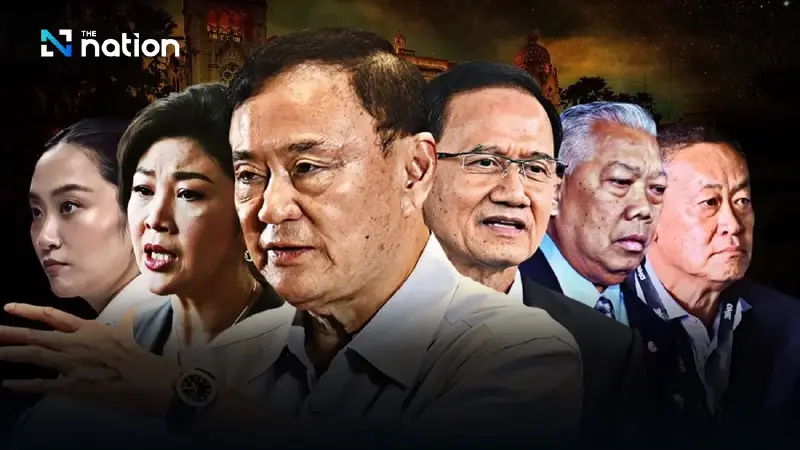


The political turmoil surrounding six Shinawatra-linked prime ministers raises the question: will Paetongtarn Shinawatra follow in her family's footsteps or overcome the challenges to secure her position?
Dissolution of the Lower House, resignation, and Cabinet reshuffle – all of these are options, but the Cabinet reshuffle is the method that Prime Minister Paetongtarn Shinawatra is most likely to choose during this period of political instability.
Not only is she dealing with internal political battles, but she is also facing international pressure due to the leaked audio clip of a conversation with Cambodian Senate leader Hun Sen, which has deepened tensions between the two countries.
Seizing the opportunity, the Bhumjaithai Party, after losing the Interior Ministry to Pheu Thai, has withdrawn from the coalition government. The party is now fully embracing its role as the opposition, stepping up pressure on Paetongtarn to take responsibility for the national disgrace caused by the scandal, which has damaged Thailand’s honour, national pride, and the image of its people and military.
Since the Shinawatra family’s rise to power in 2001, every Prime Minister from the Thai Rak Thai, People's Power, and Pheu Thai parties has faced an unfortunate downfall.
The only exception was Thaksin Shinawatra, who served as Thailand's 23rd Prime Minister from 2001 to 2006. His government completed its full four-year term due to a massive electoral victory, securing 248 seats out of 500 in the 2001 elections under the 1997 Constitution. This victory led to the formation of a strong coalition government with over 300 seats, which led to a merger with parties such as the New Aspiration, Chart Pattana, and the Liberal Democratic Party.
Thaksin's Coup and the End of Thai Rak Thai
The coup that ousted Thaksin marked the end of the Thai Rak Thai Party. In 2005-2006, Thaksin won a landslide victory in the elections, receiving overwhelming support with 19 million votes and securing 377 seats for his party, allowing him to form a single-party government. However, his tenure was cut short due to mass opposition from the People's Alliance for Democracy (PAD), which raised concerns over the sale of Shin Corporation shares to Temasek Holdings without paying taxes.
This controversy led to widespread protests, eventually prompting the military leaders to stage a coup on September 19, 2006, while Thaksin was abroad attending a United Nations meeting in New York.
Samak's Downfall Over "Cooking Show" Scandal
In 2007, after the dissolution of the Thai Rak Thai Party, its DNA was transferred to the People's Power Party, led by Samak Sundaravej. The party won a majority in the elections, securing 233 seats, and formed a coalition government with parties such as the Chart Thai Party, the Neutral Democratic Party, the Puea Pandin Party, and the Chart Pattana Party.
Samak became the 25th Prime Minister, but his time in office was short-lived. Within less than a year, he faced severe pressure from the yellow-shirted protesters, who seized the Government House, leading to escalating unrest.
The Constitutional Court unanimously ruled on September 9, 2008, that Samak was disqualified as Prime Minister due to his involvement as the host of the TV shows Tasting and Complaining and The 6 O'Clock Parade. This marked the end of Samak's brief tenure as Prime Minister, which had been supported by the Shinawatra family to ensure loyalty.
Somchai: The Prime Minister Who Never Entered Government House
The next Shinawatra-affiliated Prime Minister, Somchai Wongsawat, was elected by the House of Representatives as the 26th Prime Minister. He served a brief term and remains the only Prime Minister in Thailand's history to never set foot in Government House. As the brother-in-law and deputy leader of the People's Power Party, Somchai's government operated from Don Mueang Airport, where Cabinet meetings were held.
However, the People's Alliance for Democracy (PAD) escalated its protests, occupying both Government House and Don Mueang Airport, as well as Suvarnabhumi Airport.
The Constitutional Court ultimately dissolved the People's Power Party, along with the Chart Thai Party and the Neutral Democratic Party.
Somchai's tenure lasted less than three months, from September 18, 2008, to December 2, 2008, before he was disqualified from politics, along with the party executives.
Coup Overthrows Yingluck
The next Shinawatra Prime Minister, and the second of the Shinawatra family, was Yingluck Shinawatra. She served as Thailand's 28th Prime Minister from August 5, 2011, to May 7, 2017, holding office for two years, nine months, and two days. Yingluck led the Pheu Thai Party to a massive election victory, winning 265 seats in the House of Representatives and forming a coalition government.
However, her time in office ended similarly to her brother, Thaksin. The government initially faced turmoil over the controversial amnesty bill, which sparked protests outside Parliament. The Democrat Party, led by Suthep Thaugsuban, led the People's Democratic Reform Committee (PDRC) protests, which eventually led to the dissolution of the lower house on December 9, 2013.
The February 2, 2014, general election was declared void, and Yingluck was later removed from office by the Constitutional Court due to her involvement in the removal of Thawil Pliensri as National Security Council Secretary-General. This led to further protests, including from both the PDRC and the Red Shirts (United Front for Democracy Against Dictatorship, UDD).
Gen Prayut's Coup and the End of Shinawatra's Political Dynasty
On May 22, 2014, Gen Prayut Chan-o-cha, the Commander-in-Chief of the Royal Thai Army, took decisive action and announced a military coup, effectively taking control of the country's government. This marked the end of the Shinawatra family’s direct rule, with Prime Minister Yingluck forced to flee and eventually face charges related to the rice-pledging scheme.
PM Srettha’s Ethical Dilemma and Short-Term Leadership
The next prime minister from the Shinawatra political line, Srettha Thavisin, became the fifth individual associated with the family to assume the position. The CEO of a real estate company, Srettha, was nominated as the Pheu Thai Party’s candidate and campaigned during the final stretch before the May 14, 2023, elections. However, his party lost to the Move Forward Party.
On August 22, 2023, Srettha was elected as the 30th Prime Minister by the joint session of Parliament.
Srettha, who served for only 358 days, was removed from office on August 14, 2024, following a Constitutional Court ruling, much like his predecessors Samak and Somchai. He faced allegations of lacking integrity, particularly in his appointment of Phichit Chuenban as the Prime Minister’s Office Minister.
PM Paetongtarn Faces Pressure to Resign and Dissolve Parliament
The third Shinawatra family member to become Prime Minister, Paetongtarn Shinawatra, is the youngest daughter of Thaksin. As the second female prime minister and the 31st of Thailand, she rose to power after a parliamentary vote of 319 in favour. She officially assumed office on August 16, 2024. However, she now faces a turbulent future, with the potential of experiencing similar struggles as her father and uncle.
Paetongtarn is facing intense political resistance from the Bhumjaithai Party, which has lost control of the Interior Ministry, as well as opposition parties calling for her to dissolve Parliament and take responsibility by resigning. Additionally, she is dealing with external diplomatic tensions, particularly with Cambodia, where the release of an audio clip between the Cambodian leader has ignited political controversy, adding to the already volatile domestic situation.
The leaked audio has sparked a significant political crisis within Thailand, with the opposition and civil society movements, under the banner of "Unity of the Land," organising large-scale protests. These protests are scheduled for June 28, 2025, as pressure mounts for the government to address both internal and international challenges.
Senate Pushes for Investigation: Ethics Issue Raises Concerns for Paetongtarn
The Senate, aligned with the pro-military faction, has intensified pressure on Prime Minister Paetongtarn by submitting a formal complaint to the National Anti-Corruption Commission (NACC) to investigate whether she has engaged in misconduct or violated constitutional provisions and laws, as well as whether she has seriously breached ethical standards in her capacity as Prime Minister.
In addition, the Senate has referred the matter of "ethics" to the Constitutional Court for a ruling, invoking Article 170, paragraph 3, in conjunction with Article 82 of the Constitution. The Court is to decide whether Paetongtarn’s tenure as Prime Minister should be terminated under Article 170, paragraph 1(4), and Articles 160(4) and (5).
If Paetongtarn can navigate her administration successfully, balancing the interests within the coalition government, her fate may not mirror the downfall of her father or uncle. Whether the latest Shinawatra prime minister will complete her term remains uncertain, with the political landscape still in flux.
