
Four parties battle for Bangkok’s 33 seats in 2026 election as capital becomes key popularity test
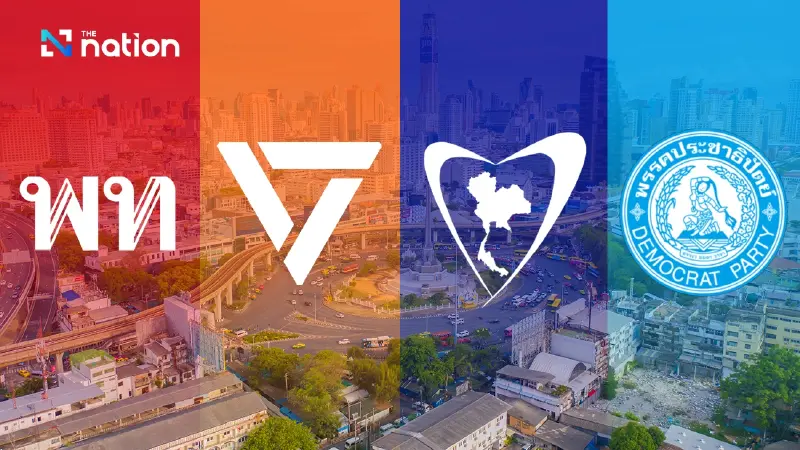


Bangkok’s 33 seats will be a major test of party popularity in the February 8, 2026 election, with the People’s Party defending its 2023 landslide against three rivals.
The February 8, 2026 general election will bring an intense fight for Bangkok’s 33 constituency seats, a battleground widely seen as a key barometer of party popularity. Major parties are expected to deploy full-scale strategies to capture as many seats in the capital as possible.
People’s Party aims to defend its Bangkok dominance
The defending champion in Bangkok is the People’s Party (formerly the Move Forward Party under the leadership of Pita Limjaroenrat), which won 32 of 33 seats in the 2023 election, missing only one seat in Lat Krabang.
Since then, the party has built a record as an opposition force, proposing several progressive bills and strengthening its “new generation” brand among urban voters.
In the new contest for the capital, the orange tide is still seen as having a clear advantage, partly because Bangkok voters have not yet seen the People’s Party in executive power and are still inclined to “try something new”.
Although Natthaphong Ruengpanyawut, the party leader, has not yet generated the same wave of personal popularity as the earlier “Pita effect”, there is still nearly two months left to build momentum.
Strategically, the People’s Party has also adjusted its candidate line-up by shifting some high-profile former Bangkok MPs to the party-list race, amid concerns that several “vote magnets” could face political cases. Those named include Rukchanok Srinork, Piyarat Chongthep, and Nattacha Boonchaiinsawat. The move would allow the party to replace them through the party-list system if any lose their constituency seats, avoiding the uncertainty of by-elections.
Pheu Thai recalibrates after 2023 setback
Pheu Thai has never topped the Bangkok table outright, but has traditionally won a share of seats in each election. In 2023, however, it underperformed badly in the capital, taking just one seat. This time, the party has recalibrated its strategy.
Pheu Thai is betting that part of the orange surge in 2023 came from conservative voters crossing over, and that some of those votes could now drift back to the conservative camp, particularly amid a rising nationalist mood linked to clashes on the Thai-Cambodian border.
If the orange momentum softens, Pheu Thai believes it may have a better chance to compete in key strategic areas where it can manage vote distribution more effectively.
Bhumjaithai seeks breakthrough with Akanat Promphan
For Bhumjaithai, Bangkok has long been hostile terrain: the party has never won a Bangkok MP seat. Yet senior figures in the blue camp are setting higher expectations this time, helped by the involvement of Akanat Promphan, former secretary-general of the United Thai Nation Party.
Akanat carries a recognisable conservative brand and has an established network in Bangkok, having previously been with the Democrat Party and having served as a Bangkok MP.
The factor that could reshape Bhumjaithai’s prospects, observers say, is nationalism. If the Thai-Cambodian border conflict evolves in a way that boosts Prime Minister Anutin Charnvirakul’s standing, the party could gain a stronger opening in the capital.
Democrats hope for a ‘blue wave’ comeback
The Democrat Party has been wiped out in Bangkok for two straight elections, in 2019 and 2023, with the party’s brand in sharp decline after Abhisit Vejjajiva stepped down following the 2019 defeat to Gen Prayut Chan-o-cha.
For the 2026 election, however, the Democrats are seeking a revival after Abhisit returned as party leader. Even so, the party faces a serious candidate shortage after many former Bangkok heavyweights left the party, leaving it with a weaker bench for constituency races.
That means Abhisit and the Democrats are likely to pin their hopes on a renewed “blue wave” fuelled by conservative votes returning from the orange camp.
These are the four major parties most likely to compete seriously for Bangkok’s parliamentary seats. While the People’s Party is still considered to have the strongest head start, Bangkok voters are notoriously unpredictable, and political momentum could shift right up to polling day.
