
Dissecting Paetongtarn’s defence in court over leaked Hun Sen audio case
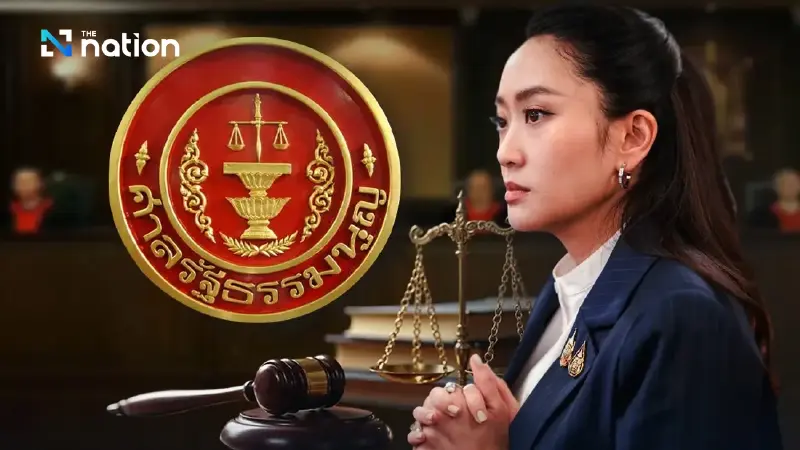


Paetongtarn told the Constitutional Court that her conversation with Hun Sen was not intended to harm national interests but aimed at preserving peace and security along the border, insisting her actions followed information and advice from national security agencies.
August has brought political turbulence for the government, with the Shinawatra family facing a tense month as two crucial court cases, one involving the father, the other his daughter, are set for rulings before the end of August.
On August 22, 2025, the Criminal Court will deliver its verdict in a lèse-majesté case against former prime minister Thaksin Shinawatra.
A week later, on August 29, the Constitutional Court will rule on whether suspended Prime Minister and Culture Minister Paetongtarn Shinawatra committed a serious breach of ethical standards in what has become known as the “audio clip” case.
The case stems from a leaked private conversation in June between Paetongtarn and Hun Sen, the Cambodian Senate President, discussing the Thai–Cambodian border situation.
The release of the recording gave “blue camp” senators, already on the defensive in the heated legal battle over the “Senate collusion election” case, an opening to collect signatures and petition the Senate Speaker to seek a Constitutional Court ruling on whether Paetongtarn’s actions warranted her removal from office.
Since July 1, when the Constitutional Court ordered her to temporarily step aside, Paetongtarn has kept a low profile, limiting public communication and focusing on projecting an image of working diligently behind the scenes. She has refrained from commenting on matters that could influence the court’s deliberations.
Paetongtarn twice requested extensions to submit her defence to the Constitutional Court and eventually filed her statement on 4 August, the court’s deadline.
In her statement released to the media, Paetongtarn Shinawatra divided her defence into two parts.
The first part requested that the Constitutional Court lift its suspension order against her, supported by a submission of five proposed witnesses for additional examination. They included:
- Chatchai Bangchuad, Secretary-General of the National Security Council (NSC)
- Ansit Samphantharat, Permanent Secretary of the Interior Ministry
- Gen Phuchong Rattanawan, retired official and Cambodian affairs expert
- Lt Gen Puttipong Cheepsamut, Deputy Chief of the Army Department
- Thanathip Uppatsrung, former Thai ambassador with postings in several countries
Paetongtarn argued that all five witnesses could testify to her true intentions and adherence to established diplomatic and national security protocols reflected in the leaked audio clip. She said their testimony would demonstrate that her actions during the incident were neither in line with the allegations made by the petitioners nor in violation of the Constitution or serious ethical standards.
She further stated that her actions were based on information and advice from national security agencies that had assessed the situation comprehensively, and that her sole aim had been to safeguard Thailand’s sovereignty and national security, not to act with the intent alleged. She asked the court to allow the full witness examination to ensure the case was assessed thoroughly, fairly, and without any lingering doubts that could undermine her legitimacy as prime minister.
However, the Constitutional Court allowed only two witnesses to be examined: Paetongtarn herself and Chatchai Bangchuad. Their testimonies are scheduled for August 21, 2025, with final written statements from both sides due by August 27.
The second part of Paetongtarn’s statement focused on clarifying her intentions and the diplomatic techniques applied during her conversation with Hun Sen.
She explained that the exchange was aimed solely at building mutual trust as a foundation for discussions to promote peace and stability along the Thai–Cambodian border.
Referring to her remark, “If there is anything you want, please let me know and I will take care of it,” Paetongtarn said this was intended only to encourage her counterpart to present his conditions or requests first, a key principle of principled negotiation. This approach, she explained, involved using interest-based questioning to uncover the true needs and concerns of the other party without attacking their position. The goal, she said, was to understand the underlying interests so that both sides could negotiate terms that might help resolve tensions.
Addressing her reference to the Second Army Area Commander, Lt Gen Boonsin Padklang, as being on the “opposite side”, Paetongtarn clarified that this arose from an explanation given by Hun Sen’s close aide, Mr Huot. According to Huot, Hun Sen had ordered the closure of Cambodia’s border crossings in response to his dissatisfaction with the Second Army Area commander.
Paetongtarn said her phrasing reflected a diplomatic technique of separating the problem from the person, and was not intended as criticism or to portray the commander as opposed to the Thai government. Rather, it was a way of explaining the situation to the Cambodian side to foster understanding that Thailand’s administration sought to maintain peace.
She stressed that it did not signal yielding or granting advantage to any party, but instead represented a diplomatic strategy to safeguard national stability and prevent further escalation of the conflict.
These, Paetongtarn said, were the key points in explaining her intentions during the private phone conversation with Hun Sen, framing her remarks as diplomatic techniques. Regarding her comments about the Second Army Area Commander, she insisted they were not intended as criticism but merely as an explanation of the situation.
She further stated that before speaking to Hun Sen, she had held an afternoon meeting on June 15, 2025 with Phumtham Wechayachai, then deputy prime minister and defence minister; Foreign Minister Maris Sangiampongsa; and Prime Minister’s Secretary-General Dr Prommin Lertsuridej.
She argued that the entire conversation with Hun Sen was conducted within the framework of Thailand’s foreign policy and in line with international principles of peaceful diplomacy, not as a covert act or with the intention of undermining the national interest.
Paetongtarn also noted that Hun Sen, as President of Cambodia’s Senate, holds no legal status under Cambodian domestic law or international law to make decisions that would create binding obligations between the two states.
Both she and National Security Council Secretary-General Chatchai Bangchuad are scheduled to testify before the Constitutional Court on August 21, followed by the submission of final written statements on August 27. The court is set to deliberate and deliver its ruling on August 29, 2025.
Observers see three possible scenarios: the court could dismiss the petition if the evidence is deemed insufficient to prove a serious ethical violation; it could rule against Paetongtarn, finding the allegations substantiated; or she could resign before the verdict, which would nullify the case.
Whether Paetongtarn will fight to the end or step down will be known before the tense deadline of August 29.
