
‘Six small parties’ gear up for next polls, eye role as coalition backups
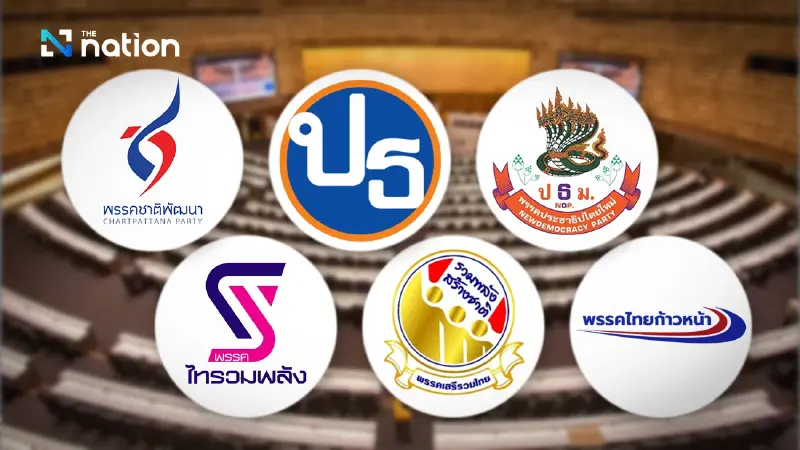


Six small political parties are mobilising in preparation for a possible early election, all sharing the same goal — to secure a place in the next coalition government and serve as “political backups” in forming the administration.
- Six small Thai political parties, including Seri Ruam Thai and the Fair Party, are mobilizing for a potential early election by launching new strategies and visiting constituencies.
- Their primary objective is to win enough seats to become valuable partners or "backups" in a future coalition government.
- Despite challenges such as MP defections, the party leaders are pressing forward with their campaigns, aiming to attract voters by focusing on issues neglected by larger political blocs.
Signs of tension within Thailand’s political arena are fuelling speculation that the House of Representatives could be dissolved earlier than the timeline agreed upon.
The growing sense of uncertainty has pushed all political parties into campaign readiness mode, with potential candidates rushing to visit local constituencies and build name recognition ahead of a possible election.
Among the smaller political parties now mobilising are Chart Pattana, Thai Rumphalang, Fair Party, Seri Ruam Thai, New Democracy, and Thai Progress Party. All are beginning to position themselves as the electoral drums start to sound.
However, three of these six small parties have seen their current MPs break away from their original affiliations.
In the Seri Ruam Thai Party, Mangkorn Yontarakul took over an MP seat after party leader Pol Gen Sereepisuth Temeeyaves resigned, but has since declared himself an opposition defector.
The Fair Party’s sole MP, Kannavee Suebsaeng, has aligned himself with Prime Minister Anutin Charnvirakul, publicly backing his leadership.
Chaiyampawan Munphianchit, formerly of the People’s Party, has sought refuge under the Thai Progress Party banner after his expulsion, and now reportedly works in coordination with the Klatham Party.
Despite the defections, all three party leaders have vowed to press on with their electoral missions.
Sereepisuth relaunches ‘Seri Ruam Thai’ brand
Sereepisuth is planning a major party assembly in December, signalling a renewed campaign under his long-standing image as the “hero of Na Kae”, a steadfast opponent of former Prime Minister Thaksin Shinawatra. He remains confident that his anti-establishment stance still resonates with voters.
Fair Party aims ‘bigger than before’
Pitiphong Temcharoen, leader of the Fair Party, is preparing to unveil the party’s new “Bigger Than Before” strategy, aiming to position the party for a potential role in the next coalition government.
Although Kannawee has broken ranks, Pitiphong believes the party remains viable, noting that Kannawee’s allies have not followed him. The party has also attracted experienced political strategists formerly associated with Kla and Palang Pracharath, and continues to promote its brand as a “clean, fair political alternative”, distancing itself from grey politicians, illicit money, and power brokers.
With a platform built around five key policy pillars to drive Thailand towards international standards, Pitiphong is confident that the Fair Party will win more seats this time around.
He has deployed campaign teams across multiple regions, targeting at least one MP per region, aiming to position the Fair Party as a constructive, pro-government force in the next Parliament. “We are a party that can work with all sides,” he said, stressing that the party’s neutrality and clean image will be its greatest strengths going into the next election.
The New Democracy Party, led by veteran politician Suratin Picharn, has begun early groundwork ahead of Thailand’s next general election, which Suratin describes as the party’s “final political battle.”
The small but determined party has already deployed teams in over 30 constituencies, focusing on three key provinces, Kalasin, Nong Bua Lamphu, and Sa Kaeo, particularly in areas historically aligned with the Thai Nation Development Cooperators’ Network, a long-standing grassroots base for the New Democracy Party.
Suratin said he decided to send MP candidates to meet voters as soon as the last parliamentary session ended, believing that early engagement would give his party a strategic advantage, especially over entrenched political families and local power brokers who are facing waning popularity and internal realignments.
“I’m not afraid of the old political dynasties,” Suratin said. “Our candidates aren’t the newcomers, they are well-known local figures who once worked as campaign coordinators for former MPs. We’re confident we can win. Meeting people early gives us the upper hand. We go to them with clear, people-centred policies.”
Small parties aim to fill the gap left by big ones
Suratin acknowledged that the coming election would be dominated by money, momentum, and media attention, largely centred around the major “blue” and “orange” political camps.
However, he argued that smaller parties still have the opportunity, by addressing the pain points left unresolved by larger parties and offering policies that reach the poor, ethnic minorities, and rural communities often neglected by mainstream politics.
He was particularly critical of the Bhumjaithai Party, saying its cannabis policy left many Thais with criminal records and debts from failed investments in cannabis cultivation. He also questioned the appeal of the People’s Party, noting that “voters are asking what they really gained, even a single lightbulb was never delivered.”
Despite limited resources, Suratin said the New Democracy Party’s goal remains clear, to secure at least one parliamentary seat and join the next coalition government after the 2026 general election.
Several small political parties that won just one seat each in the last general election are now realigning ahead of Thailand’s next polls, with most joining the Klatham Party, led by Thammanat Prompao.
Among them are the Teachers for the People Party, which won a seat through Preeda Boonpleng; the Thai Local Power Party, represented by Buncha Dejcharoensirikul; the New Social Power Party, led by Chaowarit Khajornpongkirati; and the New Party, whose MP Kriditach Saengthanayothin gained a seat in the last election.
All four have now moved under the Klatham Party banner and are expected to continue working together in the next election cycle.
Meanwhile, the Chart Pattana Party, led by the Liptapanlop family, currently holds three MPs, one from the party list and two constituency MPs representing Nakhon Sawan and Prachin Buri. The party continues to maintain its provincial networks and local alliances.
Similarly, the Thai Ruamphalang Party, affiliated with the Wangsuppakitkosol family, holds two MPs from Ubon Ratchathani and remains active in fieldwork to reinforce its voter base ahead of the next campaign.
Political observers are watching closely to see how these smaller groups will redefine their roles in the shifting landscape, whether they will become “spare parts” for major parties or serve as mentors and allies to politicians who fail to secure spots within larger, more dominant political blocs.
THEPJON
