
Bound by power: Anutin and Thammanat can’t quit each other
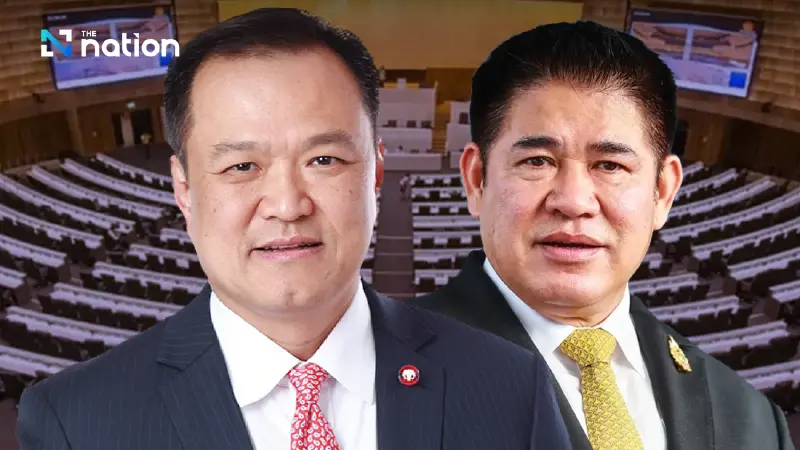


Anutin Charnvirakul and Thammanat Prompao must stay united to maintain government stability amid mounting political pressure, with their alliance key to Thailand’s next coalition.
As pressure mounts on the government over issues of grey capital and online scam networks, Prime Minister Anutin Charnvirakul has found himself under heavy political fire, much like Deputy Prime Minister and Agriculture Minister Thammanat Prompao, who is facing fierce attacks from the People's Party.
The People’s Party is pressuring Anutin to remove Thammanat from his post to improve the government’s public image and restore credibility. Yet Anutin, fully aware that his party holds only a minority share of parliamentary seats, remains cautious, torn between public perception and political stability. As one insider put it, “He knows that without Thammanat, he won’t survive.”
Political observers are now asking whether the People's Party’s campaign against Thammanat has been secretly fuelled by members within the coalition itself, aiming to divert public criticism away from the prime minister and Bhumjaithai.
After all, Thammanat’s Klatham Party and the Bhumjaithai are direct electoral rivals in several provinces.
For example, in Phetchabun, for instance, veteran politician Santi Promphat, who defected from Palang Pracharath to join Bhumjaithai along with his MPs and local networks led by provincial chief Akkaradet Thongjaisod, faces a rift. Jakrat Phuachuai, the MP for Constituency 2, recently broke ranks with Santi and is expected to align himself with Klatham as part of a campaign to expand its influence in the province.
Public unity, private rivalry
While Anutin and Thammanat continue to project an image of unity at the leadership level, tensions among their lieutenants are far more intense. Political operators on both sides, armed with influence and ground-level machinery, are preparing for fierce competition in upcoming elections.
Behind closed doors, Anutin and Thammanat reportedly held a three-hour meeting in the prime minister’s office at Thai Khu Fa Building, an encounter that was deliberately publicised through photos showing the two smiling side by side, emphasising that their partnership remains unbroken, at least for now.
Strategic moves and hidden motives
The private discussion between the government’s two power poles has sparked speculation that they may be coordinating to defuse political tensions. Thammanat later confirmed he had asked Anutin whether rumours of a possible House dissolution within four months were true should the opposition launch an aggressive censure debate. “He said it’s true,” Thammanat admitted.
More intriguingly, leaks from that meeting suggest that one key agenda item was Thammanat’s desire to clear his name from long-standing allegations of involvement in grey-area activities. Insiders claim there is a plan for certain senators to petition the Constitutional Court to review the ethical implications of his past conviction in Australia.
Thammanat reportedly feels confident that if such a petition were filed, the court would rule in his favour, citing precedent from the “it was flour” controversy, when he survived both a no-confidence debate led by the former Future Forward Party and a separate court review under General Prayut Chan-o-cha’s administration. The Constitutional Court at that time ruled that a conviction handed down by a foreign court did not disqualify him from holding political office in Thailand.
Eyes on the next election
For Thammanat, the deputy premiership is not the final stop. Political insiders believe he is laying the groundwork to position himself as Klatham’s prime ministerial candidate in the next election.
For Anutin and Bhumjaithai, maintaining close ties with him is equally crucial, as both sides may need each other to form the next coalition government.
Bhumjaithai is targeting 120 House seats, while Klatham expects around 80, still short of a parliamentary majority. Both will therefore need to forge alliances with other mid-sized parties.
For now, the key power brokers behind the current blue-led administration remain firmly in place, unchanged by the storms of scandal and speculation.
The next government, should the two camps prevail, will likely resemble the current one, navigating the same delicate balance between political survival and moral controversy, as they attempt to turn a fragile four-month truce into a full four-year term.
