
China’s 15th plan elevates Chengdu–Chongqing as western economic hub
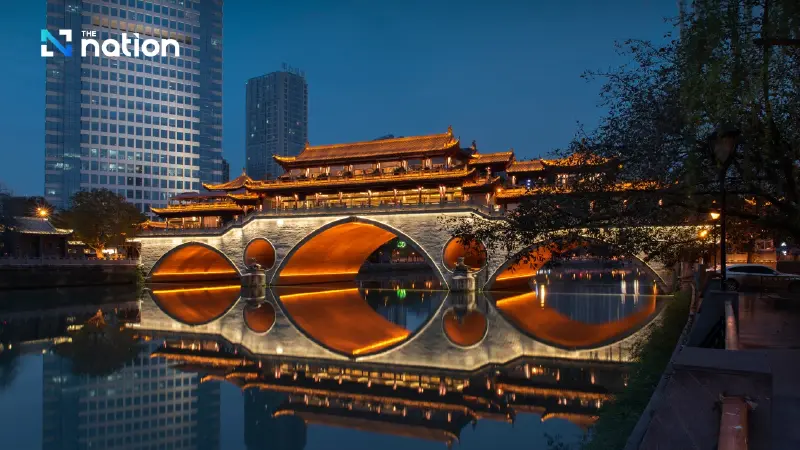


China’s 15th Economic Development Plan (2026–2030) aims to position the Chengdu–Chongqing Economic Circle as the new growth centre of western China, with Chengdu set to become an innovation and cultural hub while Chongqing advances toward high-end manufacturing and logistics leadership.
The website of Thailand’s Department of International Trade Promotion (DITP), through its Chengdu office, reports that the Chinese government has officially released its 15th National Economic and Social Development Plan (2026–2030), outlining the country’s direction over the next five years. The plan emphasises “high-quality economic growth” anchored on three pillars: economic resilience, science and technology innovation, and sustainability.
President Xi Jinping underscored that China’s next phase of industrial development will be driven by “new-quality productive forces”, aiming to strengthen technological capability, modernise traditional economic structures and improve resource efficiency to build a new innovation-driven Chinese economy.
A key feature of the 15th Plan is the continuation of the Go West Policy, designed to reduce the development gap between eastern and western China. Central to this is the advancement of the Chengdu–Chongqing Economic Circle, positioned as the country’s next major economic hub.
Strategically located between the Belt and Road Initiative (BRI) and the Yangtze River Economic Belt, the region also serves as the starting point of the New Western Land–Sea Corridor, a logistics route linking western China with Southeast Asia.
In 2023, Chengdu recorded a population of 21.4 million, while Chongqing reached 31.9 million, with a combined GDP of 5.2 trillion yuan, cementing the area as one of China’s rising industrial, technological and consumer markets.
Chengdu and Chongqing set targets to become modern global cities by 2035
Under the 2035 vision, Chengdu and Chongqing are tasked with transforming into fully modernised international metropolises:
- Chengdu will focus on becoming a “model garden city”, strengthening its role as a global centre for innovation, science and culture.
- Chongqing aims to develop into a “high-end manufacturing metropolis” and western China’s financial and logistics hub, while improving urban liveability and environmental quality.
The plan integrates four national development strategies to foster complementary regional growth:
- Coordinated regional development
- Development of key strategic areas
- Functional zoning across the country
- New-type urbanisation
These strategies aim to form a high-quality regional economic system, leveraging major growth poles such as the Beijing–Tianjin–Hebei (Jing-Jin-Ji) region, the Yangtze River Delta, and the Guangdong–Hong Kong–Macau Greater Bay Area.

Opportunities for Thai businesses: Chengdu–Chongqing poised to become western China’s industrial and innovation hub
The DITP office in Chengdu notes that Thai businesses should closely monitor emerging opportunities in the Chengdu–Chongqing region, which is set to become a centre for advanced manufacturing and innovation in western China.
Thai investors are encouraged to explore mid- to downstream supply-chain opportunities, such as:
- electronic components
- processed rubber and plastic products
- health foods
- high-value agricultural products
Investment should be aligned with modern industrial parks in Chengdu and Chongqing, where local governments offer favourable tax and logistics incentives.
Thai businesses are also advised to make use of the New Western Land–Sea Corridor, a rail–port logistics route linking western China directly with ASEAN. The route can help reduce transport costs for Thai agricultural products, food items and industrial raw materials. Investment in a Thai Distribution Hub in Chengdu or Chongqing could further expand access to inland Chinese markets.
Rising demand in services, culture and soft power opens new doors for Thailand
The twin cities are actively promoting cultural industries, tourism and modern services. Thai businesses can leverage platforms such as Thai Select, Thai Wellness and Thai Creative Cuisine to tap into young consumers, while lifestyle, wellness and ESG-driven products are gaining traction under China’s focus on a high-quality living environment.
Expansion into western China should be undertaken through strategic partnerships—including local trade associations, technology universities and logistics companies—to gain faster access to provincial-level policies, information and incentives.
A turning point in China’s long-term development
The DITP concludes that China’s 15th National Plan marks a major turning point toward “Chinese-style modernisation,” with the Chengdu–Chongqing Economic Circle expected to spearhead growth in the next decade. Thai businesses that successfully integrate supply chains, technology and cultural elements with this region will be well-positioned to expand sustainably in China and stay ahead of regional economic shifts.
