
Putin meets Trump team for lengthy Ukraine peace talks
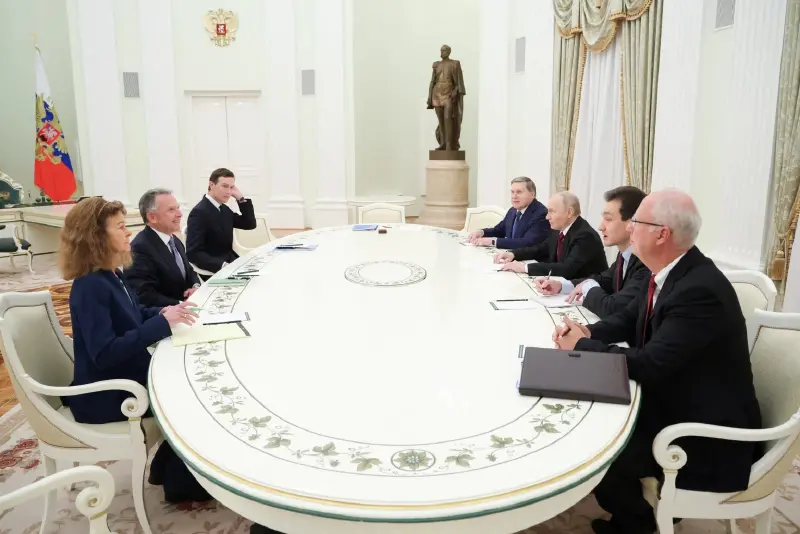


Russian President Vladimir Putin held more than four hours of discussions in the Kremlin on Tuesday with Steve Witkoff, US President Donald Trump’s special envoy, and Jared Kushner, as Washington continues to explore a potential route to end the war in Ukraine.
The meeting took place shortly after Putin issued a stark warning to European governments, claiming they would face a swift defeat if they attempted to confront Russia militarily. He also dismissed Europe’s alternative proposals for resolving the conflict as entirely unacceptable from Moscow’s perspective.
Trump has repeatedly insisted he wants to bring the conflict to an end. Yet despite his summit with Putin in Alaska in August and separate talks with Ukrainian President Volodymyr Zelenskiy, no breakthrough has materialised.
A leaked batch of 28 US draft proposals that surfaced last week unsettled Kyiv and European capitals, with officials arguing that the outline appeared to concede several of Moscow’s core demands, including limits on Ukraine’s military, Russian control of occupied territory, and guarantees on NATO.
European states subsequently produced a counter-proposal, and talks in Geneva saw Washington and Kyiv announce what they described as an “updated and refined” framework for ending the war.
Kremlin meeting runs past midnight
Welcoming Witkoff with a smile, Putin asked about his and Kushner’s walk through central Moscow, including their stroll across Red Square towards the Kremlin towers and Lenin’s mausoleum.
“It is a magnificent city,” Witkoff replied, seated alongside Jared Kushner, Kremlin aide Yuri Ushakov and Russian investment envoy Kirill Dmitriev, with interpreters present.
The discussions stretched beyond midnight in Moscow, lasting well over four hours.
In Washington, Trump told a cabinet meeting that his envoys were in Russia “to see if we can get it settled”, describing the situation as “a mess” and citing monthly casualties of 25,000 to 30,000. US Secretary of State Marco Rubio, who has been reshaping the draft peace plan to reflect European and Ukrainian objections, said Witkoff’s mission was aimed at stopping the war.
Putin accuses Europe of obstructing peace efforts.
Ahead of the talks, Putin accused European governments of trying to sabotage Trump’s initiative by putting forward conditions they knew Russia would never accept.
“They are choosing the path of war,” he said, adding that the proposed changes appeared designed solely “to block the peace process entirely”.
While insisting Russia does not seek conflict with Europe, Putin warned that any war initiated by European states would end so decisively that “there would be no one left to negotiate with”.
He also threatened to cut Ukraine’s access to the sea in retaliation for drone strikes on tankers linked to Russia’s “shadow fleet” in the Black Sea. Ukraine’s Foreign Minister Andrii Sybiha said the comments demonstrated that Putin had no real intention of ending the conflict.
Russian forces currently hold more than 19% of Ukrainian territory, around 115,600 square kilometres, only slightly more than two years ago, though Moscow’s troops have advanced in 2025 at their fastest rate since the outset of the full-scale invasion, according to pro-Ukrainian mapping.
Despite nearly four years of fighting, Russia has not succeeded in subduing Ukraine, a significantly smaller neighbour backed by the United States and Europe.
Zelenskiy wary that Washington’s interest could shift
Speaking in Dublin, Zelenskiy said the outcome of the Moscow talks would be crucial, but expressed concern that Washington might eventually disengage from the process.
“There will be no simple answer,” he said. “What matters is that everything is transparent and fair, no negotiations behind Ukraine’s back.”
Putin says proposals could form “basis for future agreements”
Putin has stressed that the exchanges to date do not constitute a draft agreement but rather a set of ideas which “could serve as a basis for future accords”. He has said he is open to negotiations, yet warned that if Kyiv rejects a settlement, Russian troops will push deeper into Ukraine.
The conflict began with Russia’s full-scale invasion in February 2022, marking the most serious rupture between Moscow and the West since the Cold War. Fighting in eastern Ukraine first erupted in 2014 after the Maidan Revolution ousted a pro-Russian president, followed by Russia’s annexation of Crimea and separatist fighting in Donbas.
On the eve of Witkoff’s visit, the Kremlin released footage of Putin praising the reported capture of Pokrovsk in eastern Ukraine after months of heavy fighting. Ukrainian forces told Reuters they still held the northern part of the city and had struck Russian positions further south.
US officials estimate total casualties on both sides at more than 1.2 million killed or wounded. Neither Kyiv nor Moscow publicly discloses its losses. The war has devastated large parts of Ukraine, destroying homes, towns, and critical infrastructure and displacing millions.
Disagreement over Russian demands
Since the draft US proposals leaked, European governments have moved to strengthen Ukraine’s position amid fears that a punitive deal could allow Russia to regain access to Western investment and potentially rejoin the G8.
Moscow’s principal conditions include a permanent bar on Ukraine joining NATO, limits on its armed forces, full Russian control of Donbas, recognition of Russian authority over Crimea, Donbas, Zaporizhzhia and Kherson, and guarantees for Russian-speaking communities.
Kyiv argues that accepting these points would amount to surrender and leave Ukraine exposed to future Russian aggression. Washington has floated the idea of a 10-year security guarantee for Kyiv, though details remain unclear.
Ukraine and European officials see the conflict as an imperial-style land grab, warning that a Russian victory would embolden Moscow to challenge NATO in the future. Zelenskiy has repeatedly said Russia must not be rewarded for launching the war.
Reuters
