
China encircles Taiwan in massive military display
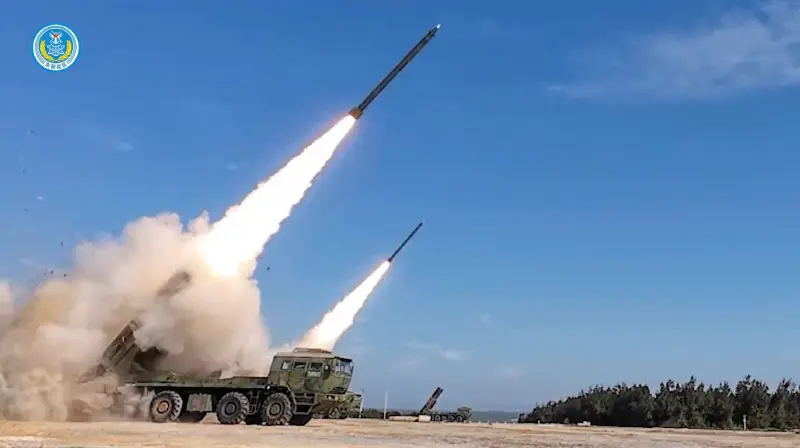


China launched rockets into waters around Taiwan on Tuesday (December 30), unveiled new amphibious assault ships and warned that any attempt by the United States or its allies to intervene would be futile, as Beijing carried out what it described as its most extensive military drills to date.
China’s Eastern Theatre Command said the exercises, which included rehearsals for a blockade, featured around 10 hours of live-fire activity and rocket launches into areas north and south of the self-ruled island.
Taiwan’s defence authorities said Chinese forces also ran strike simulations against targets at sea and in the air, alongside anti-submarine manoeuvres encircling the island. Chinese state media broadcast images intended to highlight the PLA’s modernisation and readiness, reinforcing Beijing’s long-stated position that it would use force if necessary to bring Taiwan under its control.
The drills, titled “Justice Mission 2025”, began 11 days after Washington announced an $11.1 billion arms package for Taiwan — a move that drew sharp criticism from China’s defence ministry, which vowed “forceful measures” in response.
US President Donald Trump said on Monday that he had a “great relationship” with President Xi Jinping and downplayed the significance of the exercises. But US lawmakers and the European Union accused Beijing of raising tensions and threatening stability in the region.
Warning to “external forces”
In a notable shift in messaging, China’s military said the drills were explicitly designed to deter outside intervention. China’s Taiwan Affairs Office stated Monday warning that any foreign forces seeking to interfere would face overwhelming resistance from the PLA.
Beijing has also stepped up its rhetoric in recent weeks, particularly after Japan’s Prime Minister Sanae Takaichi suggested that a hypothetical attack on Taiwan could prompt a response from Tokyo.
Adding to the sense of escalation, Xi promoted the commander of the Eastern Theatre Command, responsible for operations focused on Taiwan, to full general last week. Analysts said the move underlined an emphasis on combat readiness following a recent leadership purge.
Lyle Goldstein, Asia programme director at the US think tank Defence Priorities, said China now holds both numerical strength and broad qualitative advantages in weapons and likely training, arguing that Taiwan cannot match the pace of the arms build-up.
Trump said he was not concerned, noting that China has conducted naval drills around Taiwan for decades. However, John Moolenaar, the Republican chair of the US House select committee on China, called the moves a “deliberate escalation” aimed at intimidation and reshaping the regional order.
He said Washington would continue working to support Taiwan’s security.
The EU said it had a “direct interest” in maintaining the status quo in the Taiwan Strait and warned that Beijing’s actions endangered international peace and stability.
Taiwan: ready to defend, not seeking escalation
Taiwan’s defence ministry said 71 Chinese military aircraft and 24 navy and coast guard vessels were operating around the island on Tuesday, adding that China had fired 27 rockets into nearby waters.
A senior Taiwan security official said China appeared to be practising strikes on land-based targets, including the US-made HIMARS rocket system, mobile artillery with a range of about 300 kilometres, which could threaten coastal positions in southern China.
President Lai Ching-te said in a Facebook post that Taiwan’s frontline forces were prepared to defend the island, while stressing that Taipei did not want to escalate the situation.
Chinese state media circulated propaganda posters during the drills, including one titled “Hammers of Justice”, depicting Lai being crushed by two hammers striking the island from north and south.
Chinese outlets also highlighted the first deployment of the Type 075 amphibious assault ship. Zhang Chi, an academic at China’s National Defence University, said the vessel can deploy attack helicopters, landing craft, amphibious tanks and armoured vehicles at the same time.
Focus on ports, shipping lanes and 2027 target
The Taiwan Strait sits on major commercial routes, with an estimated $2.45 trillion in trade passing through the corridor each year, while airspace above the island is a key link between China and markets across East and Southeast Asia.
Taiwan’s Civil Aviation Authority said 11 of Taipei’s 14 flight routes were affected, though no international flights were cancelled. Routes to the offshore islands of Kinmen and Matsu, close to China’s coast, were blocked, affecting about 6,000 passengers.
A Taiwan coast guard official said Chinese coast guard ships were closely tracking Taiwanese vessels during the exercises.
A Pentagon report released last week said US military assessments pointed to China seeking the capability to win a conflict over Taiwan by 2027, marking the 100th anniversary of the PLA’s founding.
China’s military said its drills centred on simulating a blockade, including around Keelung in the north and Kaohsiung in the south, Taiwan’s largest port city.
The Pentagon report said US planners also believed Beijing was considering strikes launched from the mainland to seize Taiwan by “brute force” if required.
Reuters
