
Jesse Jackson, civil rights leader and US presidential hopeful, dies at 84
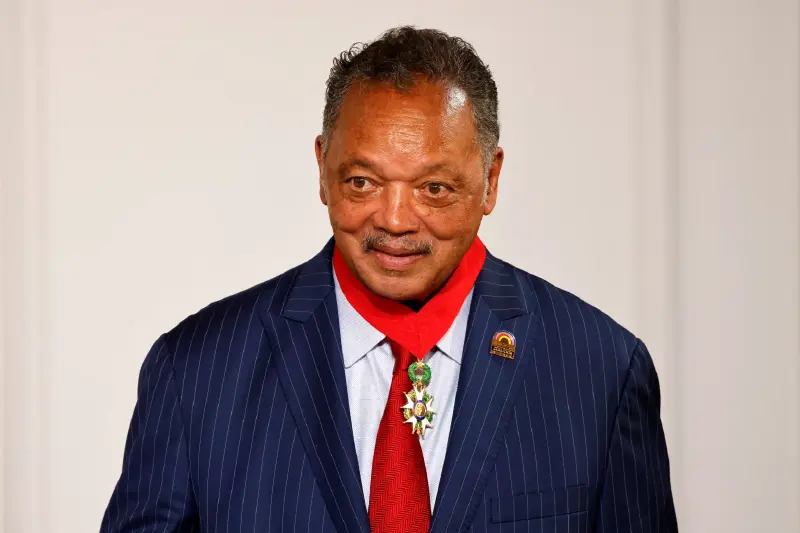


Jesse Jackson, the fiery Baptist minister and enduring icon of the American civil rights movement who broke political barriers with two historic bids for the presidency, died on Tuesday (February 17).He was 84.
The Jackson family announced his passing in a statement, honouring him as a "servant leader" who dedicated his life not only to his relatives but to "the oppressed, the voiceless, and the overlooked around the world."
A longtime resident of Chicago, Jackson had been battling Parkinson’s disease since his diagnosis in 2017.
Jackson’s death occurs during a turbulent period in US politics, as the Donald Trump administration actively seeks to purge what it labels "anti-American" ideologies from federal institutions.
These efforts, which include dismantling slavery exhibits and restoring Confederate monuments, have drawn sharp criticism from civil rights advocates who fear a rollback of social progress.
A charismatic orator and media presence, Jackson championed the rights of Black Americans and other marginalised groups for over half a century.
He emerged from the civil rights struggles of the 1960s as a protégé of Martin Luther King Jr. and remained the country’s most visible civil rights figure for decades, surviving various controversies to maintain his influence.
Though he never held elected office, Jackson reshaped the Democratic Party.
He ran for the presidential nomination in 1984 and 1988, mobilising Black voters and white liberals alike.
In 1988, he mounted a formidable campaign, winning 11 primaries and caucuses and securing 6.8 million votes, roughly 29% of the total, ultimately finishing second to nominee Michael Dukakis.
His 1984 bid was less successful, garnering 3.3 million votes, and was marred by a scandal involving antisemitic remarks he made privately regarding New York City.
Jackson’s mesmerising speaking style was a hallmark of his career.
At the 1988 Democratic National Convention in Atlanta, he delivered a defining speech in which he described America not as a single blanket, but as a quilt of many patches, urging those struggling to "Hold your head high" and reminding them that "Strong winds don't blow forever."
Beyond the campaign trail, Jackson was a prolific diplomat and organiser.
He founded Operation PUSH and the National Rainbow Coalition, organisations he later merged and led until his retirement in 2023.
He served as President Bill Clinton’s special envoy to Africa and leveraged his personal diplomacy to negotiate the release of Americans detained in Syria, Iraq, Cuba, and Serbia.
Born on October 8, 1941, in Greenville, South Carolina, Jackson grew up under the oppressive Jim Crow laws of the segregated South.
He attended the University of Illinois on a football scholarship but transferred to North Carolina A&T, a historically Black college, citing racial discrimination.
His activism began in earnest during his student years, including an arrest for attempting to use a white-only library.
Jackson was ordained in 1968 and became a lieutenant to Martin Luther King Jr., focusing on economic empowerment.
He was at the Lorraine Motel in Memphis when King was assassinated in April 1968.
Jackson famously claimed to have held the dying civil rights leader in his arms, an account that caused friction with other members of King’s inner circle.
His personal life included a marriage to Jacqueline Brown in 1962, with whom he had five children.
His son, Jesse Jackson Jr., was elected to Congress but later resigned and served time in prison for fraud.
Jackson faced his own scandal in 1999 when it was revealed he had fathered a child with a staffer from his non-profit organisation.
In his later years, Jackson remained active in public life.
He hosted a weekly show on CNN from 1992 to 2000 and was awarded the Presidential Medal of Freedom by Bill Clinton.
He continued to advocate for racial justice well into his 70s, speaking out against the police killing of George Floyd in 2020.
Reuters
