
Takaichi avoids rift in sensitive talks with Trump
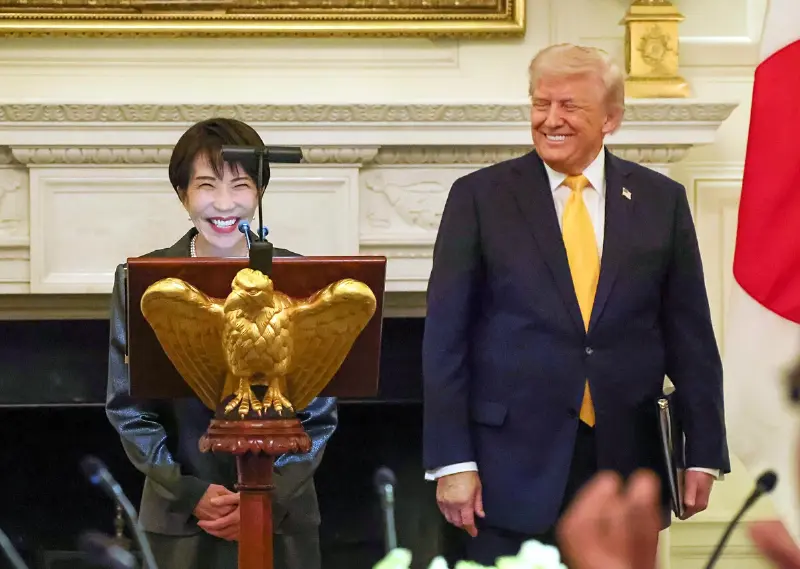


Japanese Prime Minister Sanae Takaichi was able to avoid the worst-case scenario of exposing a rift with US President Donald Trump in a summit during her first visit to the United States since taking office last year.
But Takaichi failed to achieve her initial goal of showcasing a united front with the US government against China, ahead of the summit between Trump and Chinese President Xi Jinping, originally scheduled for early April.
The prime minister also faced pressure from Trump to enhance Japan's contribution to ensuring the safety of navigation in the Strait of Hormuz, which has been effectively blocked by Iran, following strikes on the country by the United States and Israel.
Friendly Mood
After welcoming Takaichi with open arms upon her arrival at the White House, Trump said at the beginning of their meeting that "she had the most successful election, in my opinion, in the history of Japan," praising her for the ruling Liberal Democratic Party's landslide victory in the Feb. 8 House of Representatives election.
"We've had tremendous support and a relationship with Japan on everything," the president also said.
In response, Takaichi said, "Only Donald can bring peace and prosperity to the world." On the Iranian situation, the prime minister vowed to offer strong support by working with other countries.
Takaichi avoided commenting on the U.S.-Israeli military actions against Iran. Considering Japan's relationship with Iran, she stopped short of taking part in the conflict, while standing by the United States as much as possible. Her remarks in the summit represented Japan's attempt to walk a fine line.
"The worst-case scenario had been averted," a source familiar with Japan-US relations said.
The series of events during Takaichi's three-day visit to the United States through Friday proceeded amicably on the surface.
The two leaders inspected cherry tree saplings gifted by Japan to commemorate the 250th anniversary of the United States' founding this year.
A dinner was hosted by Trump in a rare occurrence during his second term, fostering a relaxed atmosphere of friendship.
When the Japanese side learned that the scheduled working lunch had been abruptly cancelled and the time would instead be used to extend the summit talks, tension ran high among Japanese government officials. However, once the summit was over, voices of relief could be heard from those accompanying Takaichi, calling it a "success."
Oil Price Stability as Common Interest
Initially, ahead of Trump's visit to China scheduled for early April, the Japanese side had focused primarily on aligning views regarding China's increasing coercive moves around Taiwan and in the East and South China Seas.
However, just before Takaichi visited the United States, the planned Trump-Xi summit was abruptly postponed. Furthermore, in response to the deteriorating situation in Iran, the US side demanded the dispatch of naval vessels to the Strait of Hormuz, a key shipping route for crude oil.
Following the developments, Takaichi's summit with Trump was seen as carrying only risks, according to a Japanese government source.
While rushing to make preliminary arrangements, the Japanese side focused on the common interest of Japan and the United States in "stabilising oil prices."
The Japanese government intended to show its contribution by proposing cooperation to increase US crude oil production and joint stockpiling by Japan and the United States. A senior official from the prime minister's office said, "It is in line with Trump's desire to curb domestic gasoline prices ahead of the midterm elections in November."
At the same time, Tokyo worked to promote cooperation with other countries. Just before the start of the Takaichi-Trump summit, leaders of Japan and five other countries, including Britain and France, issued a joint statement expressing their "readiness to contribute to appropriate efforts to ensure safe passage" through the Strait of Hormuz.
Trump's Pressure on Japan
Despite his calm demeanor in the summit, his remarks apparently signaled his pressure on Japan.
Referring to the fact that Japan heavily relies on the Middle East for its crude oil imports, Trump said, "I expect Japan to step up" further.
After the press had left, Trump asked Takaichi about dispatching mine-sweeping vessels, according to a person who was present at the meeting.
Takaichi said, "There are things we can do and things we cannot do within the bounds of the law," managing to avoid a rift with the president.
Still, the president also said, "We have 45,000 soldiers in Japan," adding, "We have, we spent a lot of money on Japan." The remarks suggested that there is no change in his belief that the United States should ask its allies to bear their fair share of the burden.
The explanation after the summit by the Japanese government generally lacked clarity.
While a statement issued by the U.S. government after the summit said "the two leaders committed to peace and stability across the Taiwan Strait" and "opposed any attempts to unilaterally change the status quo, including by force or coercion," the explanation by Japan did not have the phrases, resulting in a lack of alignment on a critical issue, pundits said.

[Copyright The Jiji Press, Ltd.]
