
Japan, Saudi Arabia form oil supply task force amid Middle East crisis


Japan and Saudi Arabia will start talks early next week, while Japan and the EU stress stable energy markets, safer shipping and supply chains.
- Japan and Saudi Arabia have agreed to form a joint task force to discuss energy issues.
- The task force's primary goal is to maintain stable crude oil supplies in response to the ongoing crisis in the Middle East.
- The agreement was reached in an online meeting between Japan's Minister of Economy, Trade and Industry and Saudi Arabia's Energy Minister.
Japan and Saudi Arabia agreed on Thursday (May 7) to establish a task force to discuss energy issues, including the need to maintain “stable crude oil supplies” as tensions continue in the Middle East.
The decision was made during an online meeting between Japanese Minister of Economy, Trade and Industry Ryosei Akazawa and Saudi Energy Minister Abdulaziz bin Salman Al-Saud.
The task force is expected to begin discussions early next week. Its launch is aimed at strengthening energy security cooperation between the two countries following the Middle East crisis.
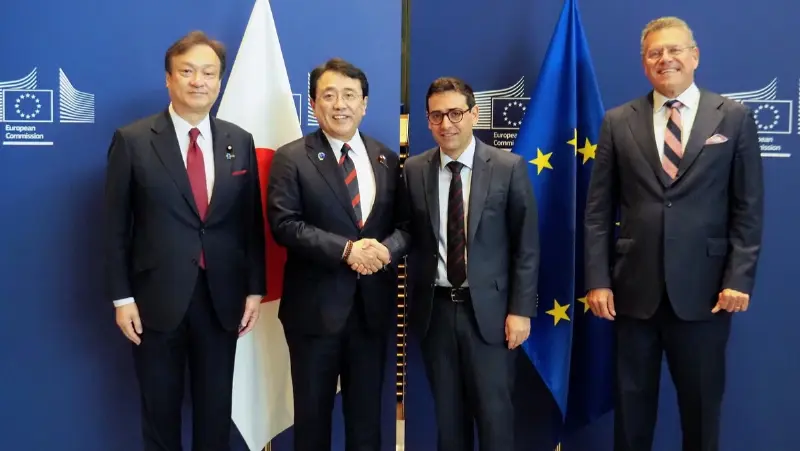
Earlier on Thursday, Akazawa took part in a high-level economic dialogue with the European Union in Brussels. Japan’s delegation also included State Minister for Foreign Affairs Iwao Horii.
Representing the EU were Stephane Sejourne, European Commission executive vice president for prosperity and industrial strategy, and Maros Sefcovic, the commission member responsible for trade and economic security.
The participants reviewed the situation in the Middle East and adopted a joint statement underlining the importance of a “stable and highly transparent energy market”.
They also agreed on the need to protect supply chains, including safe ship navigation, maritime transportation routes and related infrastructure.
Japan and the EU additionally shared concerns about “economic coercion” and “unfair export controls”. They confirmed plans to deepen cooperation in critical minerals, batteries, defence, space and clean energy.
Akazawa also joined an online meeting on critical minerals with the Group of Seven major industrialised nations. It was the first such meeting among the G7 members, Britain, Canada, France, Germany, Italy, Japan and the United States, together with the European Union.
At a press conference, Akazawa said he had conveyed Japan’s concern to the EU over its industrial accelerator act. Under the measure, electric vehicles and other Japanese goods could be left off the EU’s list of products eligible for public aid.
The act, announced in March, gives preferential treatment to goods produced within the EU. Akazawa said Japan and the EU had agreed to keep discussing the matter in search of a solution.

[Copyright The Jiji Press, Ltd.]
