
Trump signals swift Iran exit, warns of possible return strikes
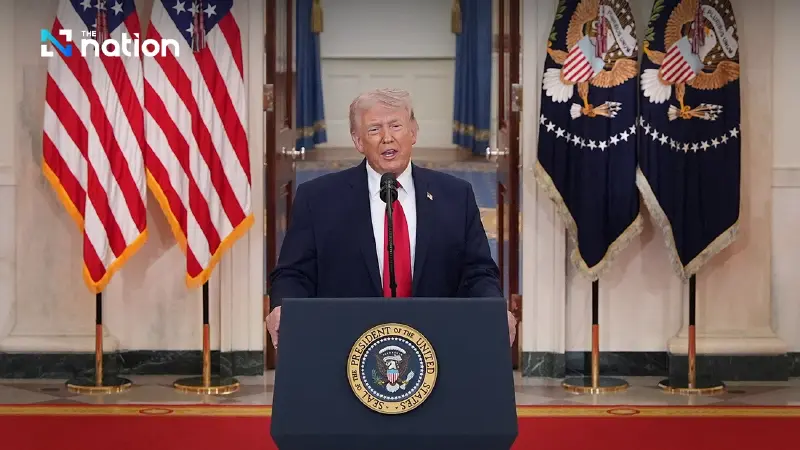


Trump said the United States could scale back its role in Iran in the near future, while still reserving the option of carrying out targeted follow-up strikes if necessary.
- President Trump stated that U.S. military objectives in Iran have been largely achieved, citing the destruction of its navy and air force and the weakening of its nuclear and missile programs.
- Despite suggesting the conflict could end within weeks, Trump refused to set a firm exit timeline and has given varying indications about the war's duration.
- Trump warned that the conflict could escalate to target Iran's energy infrastructure if negotiations
Donald Trump said the United States could scale back its role in Iran in the near future, while still reserving the option of carrying out targeted follow-up strikes if necessary.
Speaking to Reuters by phone on Wednesday (April 1), hours before a 9pm EDT (0100 GMT) prime-time address on the war, Trump said Washington would be “out of Iran pretty quickly”, though he added that US forces could return for “spot hits” against Iranian targets when needed.
The speech was due to close out a day that began with what was described as Trump’s historic visit to the Supreme Court.
With the conflict now in its fifth week and the president under growing pressure to map out an exit strategy amid higher fuel prices, Trump said part of his address would focus on his frustration with NATO, which he said had failed to support US aims in Iran.
The divide between Washington and its European allies has widened during Trump’s second term, particularly after they rejected his request to help protect oil shipments moving through the Strait of Hormuz.
Trump said he was seriously considering pulling the United States out of NATO, the alliance ratified by the US Senate in 1949.
He has threatened such a move before and has previously pushed member states to spend more on defence.
He said NATO had not acted like a friend when the United States needed support, describing the relationship as one-sided.
Trump and senior members of his administration have given varying indications about how long the war could continue.
On Tuesday, he said the US military campaign against Iran might be over within two to three weeks.
But in the Reuters interview, he refused to set a firm timetable, saying only that the US would leave soon.
The war has expanded across the Middle East, leaving thousands dead and driving energy prices sharply higher, fuelling fears of renewed global inflation.
A Reuters/Ipsos poll conducted from Friday to Sunday found that two-thirds of Americans want the United States to end its involvement in the Iran war quickly, even if that means falling short of the administration’s stated objectives.
Trump said he had hoped to reach an agreement with Iran after the first wave of airstrikes killed Supreme Leader Ayatollah Ali Khamenei.
Several other senior Iranian figures have also been killed.
Mojtaba Khamenei has succeeded his father as supreme leader, while the United States believes he has been wounded and likely disfigured.
Iran’s president and foreign minister, however, remain unchanged.
According to Trump, Iran’s leadership is now made up of “totally different people”.
He said regime change had not been his original objective, but argued that wartime casualties had effectively produced that outcome.
He added that the key result was that Iran would not obtain a nuclear weapon and no longer wanted one.
The White House has said indirect talks with Iran are continuing, although Tehran has denied that such negotiations are taking place.
A source briefed on the matter told Reuters that Vice President JD Vance had been in contact with intermediaries from Pakistan about the conflict as recently as Tuesday.
The same source said that, acting on Trump’s instructions, Vance had privately indicated that the president could accept a ceasefire if certain US conditions were met.
Trump said there had already been full regime change and that there was now a strong chance of reaching an agreement because Iran did not want to be attacked again.
Trump has repeatedly said that stopping Iran from developing a nuclear weapon was a central reason for going to war.
But earlier this month, UN nuclear watchdog chief Rafael Grossi said that nearly half of Iran’s uranium enriched to 60% purity, a short technical step from weapons-grade, was likely still stored in a tunnel complex at Isfahan.
That underground site appears to be the only major target not badly damaged in the Israeli and US attacks carried out last June against Iranian nuclear facilities.
Even so, Trump said the objective had already been achieved.
He brushed off concern over the enriched uranium stockpile, saying it was buried so deep underground that he was not worried about it, and added that it would continue to be monitored by satellite.
He also said Iran was now incapable of building a nuclear weapon.
Iran has consistently denied seeking a nuclear bomb, insisting that its nuclear programme is for peaceful purposes.
The International Atomic Energy Agency has said that when Israel launched its first strikes in June, Iran possessed 440.9 kilograms of uranium enriched to 60% purity, enough, if further enriched, to provide the explosive material for 10 nuclear weapons under the agency’s benchmark.
Reuters
