
Transitioning to the ‘Thai Model’ of Refugee Management
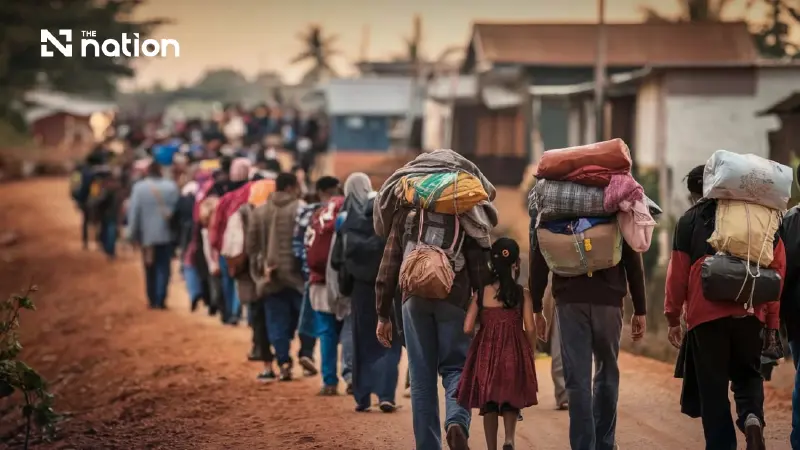


Thailand’s emerging ‘Thai model’ gives Myanmar refugees access to legal work, identity cards, healthcare and education.
Thailand has provided a safe haven to masses of refugees since the Second World War, covering persons fleeing from persecution and or warfare across frontiers. However, till recently, there was hesitation towards the call for more comprehensive policies and practices.
The case in point is the 80,000 Myanmar refugees in nearly ten camps, mainly ethnic minorities, along the western border. They have been here for about four decades. About 40,000 are of working age.
The authorities are now giving the green light to more inclusive measures, transitioning to a more cohesive, humanitarian response. This is a positive development, in spite of the decline of international aid.
The breakthrough has come with the new policy to allow the population from those camps to work outside the camps. This is now being implemented with nearly 10,000 persons being processed, as a starting point, reaching out to over 40 locations for possible employment in Thailand.
The work permit is granted for one year. This opening helps to promote a sense of self-reliance among the refugees, on the one hand, and to reduce the manpower shortage in the country, on the other hand.
It moves away from the previous ‘sedentary vacuum’ whereby refugees were kept waiting in the camps for decades without access to occupations and meaningful opportunities.

Another innovation is the recent issuance of the ’pink card’ to this group as a kind of identification card for non-Thais. This should enable the beneficiaries to open bank accounts and buy Sim cards.
Importantly, it will protect them from being arrested as so-called illegal immigrants. It helps to validate their status as persons needing respectful treatment and protection.
Also in the offing is the possible introduction of the Thai language as part of the education inside the camps. To date, the educational process has been based on the Burmese language. This about-turn will enable the camp population to feel more attuned to the opportunities that are emerging beyond the camps.
The next step should be to align the curriculum in the camps to the Thai curriculum outside the camps as part of the needed synchronization.
A cautionary note is that a number of the children are now going to school outside the camps. They should be allowed to continue their education progressively without the disruption of being pushed back into the camps.
Another significant step is access to health care. Those who access employment and social security will enjoy the medical benefits accompanying that status as employees.
The Thai authorities are also offering medical check-up to those who are in the camps and who are not yet employed outside the camps.
A small sum will be required to pay for medical insurance, and the fee will be reduced for children, irrespective of immigration status. Gradually, the universal health care available to Thais should be shared increasingly on the basis of non-discrimination.
Various concerns deserve more attention. The authorities should enable the camp population to enjoy freedom of movement, and the camps should logically open up to links with the surrounding neighbourhood.
Family unity is a key principle which should be upheld. Those who work outside the camps should be accompanied by their families. The principle is also part of the Convention on the Rights of the Child to which Thailand is a party.
In this regard, a couple of years ago, implementation of the Convention was strengthened by the withdrawal of the country’s reservation to article 22 of the Convention which guarantees a range of rights for refugee children.
This is despite the fact that the country has declined to become a party to the 1951 Refugee Convention and its 1967 Protocol which are the anchor for a more systematic approach to refugee management.
Various children deserve special attention. A number are unaccompanied minors, and there are various preferred practices for assisting them, such as to enable them to be cared for by relatives nearby.
There must also be safeguards to prevent violence, abuses and exploitation, as well as to identify cases needing protection. Cross-referral to the concerned authorities and community-based supports are essential to deal not only with physical trauma but also psycho-social harm.
An area needing research and data is whether some children have become the victims of online scams and or lured into the various hell-hole compounds operating near the border.
Of course, the plight of other groups seeking refuge in Thailand should not be overlooked. Since the coup in Myanmar in 2021, for example, there have been sporadic new refugee influxes into Thailand.
This recent caseload should also be registered and have access to the basics of life. To date, the tendency has been to allow them into the country for a temporary period and then return them to the border on the other side.
Finally, there is an anomaly in regard to the country’s policy towards Rohingya refugees. About 400 of them are in a precarious situation of being detained in immigration cells. It is time to offer them community-based shelter and desist from detaining them.
With regard to the children of the group, there is already a Memorandum of Understanding adopted by the authorities to house them with communities beyond the immigration setting. Those facilities need to be assisted with an eye to community participation, consisting monitoring and related review.
There is now a welcome new development that Muslim communities in Pattani province are willing to offer them shelter, with the support of the provincial authorities. This is well complemented by the Islamic practice of Zakat whereby the rich are bound to give part of their wealth to help the poor.
Inter-community understanding between young people of different religions and backgrounds should be fostered as part of the more inclusive socialization process at our doorsteps.
The compliments are arriving to recognize that Thailand can lead in the humanitarian field; the so-called ‘Thai model’ is now being cited as an example for other countries dealing with massive refugee influxes. Humbly, policy makers need not rest on these laurels; there is more to be done, and enlightened leadership is key.
Nor should the root causes of those refugee-related displacements be forgotten. Human rights, peace, democracy and sustainable development are ever-relevant as the causative cascade for substantive, transformative change.
Vitit Muntarbhorn is a Professor Emeritus at the Faculty of Law, Chulalongkorn University and a former UN Special Rapporteur, UN Independent Expert and Member of UN Commissions of Inquiry on Human Rights. He is the author of the book titled ‘ The Status of Refugees in Asia.’
