
SilkAir begins Samui service as island broadens appeal
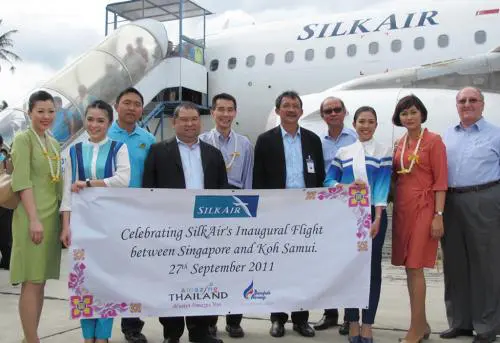


Carrier plans to attract tourists to new destination from Singapore, Australia
Airlines and operators are teaming up to increase the visibility of Koh Samui as a quality destination in overseas markets, focusing on India, Australia, Japan and Africa.
Singaporean airline SilkAir yesterday started service between Samui and Singapore with three flights per week. Koh Samui is SilkAir’s third destination in Thailand after Phuket and Chiang Mai.
The airline expects to draw tourists to the island from Singapore and Australia, where it operates to a few cities, as well as from Japan.
“Singapore is an aviation hub of Asia and SilkAir should help spread tourists into new destinations such as Koh Samui,” said the airline’s chief executive, Marvin Tan.
He added that many Australian and Japanese tourists visited Bali in Indonesia but they should go to Samui for their next vacation.
The airline has seen very positive demand for Koh Samui, so it will increase frequencies to five flights a week by the end of the year.
In addition to the Singapore-Samui route, SilkAir code-shares with Bangkok Airways on the Singapore-Chiang Mai and Singapore-Phuket routes.
Puttipong Prasarttong-Osoth, president of Bangkok Airways, which owns Samui Airport, said it wanted to increase traffic directly from Singapore as well as from long-haul routes connecting through such a major aviation hub as Singapore Changi International Airport.
“Passengers will benefit from better flight connectivity and accessibility, as SilkAir operates a morning flight while Bangkok Airways runs an evening one,” he said.
Puttipong said Samui had been a popular destination for Euro-pean markets for many years. However, the current economic crisis in Europe may slow travel from the region,
though so far it is still in positive territory. The airline will seek new high-end markets, partic-ularly in Japan, India, Africa
and Asean nations, to replace slower passenger traffic from Western markets.
It also plans to operate direct daily flights between Koh Samui and Kuala Lumpur soon and also will add flights between Bangkok and Hong Kong.
The airline is set to build two more passenger halls at Samui Airport next year on a budget of more than Bt50 million.
The expansion is expected to serve 300 more passengers per day, up from 3,000-3,200 per day currently.
During the first six months of this year, Bangkok Airways earned revenue of Bt5.2 billion, higher than Bt4.1 million during the same period last year.
The airline carried 1.5 million passengers in the first half of this year and expects to achieve its full-year target of 3.1 million travellers.
There are five scheduled airlines operating into Koh Samui – Bangkok Airways, Thai Airways International, Firefly, Berjaya Air and SilkAir – totalling more than 30 flights per day. Bangkok Airways is planing to increase flights to the maximum capacity of 50 per day.
Limited access
According to Bannasat Ruangjan, president of the Tourism Association of Koh Samui, hotels on the island are running an average occupancy rate of 62-63 per cent this month, after less than 50 per cent this time last year.
Hotel rooms now have more than 20,000 rooms. Four- and five-star hotels alone account for more than 70 properties with more than 17,000 rooms.
“There are many hotels under construction in Samui, but we still have a big problem in that access is limited by [the number of airline] seats.”
To help operators and locals stay in business, the association plans to do marketing overseas to bring in more visitors in the low season. Meanwhile, it will focus on high-end markets in both Asia and Europe.
SilkAir’s Tan said: “Koh Samui is popular with travellers seeking the ultimate tropical beach experience, and SilkAir is well placed to meet this demand, with our extensive experience in flying to exotic regional destinations and our strong interconnectivity with the Singapore Airlines network.”
Samui Mayor Ramnate Chaikwang said the government had granted a budget of Bt400 million to build a new 14-kilometre ring road almost circling the island. Moreover, Samui municipality received Bt800 to upgrade existing roads and infrastructure as well as waste-treatment facilities.
