
Ambitious KTC CEO plots aggressive turnaround of credit-card company
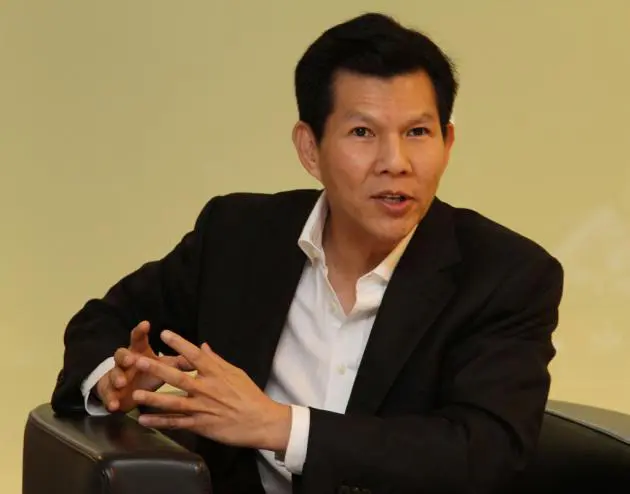


Rathian wants the company not only to return to profit this year, but also to gain market leadership in 2014
Taking the helm from Niwatt Chittalarn, who was the first CEO of Krungthai Card and held that position for 15 years, Rathian Srimongkol has set an aggressive target to turn around the fortunes of the loss-making credit-card company in the next few months.
Rathian aims to achieve a record profit by next year, and to gain market leadership as early as 2014.
“Since the organisation used to be No 1, whenever anyone asks me, I say our target has to be to regain our leadership position and sustain it,” said the new KTC chief executive.
Rathian, 52, has spent his entire career with banks and finance and securities companies, namely Thanachart Bank, Siam City Bank, Securities One, and Bank of Ayutthaya, except for the first one and a half years that he was a physician at Siriraj Hospital. Before assuming his current position as president and CEO of KTC, he was executive vice president at Thanachart Bank.
Speaking at an interview with a group of journalists, Rathian said that after a thorough review, costs were found to be the most important problem at KTC. His primary task, therefore, is to reduce the ratio of operating costs to income, making it equal to or lower than the industry standard.
“This year, we will focus on people and on reducing operating expenses, while maintaining our marketing budget. From a substantial loss in 2011, we believe we will make a loss in the first quarter of this year, possibly make a profit in the second quarter, and clearly will return to profitability in the third quarter.
“We must make a full-year profit this year, achieve historical profit next year, and prepare to become No 1 in 2014,” he said.
Despite his aggressive target for a quick turnaround, Rathian has apparently won a vote of confidence from the investor community. Since the beginning of this year, KTC stocks traded on the local bourse have already moved up about 30 per cent, from Bt11 on the last trading day of 2011 to close at Bt14.30 last Thursday.
Rathian said KTC would reduce unnecessary and redundant expenses and implement programmes that will turn the current “silo” work processes into “end-to-end” ones. A few branches such as the one at Zeer Rangsit will be closed, while others, including the one at the UBC II building on Sukhumvit that houses its headquarters, will share their spaces with Krung Thai Bank, KTC’s parent company.
The new KTC chief executive is heralding a new era of closer cooperation with KTB. During the 15-year reign of Niwatt, KTC had largely been managed independently from the state-owned parent bank and preserved a more modern look and corporate image.
“In the past, we might have been seen as independent. But we must accept the reality that KTB owns 49.5 per cent of our shares. If the cooperation is beneficial, why wouldn’t the staff and the shareholders be happy?”
Rathian also did not rule out the possibility of KTB taking a bigger share in KTC in the future, saying the cost of funding was one of the four key competitiveness factors of a credit-card and consumer-finance firm like KTC, which would not be entitled to receive a loan at cost from KTB unless the parent firm held more than 75 per cent of the company.
“The maximum possibility is that KTB owns us 100 per cent; the lower [tiers] are 75 per cent and over 50 per cent,” he said.
Rathian said KTC would be able to maintain its corporate identity and a certain degree of management independence from the parent firm, regardless of a change of shareholding structure.
Meanwhile, he said KTC would this year maintain its marketing expenses while increasing its personnel training budget fourfold from the Bt3 million to Bt4 million that it spent annually during previous years.
