
Belgium's Swift scours the globe for good ideas
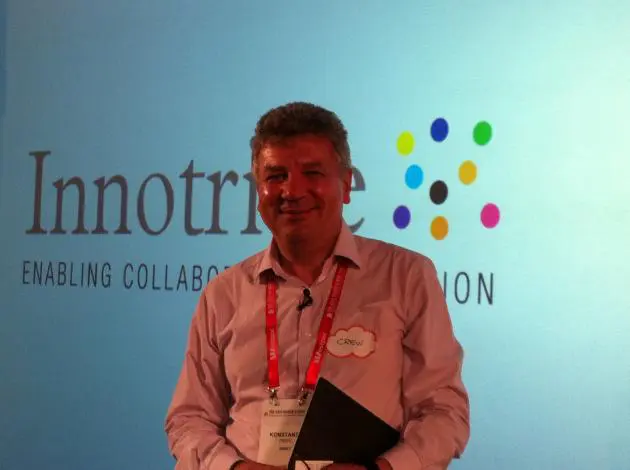


Swift International, a global financial telecommunications network provider, believes innovations with global applications can be incubated anywhere in the world - including Thailand.
That concept inspired the company to set up Innotribe in 2009 and the results have been satisfactory. Swift picked nine innovative ideas from the incubation programme last year. Three have hit the market, with four more expected to do so this year.
“In a big castle, it’s very difficult to innovate. We have to do it outside, in a smaller world where we can experiment and try. It allows us to collaborate with financial institutions,” said Kosta Peric, innovation chief at Swift.
To Peric, location and money are the keys to innovation.
“You need a place and money, which could come from the private sector and also from the government. And you need well-educated people. With all of this, you could create people who are entrepreneurs and whom you want to enable. Then, like a flower, it will bloom,” he said.
According to Peric, innovative ideas can come from any part of the world. Some come from California’s Silicon Valley, but many are originated by people in Asia – the region of growth – including those in India, Singapore, Thailand and Vietnam.
“I would very much like to have incubators in Asia, maybe Singapore and Thailand,” he said.
To him, Asia is a “booming” region and a big draw for Western companies. A presence in Asia also follows the Belgium-based company’s “Go Local” concept, whose goal is to wipe out the perception that Swift is a Euro-centric company.
“We want to change that. It’s not entirely because of the crisis. It’s simply opportunities. We don’t want to be dismissed because people think we are Euro-centric,” he said.
To that end, this year Swift is staging Sibos, an annual conference of influential global leaders from financial institutions, market infrastructures, multinational corporations and technology partners, in Osaka, Japan. In the previous two years, it took place in Toronto and Amsterdam. Supporting this are regional events in Singapore and Thailand. On the sidelines of the Asian Banker Summit 2012 in Bangkok was a session of Innotribe, which Peric attended.
At events like this, people with innovative ideas have a place to show their ideas. Then incubators – experts and venture capitalists – will pick the best and see if they are commercially viable. Peric noted that many ideas were good but their originators lacked good business models. For example, electronic account management is a forward-looking idea, but it is not viable as banks provide the service for free and few clients nowadays are willing to pay for that.
After creating its innovation section four years ago, Swift started Innotribe last year as a new business arm. With funding of US$5 million (Bt155 million) in the first year, it drew hundreds of ideas. The sound ones are picked up for testing, with funding of 500,000 to 1 million euros (Bt19.5 million to Bt39 million) each.
Of three selected commercially viable projects, Peric considered the “Digital Assets Grid” the most innovative, thanks to its forward-looking features. It was developed in the belief that banks need help in managing digital assets – or electronic data of clients – which can be spread across many sources. Such data represents clients’ identification, reputation and precious documents. Knowing what they want, banks can offer the right products and services to meet their demands.
“If you want to buy a car, you have to go to [auto] places, and that takes time. But if you have a good reputation, you can say you want this car, and they would come to offer it to you,” Peric said.
Another project helps banks manage accounts electronically in compliance with different countries’ rules.
Peric says the incubation programme helps create new products and services, which would benefit Swift and the global financial community, which need new products and services in light of the financial crisis.
“We’re proving [to be] right. We want to make sure that there is no surprise. There are many companies in the world, and many are established. But what if something happens and they are not prepared? Telecommunication is changing a lot,” he said.
