
Managing through chaos


Author Jim Collins on why some thrive through uncertainty and adversity
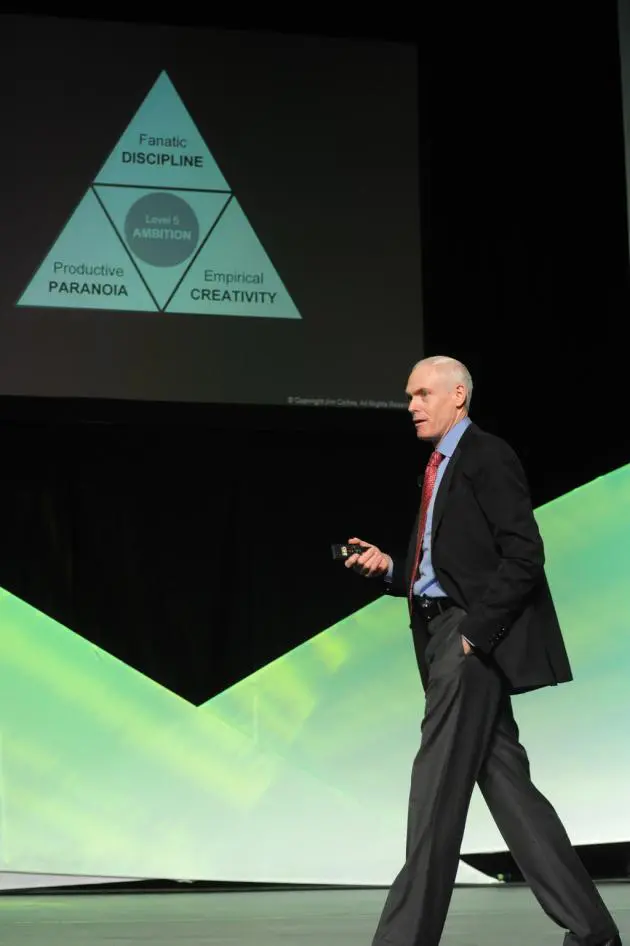
Great leaders are generally not more creative, more visionary, and more risk-taking, but are more “disciplined, empirical, and paranoid”, says Jim Collins, author of many best-selling books, including “Good to Great”, “Build to Last”, and “How the Mighty Fall”.
Collins who spent the last quarter century studying what make a great company tick, was sharing the results from his nine years of research for his latest book, co-authored with Morten T Hansen, “Great by Choice: Uncertainty, Chaos and Luck – Why Some Thrive Despite them All” at the ASTD International Conference and Exposition 2012 held recently in Denver, US.
“Good is the enemy of great,” he started.
“Greatness is not a function of circumstance; greatness is choice and disciplines. And it all begins with people,” Collins said, adding that his study found that the single most important leadership skill is “the ability to pick the right people and put them in the key seats”.
He explained that leadership is a hierarchy of capabilities, starting with Level 1 – a highly capable individual; Level 2 – a contributing team member, Level 3 – a competent manager; Level 4 – an effective leader; and Level 5 – an executive. It is these “Level 5 executives” who exhibit what Collins refers to as the “X-factor” of exceptional leadership: humility combined with an utterly ferocious will.
“We don’t have enough Level 5s in the key seats. We need to build an entire Level-5 generation, and that you can help with,” he said.
Yet, in times of chaos and uncertainty, humility and a ferocious will to succeed are not enough. Collins said leaders and organisations also need to have the three key elements: “fanatical discipline”, “empirical creativity”, and “productive paranoia”.
He said the so-called “10X” winners”, or those who beat their industry indices by 10 times or more, did not generally out-innovate everyone else but they combined creativity with discipline. “Creativity, in my mind, is not the hardest part. You need self-control in the world of out-control,” he said.
Using the story of polar explorers Roald Amundsen and Robert Scott, Collins made the case that Amundsen’s expedition succeeded while Scott failed in his bid to be the first to reach the South Pole. Because Amundsen was “fanatically disciplined” in his preparation for the dire challenges facing his team and in his management of their daily progress. Sun or snow, they consistently ticked off the 20 miles a day, which Collins dubbed it as “the 20-Mile march.”
“The key is to hit consistently, not going too far even on good days. Still, discipline alone is not enough, we must marry creativity,” he said.
Southwest Airlines and medical equipment maker Stryker are among the “10Xers” or the “20-Mile March” companies named in the book. Collins said his study found successful organisations are not luckier. The key is to focus on “what you do with the luck you get”, or “the return on luck”.
--Collins closed his address by giving the audience a 10 to-do list:
1 Commit to building a pocket of greatness on your “bus”.
2 Get the right people on the key seats of the “bus”.
3 Double your questions to statement ratio.
4 Confront the brutal facts – not opinions.
5 Find your personal “hedgehog”. What are you genetically encoded for. Where can you be useful? What are you passionate about?
6 Commit to a “20-mile march” on your “hedgehog”.
7 Get a high return on your next luck event, specify who is your best luck and what you can do to honour and share that relationship?
8 Have a Stop Doing List as well as a To Do List
9 Creative pockets of quiet time without mobile device and one day in every two weeks with no devices when you can think.
10 Set personal vision to be aligned with lifetime core values that you can pass on to others.
“Get involved in something you care so much about because it simply can be done. It’s hard to have a meaningful life without having meaningful work – knowing that your short time on this earth has been well spent,” concluded Collins.
[email protected]
