
KBank studies setting up in Singapore to serve Thai companies


Play
Kasikornbank is studying setting up in Singapore after seeing more Thai companies establishing regional offices there.
“Based on the business environment, we think we should participate … however, Thailand is playing the role as well as Singapore did, in that state agencies want to push Thailand as the trading hub.
“If Thailand can take on the same role as Singapore, we might reconsider whether we can serve Thai companies from here or [need to] establish a presence in Singapore,” president Teeranun Srihong said yesterday.
Singapore has a territorial tax system that allows foreign companies to receive a tax exemption when mobilising funds.
The number of Thai companies in Singapore is sufficient to encourage KBank to serve them.
The business environment is a key point in the bank’s decision on whether to enter a country.
Singapore, as a developed country, has a key supporting role for businesses ahead of the Asean Economic Community, as well as the other members of the AEC+3 group (China, Japan and South Korea).
As for Myanmar, KBank was among four Thai banks that submitted proposals to set up there, but Bangkok Bank was the only one to win a licence.
Teeranun said the KBank still worked with three local banks in Myanmar to help develop financial products for them. It can help those banks by transferring its knowledge of small and medium-sized enterprises, a business KBank has plenty of experience with.
“Even though the bank cannot provide loans to customers in Myanmar, we can serve Thai companies there through the border provinces. We will focus on free-trade zones in provinces bordering either Myanmar or Laos, by working with local banks in providing basic products to Thai companies,” he said.
KBank will open a branch in Vientiane next month. It was the first Thai bank to ask for a local banking licence in Laos.
It also hopes to establish a footprint in Cambodia and Vietnam, but each country has its own banking environment, which influences KBank’s expansion strategy. Vietnam might not be particularly attractive to KBank right now.
KBank is interested in entering Indonesia because of the increase in activities there. However, Indonesian authorities require a foreign bank to acquire a local institution because the country already has too many banks.
“We have no plan to acquire local banks because of the difficulty in integrating either systems or human resources, so KBank’s move into Indonesia has not happened yet,” he said.
In the Asean region, KBank will go into markets by itself if it can but if not, it will join with local banks.
KBank is inviting 33 local banks from Asean to discuss regional banking and banking innovation. The aim is to foster regional cooperation to accommodate AEC customers together under what KBank calls the Bangkok Declaration.
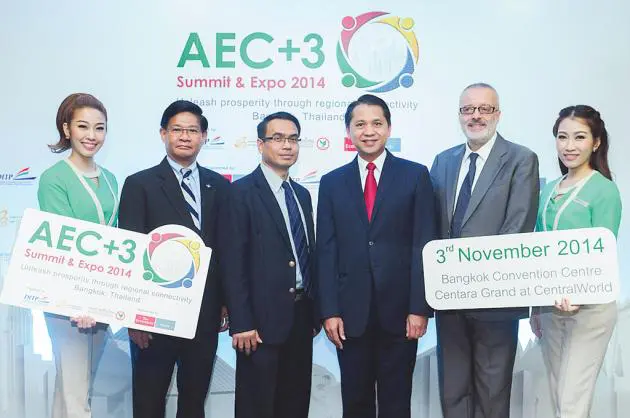
The 33 regional banks will confer on how to build the regional financial system at the “AEC+3 Summit and Expo” to be hosted by KBank, the International Trade Promotion Department, the Board of Investment and The Economist newspaper on November 3.
At least 500 business-matching deals have been registered for the event and this
will generate business agreements worth Bt6 billion.
