
R&D underpins Bayer's next 150 years


Several laboratory success stories, from Aspirin over 100 years ago to modern-day drugs and crop solutions, are encouraging German giant Bayer to invest more in research and development in the years ahead.
Celebrating its 151th anniversary this year, Bayer considers itself in the right position to pool resources in the pharmaceutical and crop-science areas to make it the world’s first and most prominent integrated "life science" company.
"We’re tilted towards investing more in labs … R&D budget growth will be at a higher rate than organic sales targets," chairman Marijn Dekkers said at "Bayer’s Perspective on Innovation 2014" last week.
Adding that the management is finalising the budget for next year, he said it would be "added to significantly" from 3.2 billion euro (Bt130.2 billion) this year.
Motivating this are some significant R&D success stories at the company. Aspirin, the pain-killer launched in 1899, still rakes in annual sales of more than 1 billion euro, while Xarelto, of which the R&D process took over 10 years and involved an investment of more than 1 billion euro, has also been a big success.
In the first three months of this year, the ‘blockbuster’ drug – claimed to help reduce the risk of stroke in people with atrial fibrillation – generated 1.16 billion euro in sales revenue.
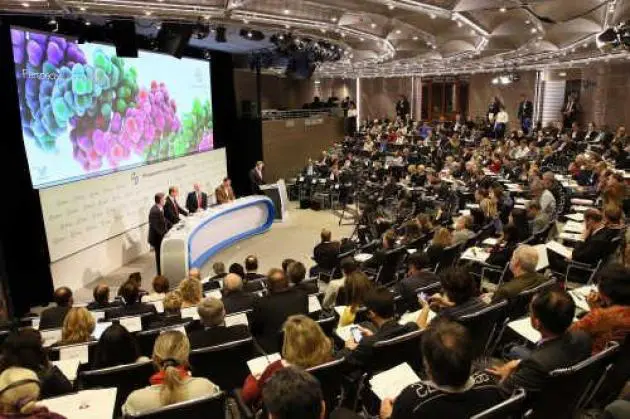
Addressing over 140 journalists at the event, Dekkers envisaged a wide range of new products in the company’s pipeline – from drugs for humans and animals, to crop solutions, all being studied by Bayer’s 13,000 researchers and through external collaboration.
Filing 233 patents last year for healthcare products and 263 for crop-related products, the company aims to maintain the momentum. Potentially, 25 new drugs will be launched soon.
"I don’t know if they will be blockbusters, but all are [targeted] to meet unmet medical needs," he said.
The chairman also said Bayer would continue to focus on acquisitions that enhance all of its businesses.
In October, the company announced the US$14.2-billion (Bt467.4 billion) acquisition of Merck & Co’s consumer unit to boost sales of non-prescription medicines,
"We are willing to spend to put projects to markets," said Dekkers, who acknowledged that R&D and commercialisation would consume much more investment than manufacturing in the years to come.
More investment in R&D is guided by the "Bayer: Science for a Better Life" vision, which was announced earlier this year.
The company aims to find innovative ingredients from studies into the molecular level of all living species. Cross-sequencing of genomes is envisaged, based on the fact that humans, animals and crops do share some genes and should benefit from the same pool of knowledge.
A scheme called NIMBUS was launched in 2012 to share common knowledge discovered by Bayer’s scientific network, also involving external expertise.
Crowd sourcing
Moreover, the ‘crowd sourcing’ concept has been adopted by the company, to find good ideas from academics, start-ups and entrepreneurs.
In Berlin and San Francisco, lab facilities are available for outsiders.
According to Jorg Moller, head of global development for the healthcare business, R&D is possible only in collaboration. "Now, no company, no university, no government is able to confront and fund research into these areas of medical needs. No company can claim to have all technology under one roof," he said.
Kemal Malik, the board member responsible for innovation, said the five-year collaboration with Boston-based Broad Institute in the US is expected to identify compounds that will lead to three investigational new drugs.
He added that the digital ecosystem promoted collaboration, not competition, particularly in genomic studies. Chiefly, it allows broader data analysis.
"The revolution is here. At Bayer, we are optimistic over the study across humans and crops," he said. "We are helping fund great ideas without taking their IP [intellectual property]."
"We have documented success in this area, and we will keep doing that in the future," said Malik.
