
OAE flags 2026 farm price winners, warns rice and rubber face pressure
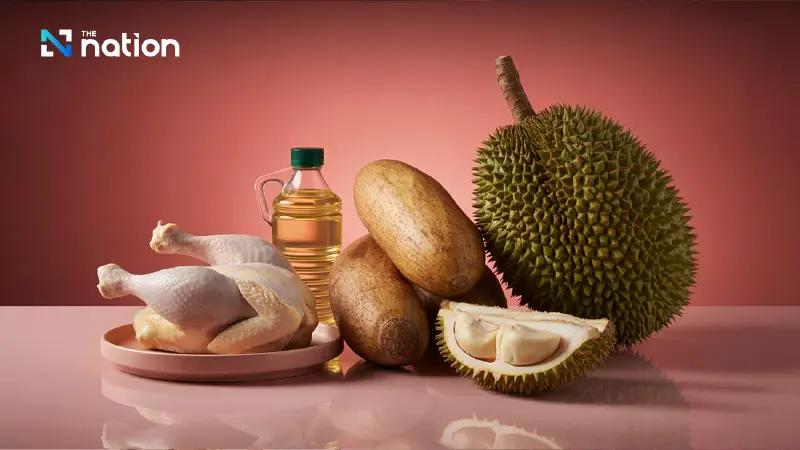


Thailand’s OAE expects firmer 2026 prices for chicken, palm, cassava and durian, but warns rice oversupply and softer rubber demand could weigh on farmers.
Thailand’s farm commodity outlook for 2026 looks mixed, with several products expected to hold up well while others face rising risks, according to the Office of Agricultural Economics (OAE).
Peeraphan Korthong, acting secretary-general of the OAE, said agricultural GDP in 2026 is projected to grow by 2.0–3.0%, valued at 723.2–730.3 billion baht. If achieved, it would mark the highest level in three years, supported by more favourable weather conditions and higher rainfall than in 2025, which should lift yields per rai.
Products expected to perform well
Cassava prices are expected to rise as output is likely to decline while demand from the food and animal feed industries remains steady. He added that Laos has moved to curb exports of fresh cassava roots abroad (including shipments to Thailand), while Thai–Cambodian border closures linked to the bilateral dispute could also support prices.
Oil palm prices are also expected to increase, driven by continued demand from the food and bioenergy sectors at home and overseas. Global supply is expected to tighten as Indonesia — the world’s largest palm oil producer — plans to raise its biodiesel blending mandate from 40% to 50%.
The OAE also noted that sunflower seed and rapeseed oil prices are projected to rise on lower output from the Black Sea region and Europe, while soybean oil prices are supported by sustained demand for biofuel feedstock.
Broiler chicken output is forecast to increase, backed by stronger domestic consumption and growing overseas demand. Improved farm management and standards have also helped Thai producers meet customer requirements.
However, the OAE cautioned that baht volatility — particularly a stronger baht — could weaken Thailand’s price competitiveness against rivals.
A broader fruit category is also expected to stay in a healthy range, including longan, durian, mangosteen and rambutan, on strong demand in both domestic and export markets.
The OAE said government efforts to improve quality standards and promote processing to add value could help, though market support measures and stricter import standards in 2025 may continue to shape price stability into 2026.
Products under pressure
Rice is a key concern, with global supply expected to outstrip demand. The OAE pointed to India’s return to exporting white rice, while major importers such as the Philippines and Indonesia have already built sufficient stockpiles and may slow purchases.
This has pushed global rice prices down rapidly, with knock-on effects for farmgate prices in Thailand. Rice exports in 2026 are estimated at 7–7.5 million tonnes, below 2025 levels.
Natural rubber is also considered at risk. Global output is expected to rise in 2026 due to favourable weather and expanded planting in several producer countries in 2020 — including Indonesia, Myanmar and Cambodia — now coming into production.
At the same time, global demand is projected to soften amid slower growth in the world economy and key markets such as China, the United States and Japan. Uncertainty in international trade policy could further weigh on rubber-linked industries, particularly tyres and auto parts, potentially reducing demand.
Peeraphan said agriculture remains a cornerstone of Thailand’s economy and society — supporting food security, jobs and incomes — but faces mounting pressures from global economic conditions, climate change, trade rules, geopolitical conflict, volatile production costs, rapid technological shifts and an ageing population.
He said Thailand needs to accelerate policy and management adjustments and adopt innovation to raise productivity and keep pace with the digital era.
