
Samsung to fight Chinese rivals with cutting-edge technology


Play
DESPITE FACING weak consumer spending in the Kingdom and fierce competition from Chinese brands, Samsung Electronics aims to maintain its growth by introducing new cutting-edge products with affordable prices.
The South Korean electronics giant plans to lure mass customers with small curved-screen smart TVs while attracting others with high purchasing power with next-generation technology.
“To deal with price-led competition, our company has to offer customers various choices,” Sasitorn Khoopatanakul, director of corporate marketing at Thai Samsung Electronics, said yesterday.
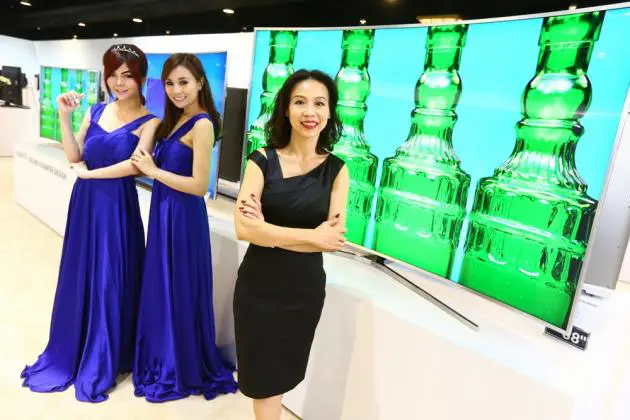
She said the company would launch a new 48-inch curved-screen television targeting mass consumers. The price is expected to be less than Bt54,000. It currently offers curved-screen TVs ranging from 48 to 78 inches starting at Bt60,000.
The new model is expected to be launched to the Thai market by midyear.
“Curved-screen TVs will remain our flagship product driving our sales this year,” Sasitorn stressed, adding that the company expected to see a threefold increase over last year’s level. The company wants to transform the local market from the flat-screen to the curved-screen era.
Samsung yesterday announced the launch of an extensive range of 88-inch SUHD TVs at its “Southeast Asia Forum”, which was held at a Bangkok venue. Samsung’s SUHD (smart ultra-high-definition) sets are its premium products for this year.
The company will also focus on more advanced home appliances, such as a cutting-edge washing machine with a built-in sink, robot vacuum cleaners, air-conditioners, air purifier and Chef Collection refrigerators. Sasitorn said these products were aimed at high-end customers.
In an opening speech at the regional forum, Yong Sung Jeon, president and chief executive officer of Samsung Electronics Southeast Asia and Oceania, said the company was focusing on designing and developing new products to be ready for the Internet of Things.
By 2017, the company wants all of its TV sets compatible with the IoT, with the rest of its hardware products ready within five years.
Sasitorn added that in the home, the TV set would be the central connection point while smartphones would be the main IoT connection point outside. To prepare for this trend, the company aims to work with partners like Mercedes-Benz and BMW to connect its products to cars.
