
Digital economy plan to take shape when related bill passes


Play
THAILAND'S digital economy will soon start taking shape, as the Ministry of Digital Economy and Society begins functioning after the bill is passed next month.
The Ministry of Information and Communications Technology Reform Bill will set up the Digital Economy Ministry to oversee planning, promotion and development of the digital economy.
The new ministry will have five offices, including four from the ICT Ministry – the ministry’s office, permanent secretary’s office, Meteorology Office and National Statistical Office. The new office is the Digital Economy Office.
The bill will abolish the ICT Ministry and transfer its tasks and restructured organisation to the new ministry.
Surangkana Wayuparb, chief executive officer of the Electronic Transactions Development Agency (ETDA) and head of the digital-law development team, said the bill passed its first reading and the National Legislative Assembly (NLA) would finish considering it by June.
He spoke on Saturday at the weekly open forum of the ICT Law Centre, a member of the ETDA, on the impact of the Personal Information Protection Bill.
The draft of the ICT Ministry Reform Bill was approved by the Cabinet in December and sent to the Council of State for checking, before it was tabled with the NLA late last month.
The bill also transfers the National Disaster Warning Centre to the Prime Minister’s Office and the Technology Crime Suppression Division to the National Cyber Security Agency, which will be set up by the National Cyber Security Bill.
Two related draft bills – the Digital Economy Bill and the National Broadcasting and Telecommunica-tions Commission Bill – have been reviewed by the Council of State and will go to the Cabinet and then to the NLA.
The Digital Economy Bill is the consolidation of the Digital Economy Committee Establishment Bill, Digital Economy Fund Bill and Digital Economy Development and Promotion Bill. The Council of State has nearly finished its review of three draft bills – the Electronic Transactions Bill, Electronic Transactions Development Agency Establishment Bill and Personal Data Protection Bill.
The last draft bills – the Computer Crime Bill and National Cyber Security Bill – are still being assessed by the Council of State.
NDEC to be set up
The Digital Economy Bill, which has been reviewed by the Council of State but not yet submitted to the Cabinet, will set up the National Digital Economy Committee (NDEC).
The chairman of NDEC will be the prime minister and the vice chairman will be the finance minister.
Serving as ex-officio members of the NDEC will be the ministers of Defence, Agriculture, Commerce, Digital Economy, Education, Industry, Public Health and Science, secretary-general of the National Economic and Social Development Board, governor of the Bank of Thailand and secretary-general of the National Broadcasting and Telecommunications Commission (NBTC).
About five to eight members will be experts appointed by the Cabinet.
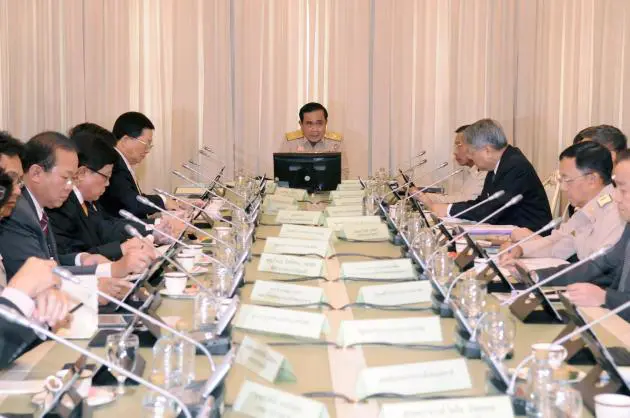
The ad hoc National Economy Committee at its second meeting yesterday gave the nod to engage a third party to design the implementation of the national broadband infrastructure, which will turn into the master plan for the national broadband network.
Then it will hire the third party to appraise the value of the broadband networks of telecom firms, the Metropolitan Electricity Authority (MEA) and other providers, which will transfer their networks in return for a share in the national broadband network holding company and then continue to invest.
Pridiyathorn Devakula, a deputy prime minister, said the committee also agreed to allow the ICT Ministry to use its Bt1.71 billion budget to link 5,000 schools nationwide to an optic-fibre network.
This will support the Education Ministry’s online learning project, which will give students in 15,000 schools nationwide the opportunity to learn the core subjects of Thai, English, science and math via the Internet from 80 selected expert teachers.
“Now, 10,000 schools have already been hooked up to the broadband network, while 5,000 schools will be connected by September,” he said.
The committee is also surveying the 300 existing government organisations on their data usage and requirements to determine what capacity the national data centre should have.
“Now, we got feedback from 90 organisations, which together have 143 data centres. If we can consolidate these data centres with the utilisation, we will be able to save on investment, management and maintenance.
Now there are six to seven large firms proposing to invest in it. After we get all the feedback, then we’ll design the data centre we need and then hold auctions to get investment and operation sunder our regulation,” he said.
For the 4G auction, the 900 megahertz and 1800MHz bands would be offered according to the NBTC’s timeframe. It could be this year.
The 2600MHz auction would follow after it gets the frequency back from MCOT and the Public Relations Department.
