
BYD investing in smart features to aid growth
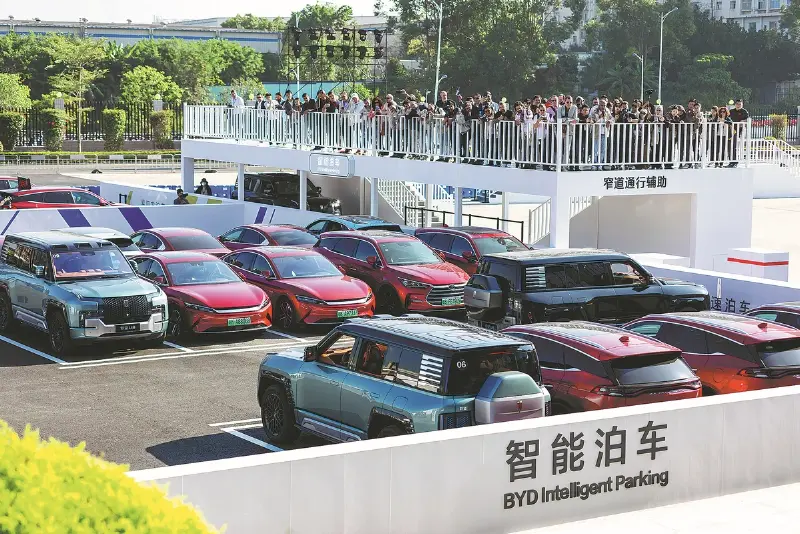


Chinese carmaker BYD said it will invest 100 billion yuan ($14 billion) to develop smart features as the focus within the automotive industry is shifting from electrified vehicles to intelligent ones.
Wang Chuanfu, chairman and president of BYD, announced the plan last week when he unveiled the company's smart vehicle strategy. He didn't specify a time frame for the investment or provide more details.
At the same event, BYD launched its smart car system, called Xuanji, saying that it serves as its vehicle's brain and neural system. Coupled with sensors and other hardware, it enables vehicles to perceive, decide, control and execute.
"Smart vehicles are much more than smart onboard features and smart driving," said Wang.
The company said this latest progress is the result of its independent research and development strength and its solid foundation in electrification, which is the basis of smart vehicles.
BYD has more than 90,000 employees in its research and development departments, and more than 4,000 of them are working on smart driving.
Wang said smart driving will come as standard in BYD cars that cost more than 300,000 yuan. It will be available as an upgrade option for vehicles priced at more than 200,000 yuan.
Advanced driving-assist systems are becoming almost a must for new vehicles in China.
Statistics from the Ministry of Industry and Information Technology show that more than 40 per cent of new vehicles sold in the first half of 2023 had driving-assist features.
A McKinsey survey in China in 2023 shows that 76% of the respondents said they would like automatic parking and 60% fancy autonomous driving in urban traffic.
Startups, such as Nio and Xpeng, and traditional carmakers are strengthening their competitive edge in this area.
BMW and Mercedes-Benz won Level 3 test permits in Shanghai and Beijing, respectively, last year.
At last week's event, BYD also went over other non-driving features that it is looking to add to enhance drivers' experiences.
The Yangwang U8 SUV, which has a price tag of around 1 million yuan, will be available with a vehicle-mounted drone and its housing case.
In some of its other models, BYD is adding palm-print motion sensor technology to enable drivers to open vehicle doors by waving at them.
Li Fusheng
China Daily
Asia News Network
