
Five new safety standards prepare Thailand for automated cars
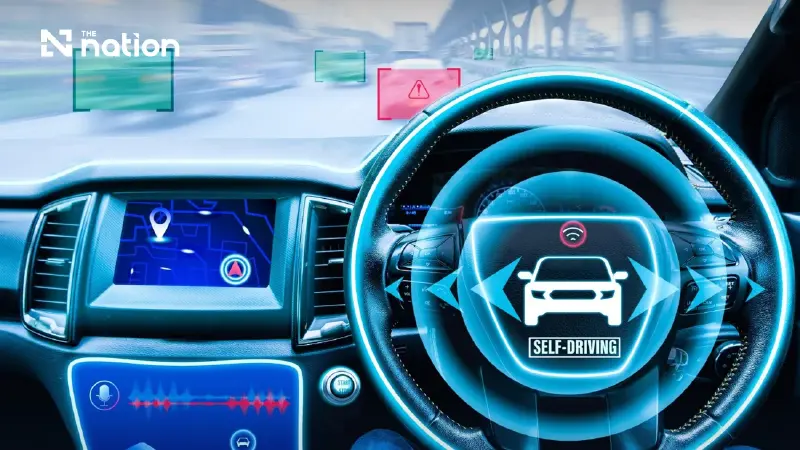


Thailand has adopted five Thai Industrial Standards covering automated driving, low-speed braking, collision avoidance, parking and shuttle safety.
- Thailand has introduced five new industrial safety standards to regulate driver-assistance and automated-driving technologies, aligning the country with international frameworks.
- The standards cover critical safety functions, including a Minimal Risk Manoeuvre (MRM) for safely stopping a vehicle after system failure and Automated Braking during Low-Speed Manoeuvring (ABLS) to prevent collisions.
- Further regulations establish requirements for Collision Evasive Lateral Manoeuvre Systems (CELM) that assist with steering to avoid objects and Partially Automated Parking Systems (PAPS).
- A specific standard also addresses the operational safety of services using Low-Speed Automated Driving Systems (LSADS), such as driverless shuttles in controlled environments.
The Royal Gazette has published five Ministry of Industry announcements introducing new Thai Industrial Standards for intelligent transport systems involving driver-assistance and automated-driving technologies.
Published on August 3, the announcements were signed by Industry Minister Varawut Silpa-archa on June 30 and came into effect the following day.
The standards were developed by the Thai Industrial Standards Institute (TISI) to establish a technical framework for vehicle manufacturers, technology developers and related service providers as vehicles equipped with varying levels of automated driving capability are expected to enter the Thai market more widely in the near future.
Thailand has previously lacked specific standards covering these technologies, while countries and regions such as Europe, the United States and Japan have continued developing safety regulations for automated vehicles.
The new standards mark an important step in providing Thailand with its own reference framework aligned with international standards, including ISO and ISO/TS guidelines.
Automated fallback brings vehicles to a safer stop
The first standard, TIS 4653 Part 1-2568, covers the Minimal Risk Manoeuvre (MRM). This automated fallback function is intended to bring a vehicle into a minimal risk condition when its automated-driving system can no longer continue normal operation.
It specifies two basic manoeuvres: stopping in a straight line and stopping within the vehicle’s existing lane. The standard sets minimum control and testing requirements from the beginning of the manoeuvre until the vehicle reaches the lower-risk condition.
Methods for detecting faults in the automated-driving system and deciding when to activate the manoeuvre are outside its scope because the industry has yet to agree on a common approach. The standard applies only to light vehicles equipped with automated-driving systems at SAE Levels 3-5.
Automatic braking targets low-speed collisions
TIS 4654-2568 concerns Automated Braking during Low-Speed Manoeuvring (ABLS). The system is designed to prevent collisions or reduce their severity when a vehicle is travelling below 2.8 metres per second, equivalent to about 10 kilometres per hour.
It covers possible collisions with pedestrians, other vehicles and obstacles or structures such as walls and posts. Although many low-speed impacts occur while vehicles are reversing, the standard also covers collisions in other directions.
The system evaluates the position and movement of surrounding objects together with the vehicle’s motion and the driver’s actions. When it identifies a collision risk, it automatically applies the brakes. Testing equipment is based on the ISO 19206 series.
ABLS is limited to vehicles at SAE Levels 0-2, meaning drivers remain responsible for controlling or supervising the vehicle’s movement at all times. Evasive steering is not covered, and the standard applies only to light vehicles without trailers.
Safety framework covers low-speed automated services
Unlike standards governing systems installed directly in vehicles, TIS 4655 Part 2-2568 examines safety gaps in services using Low-Speed Automated Driving Systems (LSADS). These services can include automated shuttles operating in controlled or speed-restricted areas such as airports and business districts.
The standard expands on ISO/TS 5255-1 by identifying additional safety roles and considerations for LSADS operations. It also addresses how service applications function, including digital platforms through which passengers may access automated transport services.
Its scope is limited to services using LSADS installed in vehicles. Control systems operating within vehicles are excluded because they are covered separately.
Industry experts believe standards of this kind will greatly benefit operators planning to launch driverless shuttle services in controlled areas of Thailand in the future.

Evasive steering helps avoid predicted collisions
TIS 4656-2568 establishes requirements for Collision Evasive Lateral Manoeuvre Systems (CELM). These systems support drivers when braking alone may not be sufficient to avoid an object in the vehicle’s path.
When a collision is predicted, CELM can move the vehicle laterally by generating a yaw moment, causing it to change direction. The manoeuvre may be initiated entirely by the system or may assist a driver who has already begun steering away from the obstacle.
The standard focuses on fundamental control strategies, minimum operating requirements and testing procedures. Object-detection methods and environmental-perception technologies are outside its scope.
It applies to both light vehicles and heavy trucks, although vehicles fitted with trailers are excluded.
Partially automated parking completes the package
The final standard, TIS 4657-2568, covers Partially Automated Parking Systems (PAPS) for light vehicles, including passenger cars, pickup trucks, light commercial vehicles and sport utility vehicles.
It recognises two operating formats. In the first, the system remains under the supervision of a driver seated in the normal driving position. In the second, it is controlled by a remote driver located either inside or outside the vehicle, which must remain within the operator’s line of sight.
In addition to safety and performance requirements, the standard also covers the Human-Machine Interface (HMI) and how the vehicle communicates the system’s operating status.
