
Thailand’s EV tax policy to target exports and local value
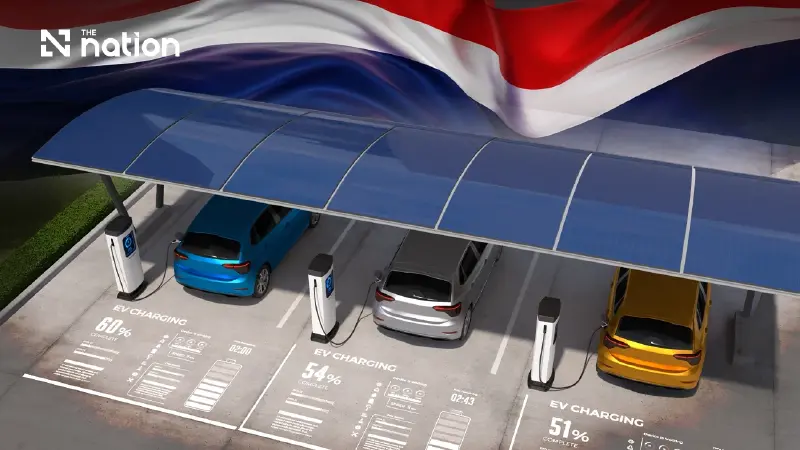


The Excise Department is designing EV tax policy around investment, export-scale production and higher-value local content, with details pending.
The Excise Department is designing Thailand’s next automotive tax framework around attracting investment, scaling up electric-vehicle production for exports and increasing higher-value local content, although specific tax measures have not yet been finalised.
Pornchai Thiraveja, director-general of the Excise Department, said work remained at the level of setting broad principles. The policy debate should not be reduced to whether automotive taxes would be cut or raised, but should address the industry’s long-term transition from internal combustion engine (ICE) vehicles to electric vehicles (EVs).
The next phase will be guided by three objectives: ensuring that imports lead to domestic investment, expanding production sufficiently for Thailand to become an EV export hub, and helping Thai suppliers move into higher-value components, systems and technologies.
The approach builds on the EV3 and EV3.5 support measures, which have brought eight to 10 factories into the programmes, including BYD, MG and GWM. About 170,000 EVs have been produced domestically, while investment in electric vehicles and parts has reached approximately 140 billion baht.
Thailand now has potential EV production capacity of up to 380,000 vehicles a year, with the industry creating around 25,000 jobs.
EV3 schemes established the first-stage platform
Thailand has spent more than 60 years developing its conventional automotive industry into an important regional production and export base.
The global shift towards cleaner energy and lower pollution has since made electric vehicles a key technology for many countries, requiring Thailand to adapt its manufacturing capabilities and remain competitive as the industry changes.
The government and the Ministry of Finance introduced EV3 and EV3.5 to support learning among both consumers and manufacturers.

Pornchai said EV imports were necessary during the initial phase to allow consumers to become familiar with the vehicles and give the industry an opportunity to learn about the technology.
The government did not, however, want Thailand to remain merely a market where imported vehicles were sold without generating wider benefits for the domestic automotive industry.
EV3 and EV3.5 were therefore designed to combine initial imports and market development with new investment and production in Thailand.
The objective was to help the country build on its established ICE manufacturing expertise while developing capabilities in EV technology.
Electric vehicles involve more than motors and batteries. Their production also requires control systems, software and other technologies that serve as the vehicle’s “brain”.
Pornchai said the industry must be viewed dynamically because battery technology, control systems and intelligent-vehicle technologies continue to develop rapidly. Further incentives will therefore be needed to attract new investment and prevent Thailand’s EV development from stopping at its current level.
Three principles to guide the next EV phase
The Excise Department has been instructed to develop the next automotive tax framework around three principles.
1. Turn imports into domestic investment
Thailand must continue to welcome new technologies and vehicle models so that consumers and businesses can learn from them and the country can maintain an attractive investment environment.
Imports should, however, lead to investment and production in Thailand rather than leaving the country as merely a destination for overseas-made vehicles.
Although EV3 and EV3.5 have already helped establish a group of participating factories, the government expects further technological changes and new forms of investment. Policy must therefore continue creating conditions that attract manufacturers and technology providers.
2. Expand production to export scale
Once Thailand has secured investment and established an EV production base, the next objective is to increase manufacturing scale sufficiently to support exports.
The country can build on its experience as a production and export centre for ICE vehicles to develop a similar role in the electric-vehicle industry.
The strategy is not limited to meeting domestic demand. Thailand wants investments made in the country to serve as a manufacturing base supplying EVs to international markets.
3. Raise the value of local content
Greater investment and exports must also deliver more benefits to Thai businesses throughout the supply chain.
Local content should move beyond basic components towards parts, systems and technologies that generate more value.
Pornchai said the goal should not be confined to producing leather seats, rubber components or general assembly parts. Thai manufacturers should develop the capability to produce more technologically advanced components and vehicle systems domestically.
Foreign investors urged to develop Thai suppliers
Increasing higher-value local content will require cooperation between Thai manufacturers and overseas investors, Pornchai said.
Foreign companies establishing production facilities in Thailand should help local suppliers develop the expertise and capacity needed to manufacture more advanced components.
Such cooperation could create benefits across investment, production, exports and the development of Thai businesses.
Investors from several countries interested in establishing operations in Thailand have already held discussions with the government.
The Excise Department believes negotiations with prospective investors should consider the long-term development of the industry rather than focusing only on the immediate effects of individual tax measures.
Stronger links between foreign manufacturers and Thai suppliers would help domestic companies participate in more valuable parts of the EV supply chain instead of remaining concentrated in basic components and assembly work.
Tax policy to balance industry and environment
Pornchai said future automotive tax policy would need to address consumption and environmental considerations together, particularly the need to reduce pollution while preserving the competitiveness of Thailand’s automotive industry.
Changes to the tax structure should therefore not be viewed merely as measures that raise or lower costs for consumers.
Tax policy should form part of a broader industrial strategy to transform Thailand’s established automotive base into a more technologically advanced centre for EV manufacturing and exports.
“The goal does not end with having EVs manufactured in Thailand,” Pornchai said. “We must move forward to becoming an export base and ensure that Thai manufacturers participate in higher-value parts of the production supply chain.”
The detailed tax measures and structure for the next phase remain under preparation. The Ministry of Finance will submit the proposals to the relevant committee and the Cabinet for consideration under the required procedures.
Source: Thansettakij
