
Asia's Open Finance Ambitions Demand Interoperability, Smarter Regulation, and Human-Centred Design


From BIS cross-border pilots to TikTok-embedded loans, panellists argue that Asia’s financial future hinges on connecting fragmented silos into a unified trust framework
- Human-centred design is being achieved by embedding financial services directly into platforms customers already use, such as offering merchant loans within TikTok Shop or salary advances through HR software.
- Interoperability is a key focus, with initiatives like the BIS's Project Aperta aiming to connect different national open finance networks to enable cross-border data portability for services like KYC and trade finance.
- Smarter regulation is needed to move beyond vague principles towards practical, collaborative policies that provide stability on issues like instant payments and KYC verification, fostering both competition and financial inclusion.
From BIS cross-border pilots to TikTok-embedded loans, panellists argue that Asia’s financial future hinges on connecting fragmented silos into a unified trust framework.
Building truly inclusive open finance ecosystems across Asia will require more than regulatory mandates — it demands interoperable infrastructure, partnership-driven business models, and a fundamental shift in how banks, fintechs, and regulators work together.
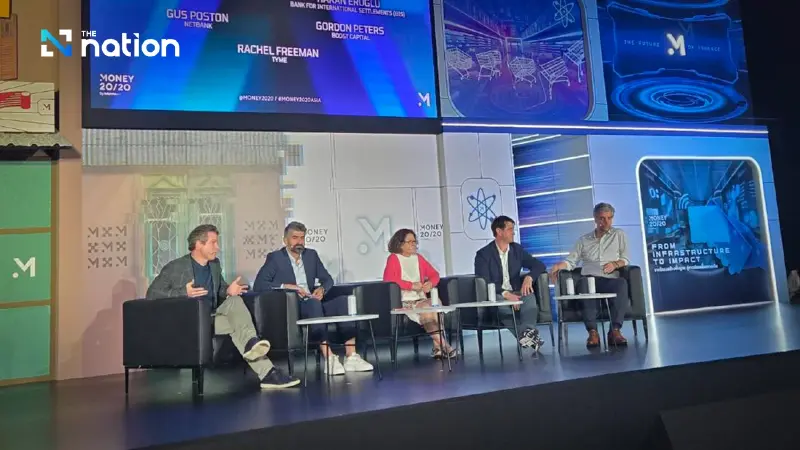
That was the central message from a panel of industry practitioners and policymakers who closed the third and final day of Money20/20 Asia 2026 in Bangkok on Wednesday.
The session, titled Building Inclusive Open Finance Ecosystems in Asia, brought together voices from across the financial services spectrum: Hakan Eroglu, adviser at the BIS Innovation Hub; Rachel Freeman, chief growth officer at Tyme; Gordon Peters, co-founder and chief executive of Boost Capital; and Gus Poston, founder of NetBank — moderated by Todd Schweitzer, chief executive of Brankas.
Embed finance where customers already are
The most actionable guidance from the panel centred on the principle of meeting customers within the platforms they already use, rather than expecting them to migrate to a bank's own app or portal.
Freeman described how Tyme had embedded a merchant cash advance product directly inside TikTok Shop in the Philippines, using transaction data provided by the platform to underwrite loans for merchants without requiring them to visit a bank.
"We take the data, score it, use that distribution model, and then supercharge what they're doing with their merchants by offering finance," she said. "For the merchants, the place where they sell is where they get their loan."

Poston outlined a similar model at NetBank, which partnered with Sprout — an HR software platform — to offer salary loans and bank accounts through an employee app.
The customer never interacts with a NetBank interface; the banking service is embedded invisibly within a tool they use daily.
"It's really just driven by the market," Poston said, describing NetBank's approach as one of flexibility over prescription. "You can't turn up with 'this is our standard way of doing it'. You have to say, 'What have you got, and how do we make the two come together?'"
Peters, whose firm Boost Capital processes documents for banks and digital wallets serving more than 100 million customers across Southeast Asia, stressed that even without formal open finance infrastructure, innovation is already advancing — but unevenly.
"Right now, if you're trying to connect data on government databases, it's not an easy API call — it's broken. If you had the basic structure to validate whether an ID or a company document is correct, that would make everything go faster."
Cross-border data portability: BIS pilots a global bridge
On the question of infrastructure at scale, Eroglu unveiled new details of Project Aperta — a prototype developed by the BIS Innovation Hub in collaboration with the central banks of Brazil, the UAE and Hong Kong, along with the UK's Financial Conduct Authority.
The project is designed to connect disparate open finance networks across borders, enabling cross-border data portability for both individuals and small businesses.
Two use cases have been tested: the first allows KYC and KYB data to travel across jurisdictions to speed up the opening of overseas bank accounts; the second addresses trade finance, streamlining the exchange of invoices, letters of credit and shipping data between buyers and sellers in different markets.
Thirteen private sector organisations participated in testing the prototype.
Crucially, Aperta does not seek to replace existing national infrastructure but to connect it – translating between different technical standards and linking trust frameworks across jurisdictions.
"We don't want to replace existing infrastructure. We want to connect them," Eroglu said.
A full report on the project is expected to be published in late May.
Eroglu also cited early findings from a BIS paper published in March, Opening Doors to Open Finance, which found initial evidence that open finance implementation correlates with increased venture capital flows into fintech, broader credit access for underserved populations, and the breaking down of data silos between industries.
"The biggest leverage we see is using payment data and additional data to underwrite micro-loans — very basic use cases that are relevant from a financial inclusion perspective," he said.

Regulation: from vague principles to practical mandates
The panel was candid about the limitations of light-touch regulatory approaches.
Freeman described how Tyme had been caught off-guard when South Africa's Department of Home Affairs raised KYC verification fees by 15,000% overnight, increasing customer acquisition costs by more than one US dollar per user.
The experience prompted the company to pivot from engaging regulators solely on its own behalf to building industry-wide coalitions on issues including instant payments, open banking, payroll portability and foreign investment rules for digital banks.
"We realised that we needed to be an industry player. We could not just be thinking one level," she said, noting that Nubank — which took a stake in Tyme a year ago — had drawn on its experience shaping Brazil's Pix instant payments system to help the company accelerate its public policy capabilities.
Poston echoed the importance of a principled rather than prescriptive dialogue with regulators, though he acknowledged the pace of progress was slow.
NetBank spent more than 18 months running regulatory workshops in the Philippines, only to be transferred to a different department and asked to start again.
"You have to understand what the regulator is actually working on at the level of underlying principle," he said, "and then apply those principles back to them to get a degree of flexibility."
Competition versus inclusion: different goals for different markets
A recurring theme was the tension between using open finance as a tool for competition in developed markets versus using it to drive inclusion in emerging ones — and the risk that incumbent banks would seek to slow progress once challenger institutions began gaining meaningful scale.
Freeman described a pattern she had observed in both the Philippines and South Africa, where large established banks initially dismissed digital challengers, then moved to restrict instant payment access once those challengers began attracting millions of customers.
"You cannot have open banking without instant payments, and you cannot have instant payments really work without more competition and more open banking," she said. "To get true access and inclusiveness, that requires government and regulators to work closely not just with incumbents, but with all the new players."
The panel closed with broad consensus that the future of open finance in Asia would not be determined by regulation alone but by the combination of practical innovation from the ground up, smarter and more prescriptive policy frameworks, and infrastructure that allows data – and trust – to move freely across borders.
