
True Corporation Prepares for New Shareholder Era as Telenor Exit Nears Completion
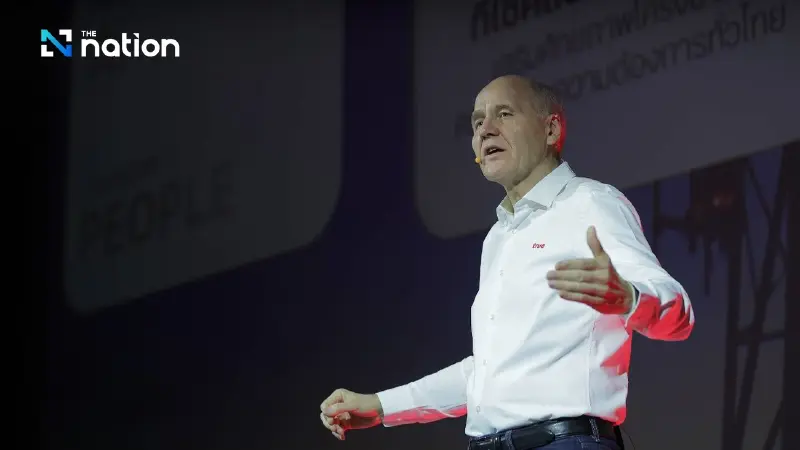


CEO Sigve Brekke insists the imminent departure of Norwegian co-owner Telenor will not alter True's strategic direction, as CP Group tightens its grip
- Norwegian telecoms giant Telenor is finalizing the sale of its 30% stake in True Corporation, with the transaction expected to be completed within weeks.
- The sale will result in Thailand's CP Group becoming the dominant institutional shareholder, consolidating its control over the company.
- Despite the major ownership shift, True's CEO, Sigve Brekke, asserts that the company's strategic direction and its transformation into a "telco-tech" business will remain unchanged.
- The CEO suggests the new structure could enhance synergies with other CP Group businesses, such as 7-Eleven and a forthcoming virtual bank, creating a competitive advantage.
CEO Sigve Brekke insists the imminent departure of Norwegian co-owner Telenor will not alter True's strategic direction, as CP Group tightens its grip.
True Corporation is approaching a significant shift in its ownership structure, with Norwegian telecoms giant Telenor set to complete the sale of its 30 per cent stake in the Thai operator within weeks — a transaction that will concentrate control more firmly in the hands of Thailand's powerful CP Group whilst leaving the company's strategic direction, according to its chief executive, entirely intact.
Speaking at a press briefing in Bangkok on Monday, Group Chief Executive Sigve Brekke confirmed the divestiture was proceeding on schedule.
"Things are going exactly as planned," he said, adding that a small number of procedural matters remained to be resolved but that a March closure remained the working timeline.
How the ownership structure evolved
True Corporation's current shareholding arrangement is the legacy of its landmark 2021 merger between True Move and DTAC, the Thai subsidiary of Telenor.
The deal created Thailand's largest mobile operator by subscriber base and brought the two parent groups — CP Group, the Thai conglomerate, and Telenor, the Norwegian state-backed telecoms company — into an unusual joint stewardship of the combined entity, each holding approximately 30 per cent, with the remaining 40 per cent in public hands on the Stock Exchange of Thailand.
Telenor's decision to exit, Brekke explained, was driven not by dissatisfaction with True's performance but by a desire to realise proceeds for reinvestment elsewhere in its global portfolio.
"They would like to take some of the proceeds and invest in other businesses," he said.
The sale will leave CP Group as the dominant institutional shareholder, moving from approximately 30 per cent to what Brekke described as a position of around 20 per cent — with the remaining stake presumed to be redistributed through the market or to other investors.
The precise final structure was not disclosed.

Brekke's commitment: No change in direction
Brekke was unequivocal in his assertion that the ownership transition would have no bearing on True's operational strategy or management autonomy.
"None of the change will alter the direction of True," he said. "We have made this very, very clear to the market."
He cited the explicit position of both CP Group and incoming investors as the basis for his confidence, noting that the board and management had received firm assurances that the current strategic roadmap — the "4 Big Moves" framework unveiled at the same briefing — would continue unimpeded.
"Both CP, even though they now hold a larger position, and the new investors have made that clear in the board and to the management," Brekke said. "They want us to continue."
The remarks carry particular weight given the ambition of the transformation programme True is currently pursuing.
The "4 Big Moves" strategy commits the company to a fundamental repositioning from a traditional telecoms operator into what Brekke termed a "telco-tech" business, with artificial intelligence embedded across networks, customer service, enterprise offerings and internal operations. A change in shareholder intent at this juncture could have materially disrupted that trajectory.

CP Group synergies as competitive advantage
Rather than framing the Telenor departure as a disruption, Brekke suggested it could, in fact, sharpen True's competitive edge by enabling closer alignment with the broader CP Group ecosystem.
He described the potential to leverage synergies with CP-affiliated businesses — including convenience retail chain 7-Eleven operator CP ALL, financial services platform TrueMoney, and the forthcoming virtual bank in which CP Group holds an interest — as a competitive advantage that True has "not yet fully utilised."
"I would say it's all the way around," Brekke said, when asked whether CP Group's expansion into virtual banking might create conflicts with True's own digital financial services ambitions. "This is a competitive advantage that True has not yet used to its fullest."
The virtual bank, which CP Group is set to launch this year, could become an integrated partner within True's expanding digital ecosystem — potentially linking financial services, loyalty programmes and AI-driven personalisation into a single customer relationship.
True already operates TrueMoney through its broader group, and Brekke suggested closer collaboration with CP entities such as Makro and 7-Eleven was actively under consideration.
Implications for operational efficiency
The ownership consolidation arrives at a moment when True is placing efficiency at the heart of its financial narrative. After posting its first-ever dividend and returning to profitability last year — a milestone Brekke referenced with evident satisfaction — the company is now targeting a sustained improvement in margins driven in part by AI-enabled automation.
"With AI and technology to automate services, a lot of what we do manually today can be done by machines," Brekke told reporters.
He described a progressive shift in which routine customer service interactions, network maintenance tasks and back-office reporting functions would increasingly be handled autonomously, freeing human employees for higher-value work.
This cost reduction agenda complements the revenue growth strategy. True is moving away from subscriber count as its primary metric — Brekke predicted the industry would "probably not talk about number of customers anymore" — and towards average revenue per account, a measure that rewards depth of customer relationship over raw volume.
The company expects revenue growth to derive from AI-powered personalisation, the bundling of digital services across households, and an expanded enterprise proposition, rather than from price competition or SIM card acquisition.
A more streamlined ownership structure, with fewer divergent institutional interests to navigate at board level, may also improve the speed of decision-making — a practical benefit in an industry where competitive dynamics are shifting rapidly.
A company in transition
The Telenor exit marks the close of a foundational chapter in True Corporation's post-merger identity. For the past three years, the company has operated under the dual stewardship of two large international shareholders with distinct strategic priorities.
With that arrangement drawing to a close, True enters its next phase of transformation with a clearer ownership line and, if Brekke's assurances hold, an undisturbed mandate to pursue one of the most ambitious corporate reinventions in the Thai telecoms sector.
"We are not there yet," Brekke said of the company's ambition to become a fully-fledged technology business. "It takes some time. But that is what I want to do."
Whether the new shareholder configuration will prove as accommodating as Brekke suggests remains to be seen. For now, the chief executive is pressing ahead — dancing included.
