
AOT Pledges Multi-Billion Baht Infrastructure and Digital Overhaul to Cement Thailand as a World-Class Aviation Hub


Airports of Thailand bypasses geopolitical headwinds to fast-track major terminal expansions, AI border security, and green energy transitions by 2034
- Airports of Thailand (AOT) is fast-tracking major infrastructure projects, including terminal expansions at Suvarnabhumi and Don Mueang airports, to increase its total annual passenger capacity to over 160 million by 2034.
- A significant digital overhaul is underway, featuring the deployment of AI-powered systems such as over 200 Automated Border Control machines and advanced 3D CT baggage scanners to enhance security and efficiency.
- The strategy includes a commitment to sustainability, with AOT aiming for net-zero emissions through the widespread installation of solar panels on terminals and a mandatory transition to electric vehicles for airport operations.
Airports of Thailand bypasses geopolitical headwinds to fast-track major terminal expansions, AI border security, and green energy transitions by 2034.
Airports of Thailand Public Company Limited (AOT) has issued a bold, long-term commitment to aggressively scale up the nation’s aviation ecosystem, pledging to expand its total airport capacity to handle over 160 million passengers annually within the next decade.
Speaking at a press conference on Thursday, Paweena Jariyathitipong, president of AOT, outlined the company’s highly ambitious strategic master plan stretching to 2037. The announcement comes at a milestone moment for the state-gated operator, which will celebrate its 47th anniversary of operations this upcoming 1 July.
Under this new mandate, the group is moving swiftly to transform Thailand into a dominant World-Class Aviation Hub. To achieve this, the group is deploying an aggressive dual strategy: breaking ground on massive terminal expansions whilst simultaneously modernising its borders using advanced artificial intelligence (AI) and automated systems.
Despite complex global economic uncertainties and shifting geopolitical developments, international travel demand across AOT's network remains resilient. During the first eight months of the 2026 fiscal year, running from October 2025 to May 2026, AOT’s six regulated airports successfully handled 552,119 flights. This represents a 1.38 per cent increase year-on-year. Passenger traffic simultaneously surged by 2.76 per cent, reaching 90.98 million.

"Our strategic direction is focused on the rapid development of infrastructure, digital transformation, and continuous enhancement of service quality," Paweena stated, noting that the current growth climate presents an unmissable opening for Thailand to secure a competitive advantage in Southeast Asia.
Accelerating Mega-Infrastructure Blueprints
To meet its 160-million-passenger target by 2034, AOT is fast-tracking critical infrastructure developments across its six regional gateways:
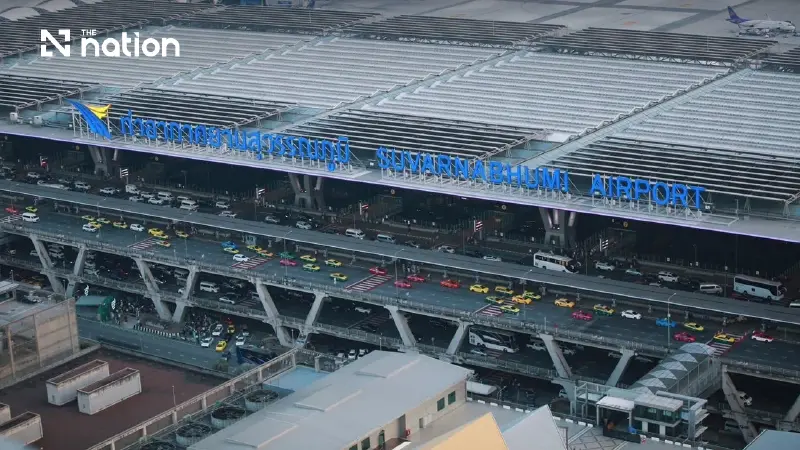
Suvarnabhumi Airport: Construction is being accelerated for the East Expansion project, adding 81,000 square metres of usable space to raise annual capacity to 70 million passengers by 2031. Concurrently, the massive South Terminal Development Project—spanning over 750,000 square metres—is in its design phase, with construction slated to begin in 2029 and Phase 1 operational by 2033.
Don Mueang International Airport: AOT will construct a brand-new Terminal 3 and entirely modernise Terminals 1 and 2 to streamline passenger flow and improve direct connectivity with Bangkok's rail transport networks by 2034.
Chiang Mai International Airport: A new international terminal will be constructed on the southern side, allowing the existing terminal to be converted into a dedicated domestic terminal by 2034.
Phuket International Airport: An expansion of the international passenger terminal and aircraft contact gates is being fast-tracked for completion by 2031.
Hat Yai International Airport: A comprehensive master plan and site optimisation study will be finalised before the end of 2026.

AI Integration and Seamless Border Upgrades
To eliminate bottlenecking at immigration checkpoints, AOT is cooperating with the Immigration Bureau to install more than 200 Automated Border Control (ABC) machines across Suvarnabhumi, Don Mueang, and Phuket airports.
This includes eight specialised assistant lanes for passengers requiring extra mobility support, set to be fully operational before the end of 2026.
Security frameworks are also receiving a tech-driven overhaul. AOT is deploying advanced baggage screening systems utilising 3D Computed Tomography (CT) X-ray technology paired with an AI-powered prohibited object detection system to automate and sharpen screening accuracy.
Furthermore, to proactively mitigate runway wildlife hazards, the operator is evaluating species-specific acoustic dispersal systems that log animal activity data for predictive risk analysis.
Operations across all six hubs remain subject to rigorous oversight by the Civil Aviation Authority of Thailand (CAAT) and the International Civil Aviation Organisation (ICAO), ensuring absolute compliance with global safety mandates.
Commercial Diversification and Green Mandates
In response to changing global travel dynamics, AOT is rolling out an aggressive airline incentive scheme running until 28 October 2028. The programme offers substantial discounts on landing, take-off, parking, and boarding bridge fees for carriers launching new routes to high-demand markets like India, China, and Europe.
Beyond aeronautical revenue, AOT intends to partner with private investors to develop vacant land surrounding its aerotropolis sites into commercial hubs. Planned projects include airport hotels, logistics parks, electric vehicle (EV) charging centres, and recreational spaces aimed at driving local employment.
Aligning with global sustainability trends, AOT has committed to a net-zero greenhouse gas emissions target. The environmental strategy mandates the widespread installation of rooftop solar arrays on terminal buildings to power airport operations, alongside a strict transition requiring all vehicles operated by AOT and its airport concessionaires to be fully electric.
