
AOT seeks new cabinet approval for Don Mueang-Suvarnabhumi expansion worth 269bn baht
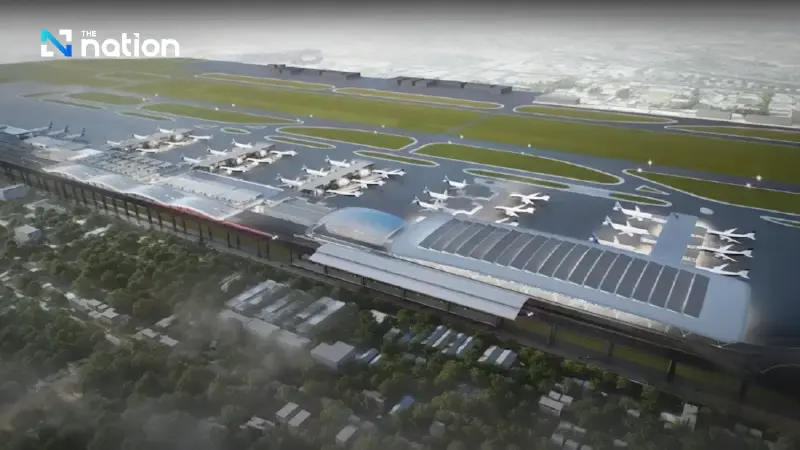


Airports of Thailand plans to submit two urgent expansion projects to Thailand’s next cabinet—Don Mueang Phase 3 (69bn baht) and Suvarnabhumi Phase 3 (200bn baht)—aiming to lift capacity to 40-50 million and 120 million passengers a year respectively, while improving connectivity and flight handling.
Paweena Jariyathitipong, president of Airports of Thailand (AOT), said AOT is preparing to submit two urgent projects for consideration by the new cabinet:
1) Don Mueang Airport development, Phase 3
AOT previously sought cabinet approval for 36 billion baht, but the design has been in place for more than eight years, requiring revisions. Paweena said adjustments are needed to ensure Don Mueang functions as a genuinely near-city airport, linking air travel with other mass-transit systems such as the Red Line commuter rail.
AOT will ask the cabinet to approve changes to the scope of work and a new investment budget of 69 billion baht.
The project aims to expand Don Mueang’s capacity to 40-50 million passengers per year, strengthening its role as a full domestic aviation hub and an international hub for low-cost carriers.
2) Suvarnabhumi Airport development, Phase 3
The Suvarnabhumi Phase 3 project carries an investment budget of 200 billion baht, with the goal of lifting passenger capacity from 60 million to 120 million.
AOT will propose an updated master plan that removes the SAT-2 concourse project, because the space will be consolidated into a single South Terminal development.
The plan includes seeking approval to build the South Terminal, covering 400,000 square metres, to be developed in three phases, along with contact gates. It also includes construction of a fourth runway, increasing flight handling capacity from 94 flights per hour to 120 flights per hour.

AOT also plans to continue using the driverless APM (automated people mover) to connect the existing main terminal with SAT-1, and related facilities.
Paweena said that the South Terminal expansion was originally planned as a single investment, but AOT has revised the approach to a three-phase rollout to better match passenger growth and reduce interest burdens.
- Phase 1: Ground improvement
This focuses on soil improvement because Suvarnabhumi was built on the former Nong Ngu Hao swamp area, where settlement occurs. The phase includes preparing core infrastructure, improvements linked to the Bang Na-Trat connection, soil stabilisation work and building design. It will take about two and a half years before moving on to road connectivity systems and utilities. - Phase 2: Construction of the first half of the South Terminal
This phase will add capacity for 30 million passengers per year. Combined with existing capacity, Suvarnabhumi would be able to handle up to 100 million passengers within five years. - Phase 3: Construction of the remaining South Terminal and the fourth runway
This phase is designed to lift the long-term passenger capacity to 120 million, within 10-12 years.
“Phasing the investment not only reduces the financial burden, but also increases operational flexibility—particularly allowing renovations to the main terminal, which has been in use for more than 25 years, without undermining overall passenger-handling capacity,” Paweena said.
She added that the East Expansion terminal extension project, valued at 12 billion baht, can be submitted for approval by the caretaker cabinet, without waiting for the new government.
