
Thailand’s digital deficit drains over 400 billion baht overseas



Thailand faces a growing digital deficit as spending on foreign platforms, cloud services, AI and online ads sends billions abroad
Thailand is facing a widening “digital deficit” as consumers and businesses increasingly rely on foreign technology platforms, sending hundreds of billions of baht overseas through streaming services, online advertising, cloud systems and artificial intelligence tools.
Pawoot Pongvitayapanu, a party-list MP for the People’s Party and a former businessman with expertise in e-commerce, e-marketing and technology, said Thailand’s dependence on foreign digital services was creating a new form of economic leakage that had yet to be fully captured in national accounts.
Speaking at a seminar organised by the Thai Journalists Association, Pawoot said Thai users had paid more than 420 billion baht to foreign online service providers over the past four years. That figure was based on payments made to just 258 companies registered in Thailand’s tax system.
Thai money flows to foreign platforms
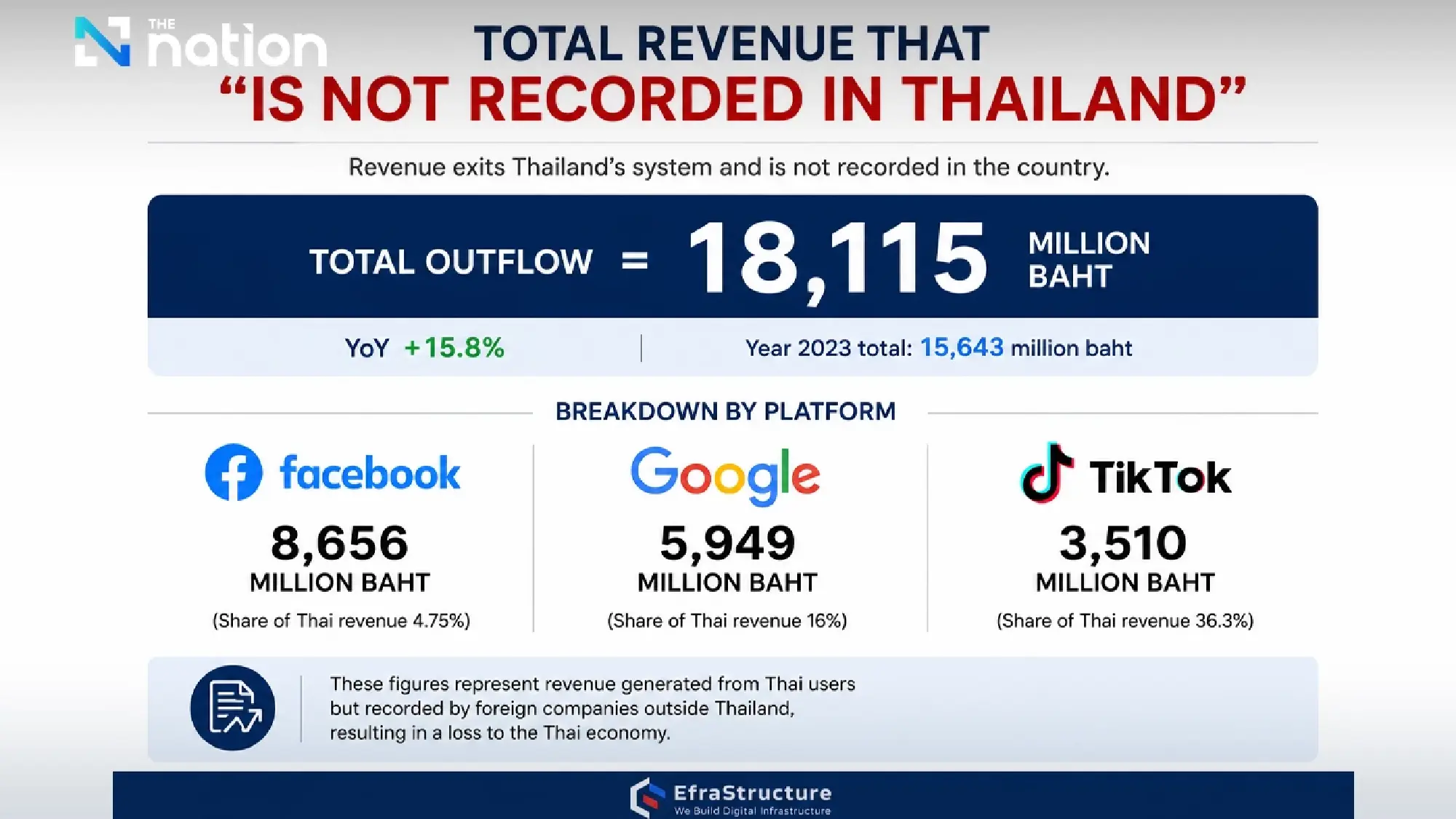
Pawoot said data on digital advertising spending in Thailand in 2025 showed that a large share of revenue from online services was “not recorded in Thailand”, even though the users were based in the country.
According to the figures he cited, Meta, or Facebook, generated 8.656 billion baht in revenue that flowed out of Thailand, while Google and YouTube accounted for another 5.949 billion baht and TikTok for 3.51 billion baht. Together, the three groups represented more than 18.115 billion baht in one year.
He said the figures showed that Thailand’s digital market was expanding rapidly, but much of the revenue was not circulating within the Thai economy.
Pawoot said the issue stemmed partly from the business structures of global technology firms, which often book revenue in countries with lower tax rates, such as Ireland or Singapore. For example, advertising fees paid by Thai businesses to Facebook are charged through a company in Dublin, Ireland, where the corporate tax rate is 12.5%.
Foreign platforms dominate Thai digital life
Pawoot said Thailand was becoming increasingly dependent on foreign technology, with online services now embedded in daily life through platforms such as Netflix, Spotify, YouTube Premium, iCloud, Google Workspace, ChatGPT and Canva.
Businesses, meanwhile, spend heavily on advertising through Facebook, Google and TikTok, while also relying on cloud infrastructure from AWS, Azure and Google Cloud to run their operations.
He said cloud services and marketing technology, or martech, had become essential infrastructure for modern businesses. Even when foreign companies invest in data centres in Thailand, much of the core revenue still flows back overseas because the hardware, software and main operating systems remain foreign-owned.
Pawoot estimated that Thais may be paying as much as 200 billion baht a year for foreign digital services.
He compared the scale of the outflow with traditional trade figures, noting that Thailand’s rice exports in 2021 were worth 107.758 billion baht, while refined oil imports that year totalled 172.75 billion baht.
This, he said, reflected a “new kind of deficit”, not in industrial goods or energy, but in technology and digital services.

E-Service tax not enough
Pawoot said Thailand had begun collecting E-Service tax in 2021, imposing 7% VAT on foreign digital platforms. The measure has generated more than 30 billion baht in tax revenue.
However, he said many saw the tax as only a partial solution because Thailand still lacked large-scale home-grown platforms or technologies capable of competing globally.
He called on the government to promote the creation and development of domestic online services to reduce dependence on foreign platforms, including stronger support for Thai technology companies and start-ups.
Pawoot also proposed that the government designate an agency to compile official figures on Thailand’s digital deficit and incorporate them into the country’s overall deficit calculations.
He said Thailand should also create conditions requiring foreign companies to record more revenue generated from Thai users inside the country.
