
Thailand Faces Mounting Economic Pressures Amid Global Headwinds, Fitch Warns


Credit rating agency highlights eroded fiscal buffers and political uncertainty as key risks to 'BBB+' rating outlook
- Fitch Ratings warns that Thailand's economy is facing intensified challenges from slower global growth, rising public debt (which has climbed to 60% of GDP), and ongoing political uncertainty.
- Reflecting these risks, Fitch has revised its outlook on Thailand's 'BBB+' rating to negative, citing concerns over public finances, slowing global demand, and a delayed tourism recovery.
- Identified global headwinds include a projected slowdown in world growth and US tariff policies, which threaten Thailand's export-driven economy.
- The country's banking sector is also under pressure, with deteriorating earnings and rising impaired loans, particularly among small and medium-sized enterprise (SME) clients.
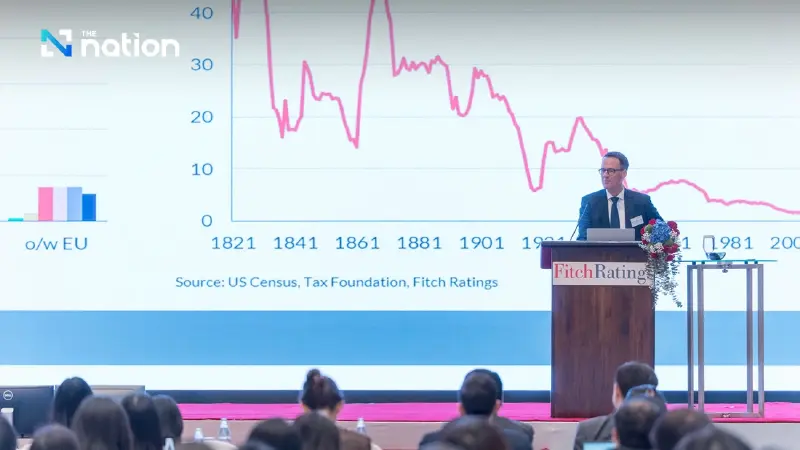
Thailand is grappling with intensified economic challenges stemming from slower global growth, diminished fiscal capacity and ongoing political uncertainty, Fitch Ratings warned at its annual conference on Thailand held in Bangkok on Wednesday.
The event, which brought together senior economists and credit analysts, painted a sobering picture of the kingdom's economic trajectory as public debt continues to climb and external headwinds mount.
Reform or Risk Decline
Opening the conference, Dr Kobsak Pootrakool, director and senior executive vice president at Bangkok Bank, emphasised that Thailand stands at a critical juncture.
He noted that whilst foreign direct investment is flowing into the ASEAN region, Thailand must act swiftly to capitalise on this opportunity.
"Thailand is at a distinctive crossroads that needs reform and takes action now or never," Dr Kobsak said, adding that the country should leverage its existing infrastructure whilst accelerating development in education and SMEs.
He stressed the importance of human capital investment to integrate Thailand into global supply chains and transition into the new global economy era.
Debt Trajectory Raises Concerns
Thomas Rookmaaker, senior director for Asia-Pacific sovereigns at Fitch Ratings Hong Kong, outlined the global risks facing Asian economies.
He noted that Fitch expects world growth to decelerate to 2.4 per cent in 2025, down from 2.9 per cent last year, amid evidence of a US economic slowdown.
"Greater clarity has emerged on US tariff policy, which points to headwinds for most of Asia, where exports are a key growth engine," Rookmaaker said.
Thailand has been particularly hard hit. The Covid-19 pandemic drove the country's general government debt ratio from approximately 35 per cent to 60 per cent currently, with projections showing it will stabilise around 65 per cent over the next few years – though considerable uncertainty surrounds this forecast.
"Thailand has been hit quite hard by the Covid pandemic, harder than other sovereigns in the region," Rookmaaker explained. "We're looking at the outlook for growth and the outlook for fiscal policy to get more clarity on that."
Negative Outlook Reflects Fiscal Risks
Fitch recently revised its outlook on Thailand's 'BBB+' rating to negative from stable, reflecting rising risks to public finances from prolonged policy uncertainty combined with slowing global demand, delayed tourism recovery and household deleveraging.
The deterioration centres on uncertainty surrounding the medium-term debt-to-GDP ratio trajectory. Key concerns include headwinds from the external environment, a lagging tourism recovery and household deleveraging, which collectively imply lower growth prospects.
Political uncertainty has further complicated fiscal policy planning, leaving questions about whether deficits will narrow or continue to widen.
However, Rookmaaker noted that a return to a stable outlook remains possible if confidence improves in the general government debt trajectory over the medium term.

Banking Sector Under Pressure
The conference also addressed challenges facing Thailand's banking sector. Parson Singha, senior director for financial institutions at Fitch Ratings Thailand, noted that sector earnings and asset quality are deteriorating, with impaired loans rising particularly amongst SME clients.
Fitch expects bank performance to remain challenging in 2026 due to the weak economic environment, low loan growth and declining interest margins.
Nevertheless, key loss absorption buffers, including loan loss allowance coverage and core capital, remain sound compared with regional peers.
Relative Strengths Remain
Despite the challenges, Thailand retains several credit strengths. The country's external finances are stronger than regional peers, with Thailand maintaining its position as a net external creditor with substantial foreign exchange reserve buffers.
"Thailand also manages to finance its increasing government debt at relatively low costs, which supports the debt dynamics to some extent," Rookmaaker said.
He added that the composition of Thailand's debt is favourable, with foreign currency debt representing a very small share, providing resilience against currency movements.
Interest payments as a percentage of government revenues also remain lower than peer countries.
Vincent Milton, managing director of Fitch Ratings Thailand, concluded that whilst Thailand possesses inherent strengths, the country now faces disruption causing economic slowdown.
He emphasised that Thailand needs long-term foreign investment for sustained growth, coupled with efficient governance and fiscal discipline, to avoid losing ground in the race to attract FDI in the region.
