
Household debt climbs to 86.7% of GDP, exposing deeper economic fragility
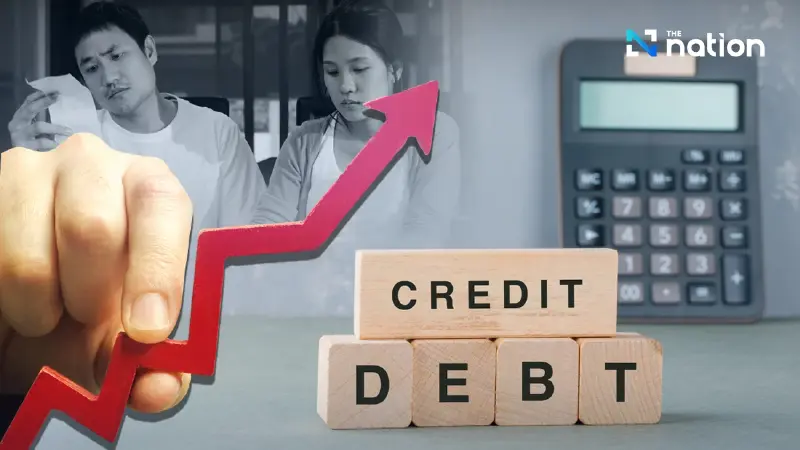


Thailand’s household debt rises to 86.7% of GDP in the fourth quarter as consumer borrowing grows and income-generating loans lose momentum
Thailand’s household debt climbed to 16.44 trillion baht in the fourth quarter of 2025, pushing the debt-to-GDP ratio up to 86.7% and reinforcing concerns that financial fragility in the household sector remains a serious drag on the broader economy.
The latest data released by the Bank of Thailand show total household debt stood at 16,443,669 million baht at the end of the fourth quarter, up from 16,329,846 million baht in the third quarter, an increase of 113,823 million baht.
On the surface, the increase was relatively modest and did not point to an acceleration in headline borrowing. But a closer look at the structure of that debt suggests the underlying picture remains troubling, particularly as the economy continues to recover only unevenly, while uncertainty and high living costs continue to weigh on households.

The central concern is that the composition of borrowing is becoming more fragile. More households appear to be relying on debt for consumption and day-to-day liquidity, rather than for investment or income generation. That shift is increasingly seen as a sign of persistent income pressure and limited financial resilience.
In terms of the headline ratio, household debt accounted for 86.7% of GDP in the fourth quarter, up from 86.4% in the previous quarter. On a seasonally adjusted basis, however, the ratio edged down slightly to 86.3% from 86.6% in the third quarter. Even so, the data still point to a household sector under sustained strain.
Commercial banks remained the largest source of household debt, with outstanding loans totalling 6,087,986 million baht, up only marginally from 6,086,476 million baht. The muted growth reflects tighter lending standards by banks, slower new borrowing and greater caution on both the lender and borrower sides.
By contrast, debt owed to specialised financial institutions rose to 4,550,212 million baht from 4,517,599 million baht, an increase of around 32.6 billion baht. State-backed lenders continue to play an important role in providing liquidity for lower-income groups and supporting economic activity through policy-driven lending.
More striking, however, was the rise in debt outside the core banking system.
Debt held through savings cooperatives rose sharply to 2,534,882 million baht from 2,486,042 million baht, an increase of nearly 48.8 billion baht. This was one of the most notable increases among all lender groups and suggests that more borrowers are turning to more accessible, flexible sources of credit as access to mainstream bank loans becomes harder.
Debt at other financial institutions also climbed to 2,438,225 million baht from 2,408,761 million baht, an increase of about 29.5 billion baht. This category reflects the widening role of non-bank channels in meeting household financing needs.
Within that group, debt from credit card companies, leasing operators and personal loan providers rose to 1,953,096 million baht, from 1,927,831 million baht, an increase of 25.3 billion baht. The trend points to growing dependence on short-term borrowing, linked both to everyday spending and to household efforts to cope with slowing income growth and persistent cost-of-living pressure.
Pawnshop debt also moved higher, rising to 121,339 million baht from 116,123 million baht, an increase of 5.2 billion baht. That was seen as another important sign of tightening liquidity, with some households turning to emergency short-term funding when income falls short of expenses or when formal credit is out of reach.
The debt picture was different in some other areas. Borrowing tied to securities firms declined slightly, reflecting reduced leverage in the capital market as investors became more cautious. Debt linked to asset management companies also fell, which may indicate a slowdown in debt transfers or restructuring, or a period in which financial institutions are leaning more heavily on debt relief and restructuring measures rather than selling distressed assets.
A deeper breakdown by borrowing purpose reveals an even clearer pattern of financial stress.
Of the 16.44 trillion baht in total household debt, the largest portion was personal consumption debt, which stood at 12.72 trillion baht and rose by more than 100 billion baht from the previous quarter. This suggests households are still relying heavily on credit to finance daily living expenses.
Debt for property purchases rose only slightly to 5.73 trillion baht. The modest increase was in line with the prolonged weakness in the property market, where many buyers are delaying home purchases amid tighter credit conditions and heightened economic uncertainty.
Debt linked to car and motorcycle purchases fell to 1.31 trillion baht from the previous quarter, reflecting the ongoing slowdown in vehicle lending and the broader contraction in some areas of consumer credit. Education loans also slipped slightly to 668,887 million baht and remained a relatively small share of total household debt.
Meanwhile, other personal consumption debt climbed to 5.01 trillion baht. Regulated credit card and personal loan debt also increased to 1.39 trillion baht, reinforcing the view that households are leaning more on short-term borrowing to manage spending pressures.
That contrasts with debt used for occupational or income-generating purposes, which fell slightly to around 2.90 trillion baht. Other categories of debt stood at 824,496 million baht, up slightly from the previous quarter.
Taken together, the figures paint a picture of an economy in which debt is still growing, but in ways that raise fresh concern about household vulnerability.
The issue is no longer only the size of the debt burden. It is also the direction of borrowing. As debt for consumption continues to rise while borrowing for income generation loses momentum, the data suggest many households are under greater financial pressure and have less room to absorb further shocks.
The rise in borrowing through cooperatives, leasing companies, personal loan providers and pawnshops adds to that concern. It indicates that some households may be finding traditional credit harder to access and are increasingly turning to near-home or short-term borrowing channels to manage cash flow in an environment of high living costs and still-fragile incomes.
For policymakers, the latest figures are another reminder that even if the headline growth in debt appears gradual, the structure beneath it remains a source of concern for both household stability and Thailand’s wider economic outlook.
