
Middle East war drives Thai diesel price to new historic high
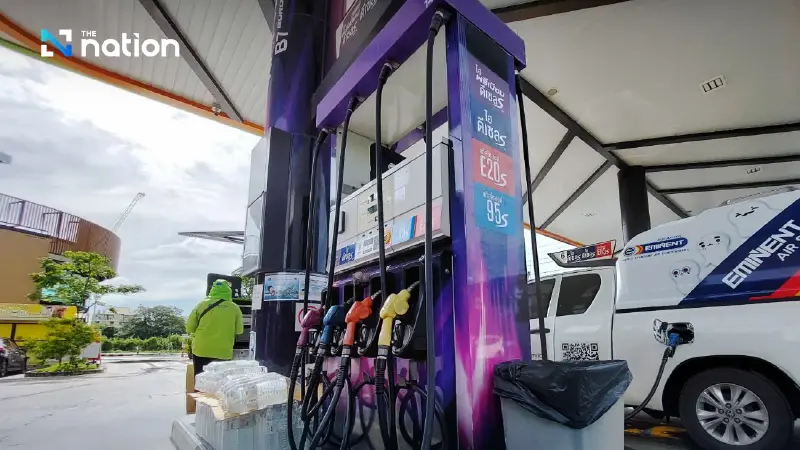


Eight diesel rises have taken Thailand’s pump price to a record 50.54 baht a litre, as subsidy cuts deepen pressure on the debt-laden Oil Fuel Fund.
- The war in the Middle East, which began on February 28, 2026, has caused a surge in global oil prices, directly leading to continuously climbing retail fuel prices in Thailand.
- Following eight price adjustments since the conflict started, diesel in Thailand reached a new historic high of 50.54 baht per litre on April 5, 2026.
- The sharp increase was exacerbated by the Thai government's decision to reduce diesel subsidies from the heavily indebted Oil Fuel Fund to better reflect actual market costs.
- The record-high diesel price is having a significant economic impact, with estimates indicating that every 1-baht increase cuts the country's GDP by 0.02%.
The war in the Middle East has now dragged on for more than a month since February 28, 2026, when the United States and Israel attacked Iran.
Although US President Donald Trump has said the conflict is nearing an end, Washington still plans to strike Iran at what he described as the most extreme level.
Oil prices have risen and remained high following the closure of the Strait of Hormuz and attacks on energy infrastructure in several Middle Eastern countries, causing retail oil prices in Thailand to climb continuously.
Petrol prices began rising on March 10, 2026, and were adjusted eight times through April 3, 2026, pushing Gasohol 91 and Gasohol 95 up by a total of 13.40 baht per litre.
Diesel prices, meanwhile, began rising on March 18, 2026, later than petrol under the policy of Prime Minister Anutin Charnvirakul, who wanted diesel prices frozen for at least 15 days after the war began.
This was despite the Energy Ministry proposing a diesel price increase from the early stage of the conflict.
By April 5, 2026, diesel had been adjusted eight times, rising by a total of 20.41 baht to 50.54 baht per litre, the highest level on record.
For the latest oil price adjustment on April 5, 2026, the Fuel Fund Management Committee resolved to reduce compensation for diesel B7 by 2.61 baht per litre, from 20.71 baht per litre to 18.10 baht per litre, and to cut compensation for diesel B20 by 2.61 baht per litre, from 22.22 baht per litre to 19.61 baht per litre.

A key factor behind the decision was continued volatility in global oil prices, which remains at crisis levels.
Cutting subsidies and allowing retail prices to reflect actual costs more closely has therefore become necessary to restore long-term balance to the Oil Fuel Fund.
The latest reduction in compensation will lower the fund’s spending by about 212.03 million baht a day, from around 1,708.75 million baht a day to about 1,496.72 million baht a day.
The Oil Fuel Fund is now carrying debt of more than 50 billion baht.
A source at the Energy Ministry said Thailand’s diesel pricing uses the Singapore market as its benchmark, as it is the region’s key reference market.
Domestic retail oil price adjustments are considered on the basis of refined oil prices in Singapore, together with the status and capacity of the Oil Fuel Fund.
The government is also facing the impact of rising oil prices, prompting Ekniti Nitithanprapas, Deputy Prime Minister and Finance Minister, in his capacity as chair of the committee reviewing fuel cost structures and pricing, to summon operators from all six oil refineries to report on the situation on April 3, 2026.

Pressuring six refineries to share profits is not easy
The meeting lasted four hours and focused on discussions with Thailand’s six oil refineries on drawing excess refinery profits into the Oil Fuel Fund to be used as an urgent mechanism to reduce pump prices, in line with the approach previously adopted under the Cabinet resolution of June 21, 2022.
The six refineries are three in the PTT Group, IRPC, GC and Thaioil, two in the Bangchak Group, BCP and BSRC, and SPRC.
Ekniti said the conflict in the Middle East had raised crude oil import costs through a war-risk premium, an additional charge imposed by sellers or an extra cost involved in moving crude tankers out of high-risk areas.
This cost is not included in the normal calculation formula.
Compared with the average refining margin over the past five years, with March 2026 standing at 7.30 baht per litre, current margins still show refinery profits significantly above normal levels.
To ease the burden on the public without waiting for the process of passing new laws, which may not keep pace with events, the committee therefore believes the Energy Ministry should urgently negotiate with refineries and seek cooperation for special excess profits earned during this crisis to be remitted to the Oil Fuel Fund and passed on immediately to the public as a retail price discount.
The Cabinet resolution of June 21, 2022, required refiners to help lower oil prices by channelling part of their profits into the Oil Fuel Fund, following the impact of the Russia-Ukraine war.
Korn Chatikavanij, deputy leader of the Democrat Party, commented on the approach taken by Prime Minister Anutin’s government, saying that in 2022 refiners had agreed to contribute a total of 24 billion baht, or 8 billion baht a month for three months.
In the end, however, only a few hundred million baht was actually paid by some companies, and the issue then faded away without any correction to the flawed price structure.
Reports said that in 2022, only refineries in the PTT Group agreed to share profits with the Oil Fuel Fund, as subsidiaries of a state enterprise.
A 1-baht diesel rise cuts GDP by 0.02%
The government is also facing the broader economic impact of higher oil prices.
Earlier, Danucha Pichayanan, secretary-general of the National Economic and Social Development Council, outlined impact scenarios arising from the war.
The National Economic and Social Development Council estimates that every 1-baht increase in diesel prices cuts GDP by about 0.02%, with three sectors directly affected and requiring priority assistance: agriculture, manufacturing and transport.
Kriengkrai Thiennukul, chairman of the Federation of Thai Industries, said higher diesel prices would feed through into raw material costs and goods prices, causing overall prices to trend higher, especially in April 2026, as old stock is gradually depleted and operators begin bearing the full new cost.
Tight fiscal position constrains oil tax cuts
The government is also dealing with limited fiscal room, leading the Finance Ministry to argue during the war-driven oil price surge that diesel excise cuts should be considered only as a last resort.
It said using the Oil Fuel Fund as the main instrument for managing fuel prices would be more flexible.
A source at the Finance Ministry said that if oil prices rose by 3 baht, the Oil Fuel Fund could immediately step in to absorb an extra 3 baht in subsidies, preventing any change in retail prices for the public.
“Using the Oil Fuel Fund mechanism allows the additional price burden to be absorbed immediately, unlike the tax mechanism, which involves multiple steps,” the source said.
Under the Oil Fuel Fund mechanism, money is collected from users of all fuel types at different rates and used to subsidise prices when world market prices rise.
This allows retail prices to adjust more gradually, softening the impact of sharp increases.
Ultimately, however, oil users themselves still bear the higher price burden, unlike a tax cut, where the government bears the cost.
Guaranteeing Oil Fund borrowing shifts the burden back to the public
The Finance Ministry is also ready to guarantee loans for the Oil Fuel Fund, which has proposed borrowing of as much as 150 billion baht under a state guarantee.
Such a guarantee would lift the public debt-to-GDP ratio and leave Thailand with fiscal space of only 300 billion baht.
This would come as Thailand’s higher public debt level is compounded by economic growth running below target because the Middle East war is hurting the global economy, while Thailand’s trading partners are also being hit, dragging down GDP.
At the same time, if Thailand is forced to cut revenue collection from oil taxes, the combined pressure could raise the risk of a sovereign credit downgrade by the three major rating agencies, S&P Global Ratings, Moody’s Investors Service and Fitch Ratings.
After 2025, both Moody’s and Fitch revised Thailand’s credit outlook to negative from stable.
If Thailand continues to add debt while revenue collection falls materially short of the target, the risk would increase.
