
Boonsithi urges mega-infrastructure push as Thai economy loses its engine
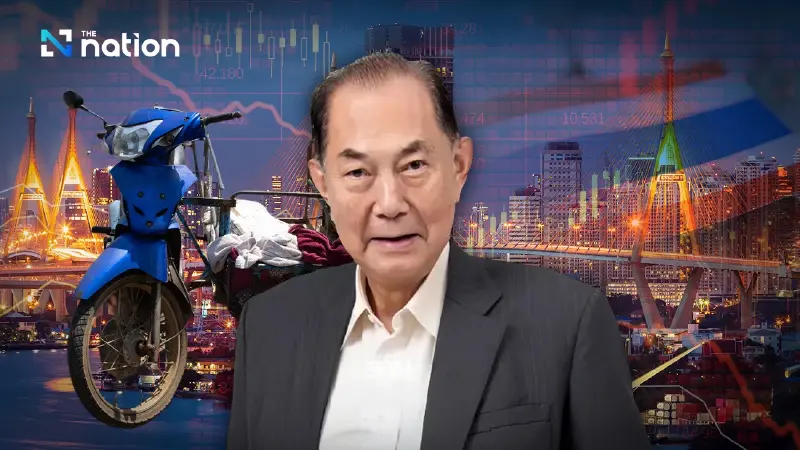


Saha Group chairman Boonsithi Chokwatana says Thailand must accelerate infrastructure investment to revive purchasing power and competitiveness
Boonsithi Chokwatana, chairman of Saha Group, has urged the government to accelerate major infrastructure investment, warning that Thailand’s economy has lost momentum and needs stronger long-term engines to restore confidence, purchasing power and competitiveness.
Speaking after a press conference for the 30th Saha Group Fair, Boonsithi said the Thai economy in 2026 was still under pressure from the global slowdown, trade tensions and fragile domestic purchasing power. The event will be held from June 25-28 at Bitec Bangna.
Boonsithi compared the economy to a vehicle that had lost power, saying it had weakened from last year’s “motorised tricycle” into a “saleng”, or pedal cart, that required everyone to help push it forward.
“Last year, the three-wheeled vehicle still had an engine. This year, we have gone back to using a saleng. The government must help pedal,” he said.
Boonsithi gave the government more than 60%, or around six out of 10, for its economic performance, but said the business sector wanted to see stronger action to stimulate the economy through investment rather than temporary measures.
He said short-term spending schemes such as “Thais Help Thais Plus” could help support purchasing power for a limited period, but their impact would fade once the measures ended.
By contrast, investment in major infrastructure could create jobs, strengthen economic activity and generate returns for the country over the next 5-20 years.
Government scored six out of 10
“The government should not look only at today. It must look five or 10 years ahead and ask what it will do for the country,” he said.
Boonsithi pointed to Suvarnabhumi Airport and the expressway network as examples of infrastructure investments that helped support Thailand’s later economic growth. Without those projects, he said, the country may not have been able to handle the expansion seen today.
He said new large-scale projects, including high-speed rail, logistics systems and other infrastructure, should continue under strong governance and transparency.
On the proposed land bridge project, Boonsithi said Thailand should think on a larger scale and improve transport links between the Eastern region and the South to strengthen the country’s long-term logistics potential.
Saha Group expects slower growth
Boonsithi said Saha Group’s overall business growth this year could be weaker than last year because of the global slowdown.
Some businesses, especially food, were still expanding well, but the fashion segment continued to face pressure from weak purchasing power.
However, the group’s diversified business portfolio had helped balance revenue, even as some sectors were more affected than others.
Chinese investment still interested in Thailand
On foreign investment, Boonsithi said Chinese investors remained interested in Thailand, but investment decisions took time because they often involved large-scale projects. Several projects were still under negotiation and feasibility study.
“In the past, Japanese investors might buy 10-20 rai of land. When Chinese investors come in, they often look at 100-300 rai,” he said.
Boonsithi said Thailand could still attract foreign investment in the long term if it maintained competitiveness, pushed ahead with infrastructure investment and built policy confidence, amid intensifying competition across Southeast Asia.
