
Thai Agriculture Faces Existential Threat Over Fertiliser Import Trap
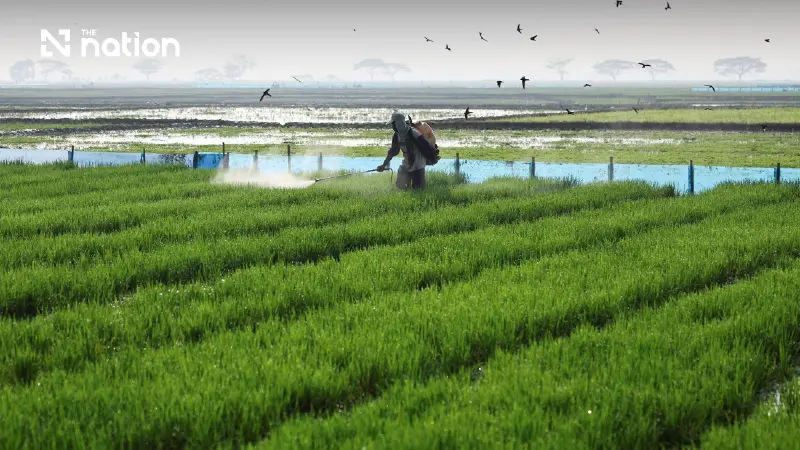


Industry leaders and officials at a Post Today roundtable urge structural reforms as a 100% reliance on imported fertiliser threatens farming margins
- Thailand's agricultural sector is 100% reliant on imported fertilisers, leaving its 16 million farmers dangerously exposed to global price volatility and geopolitical shocks like the recent crisis in the Strait of Hormuz.
- This total import dependency has caused fertiliser prices to nearly double, severely squeezing farmers' profit margins as fertiliser accounts for almost 40% of their total operational costs.
- Experts argue that past government interventions, such as price caps and limited subsidy schemes, have been ineffective and that deep structural reforms are urgently needed to address the crisis.
- Proposed long-term solutions include a coordinated shift toward organic fertilisers, modernizing the outdated 1975 Fertilizer Act, and developing more secure, regional supply sources to break the import dependency.
Industry leaders and officials at a Post Today roundtable urge structural reforms as a 100% reliance on imported fertiliser threatens farming margins.
Thailand's total dependence on imported fertiliser has left its 16 million farmers dangerously exposed to global geopolitical shocks, according to industry leaders, state officials, and academics who gathered for a Post Today roundtable on Tuesday.
The panel discussion, titled "Hormuz Shock: World Fertiliser Crisis, Survival for Thai Agriculture", concluded that while the immediate supply chain crunch triggered by recent tensions in the Strait of Hormuz has begun to ease, the episode has exposed critical structural vulnerabilities that demand urgent, systemic reform.
A Sector Entirely Reliant on Imports
Ratsachai Rianphanit, a committee member of the Thai Fertilizer and Agricultural Supplies Association, revealed that the kingdom imports 100 per cent of its nitrogen, phosphate, and potassium fertilisers.
This total reliance leaves the domestic agricultural sector acutely vulnerable whenever global production, exports, or logistics networks face disruption.
During the peak of the recent crisis, Saudi Arabia—one of the world's primary producers of phosphate—was unable to export through the critical Strait of Hormuz checkpoint, severely restricting phosphate supplies. Concurrently, other essential fertiliser components suffered from soaring production and shipping costs.
Ratsachai argued that historical state interventions have been heavily reactive, typically limited to ad-hoc supply negotiations during shortages or imposing price caps after wholesale costs have already spiked.

Such measures, he cautioned, are no longer fit for purpose in a global market shaped by escalating climate change and geopolitical volatility. Instead of managing state-run funds or engaging in direct government trading, he urged the state to pivot toward a purely regulatory role that actively fosters free market competition.
Delayed Relief and Squeezed Margins
Although global benchmark prices have recently begun to soften, relief for growers at the cash register has been remarkably slow to arrive.
Smithi Wongpaitoon, an executive director at AG (Thailand) Co, noted that sugarcane farmers have been among the hardest hit by a sharp surge in urea prices over the past two to three months.

The 46-0-0 urea formula, which is the most widely utilised blend in Thai agriculture, jumped from approximately 800 baht to between 1,200 and 1,400 baht per 50 kg bag—representing a near 100 per cent increase.
Because fertiliser alone accounts for nearly 40 per cent of total operational farming costs, the spike has severely eroded growers' margins.
Smithi explained that retailers are currently holding inventory purchased at peak market rates, meaning retail shelf prices will lag behind global declines by at least one to two months while old stock is cleared.
Dr Decharut Sukkumnoed, director of the Think Forward Center, provided a grim macroeconomic view of this pricing lag. He stated that while fertiliser costs have risen by 40 to 50 per cent across the board, the net income for rice farmers is expected to drop by more than 15 per cent as a direct consequence.

Volatility Across the Agricultural Chain
The financial pressure on Thai farmers extends well beyond the fertiliser bag. Pharm. Nop Hawaree, chief innovation officer at Green Inno Thai Co, pointed out that escalating fuel costs are simultaneously driving up the expense of pumping water onto fields.
Furthermore, economic pressures continue to fuel the environmentally damaging practice of burning rice straw, as high haulage and transport expenses make selling the straw commercially unviable for individual farmers.
Drawing on the late King Bhumibol Adulyadej’s agricultural philosophy, Nop emphasised that sustainable farming relies on three core pillars: optimal plant varieties, healthy soil, and reliable water management.
However, with more than 70 million rai of Thai farmland remaining entirely dependent on chemical fertiliser formulas, volatility in input prices inevitably ripples through the entire agricultural economy and its connected commercial sectors.
Panellists acknowledged that emergency policy measures have yielded a very limited impact.

Dr Decharut criticised current government interventions, such as the "Blue Flag" fertiliser programme (also operating as the "Green Flag Plus" initiative), as being far too small in scale.
He noted that the subsidy covers only about 1 per cent of the total domestic demand, leaving the remaining 99 per cent of the farming sector completely exposed.
To establish a more resilient buffer during global crises, Dr Decharut advocated for the creation of a strategic national fertiliser stock mechanism, operating similarly to how the country manages its national oil reserves.

Breaking the Chemical Dependence
Suchol Kaewkohsaba, deputy director-general of the Department of Land Development, called for a coordinated shift toward organic fertilisers to reduce chemical input dependence and insulate the nation from future geopolitical shocks.
He described the Strait of Hormuz disruption as a clear structural warning sign.
"This situation is a lesson about chemical fertiliser," Suchol stated. "We have relied mainly on just two or three types. If we keep depending solely on chemical fertiliser, we may eventually hit a dead end."
While acknowledging that his department’s budget remains modest relative to the scale of the crisis, Suchol explained that natural soil contains between 14 and 17 essential nutrients.
By contrast, farmers typically replenish only three through standard chemical application, leaving the remaining minerals depleted and progressively degrading long-term soil quality.
To rectify this, he advocated for localised organic fertilisers developed via precise soil testing. While practical for smallholders, large-scale commercial operators have been slower to abandon chemical options due to their immediate convenience and perceived cost-effectiveness.
Suchol also singled out the outdated 1975 Fertilizer Act as a major regulatory barrier, arguing it must be revised to make it easier for the private sector to license alternative bio-based technologies. He added that while a proposed national fertiliser fund is a sound concept in principle, current statutory restrictions leave little room to implement it.

The Productivity Gap and Regional Pipelines
Phinij Jarusombat, chairman of the Thai-Chinese Cultural Council and a former government minister, asserted that genuine self-reliance is Thailand’s most robust defence against external macroeconomic shocks.
He noted that if the country manages its domestic resources efficiently, it will have far less to fear from international maritime bottlenecks.
Phinij expressed deep concern regarding Thailand’s lagging crop yields compared to international competitors. China currently produces up to 2,000kg of rice per rai, whereas Thailand averages just 640kg.
Similarly, in sugar production, Thailand yields 11 to 12 tonnes per rai, trailing behind Brazil's 16 tonnes and Australia's 15 tonnes. Without aggressive productivity enhancements, Thai farmers risk remaining permanently trapped in cycles of debt.

Describing fertiliser as an absolute "key to success", Phinij shared his own success in pioneering a hybrid organic-chemical blend that combines sugar mill by-products with cow and chicken manure and urea—a method that lowers input costs while successfully rehabilitating soil composition.
Looking at regional market dynamics, he observed that the rapid expansion of durian cultivation across Thailand, Vietnam, and Malaysia is now functioning as a major driver of Southeast Asian fertiliser demand.
On a macro level, global potash supply lines are shifting closer to home, with massive reserves currently being developed in neighbouring Laos by Chinese investors. This could provide Thailand with a highly accessible land-based source, reducing reliance on distant suppliers in Canada or the Middle East.

A Mandate for Structural Reform
The over-arching consensus from the roundtable was clear: short-term state subsidies and reactive price controls are no longer sufficient to safeguard Thai food security.
Whether through modernising the decades-old Fertilizer Act, developing regional potash reserves, scaling up organic adoption, or restructuring national regulatory frameworks, the panel agreed that Thailand requires a cohesive, long-term strategy to untangle itself from its total import dependency.
The roundtable concluded with a formal commitment to turn these industry insights into a comprehensive White Paper for senior policymakers. Taking immediate legislative action, Dr Decharut pledged to take the lead in Parliament to actively push for a revision of the Fertilizer Act.
The participants warned that the harsh lessons of the "Hormuz Shock" must not be allowed to fade once retail prices temporarily stabilise. The ultimate consensus was absolute: Thailand cannot afford to wait for the next global shock. If the state can successfully secure its baseline fertiliser foundations, Thailand's structural role as the "kitchen of the world" will remain resilient for generations to come.
