
Suriya withdraws 6.5bn-baht biofertiliser plan after SAO warning
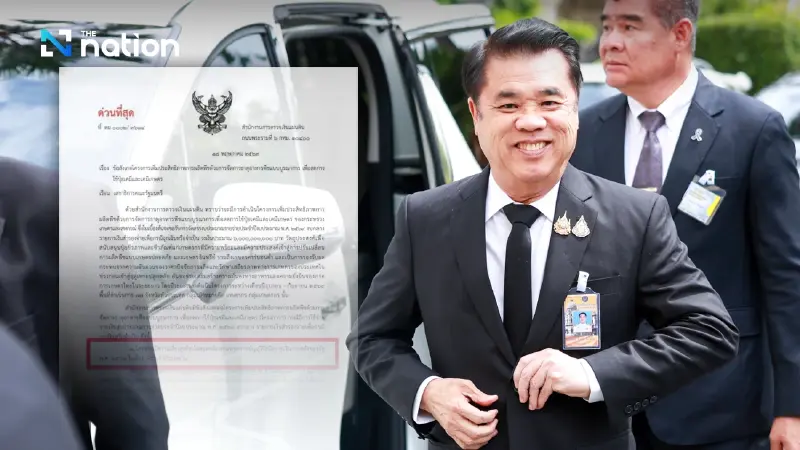


Agriculture Minister Suriya Jungrungreangkit pulls a 6.5bn-baht central budget request after audit concerns over urgency and risks.
Agriculture and Cooperatives Minister Suriya Jungrungreangkit said on Tuesday that he had withdrawn a proposal seeking 6.5 billion baht from the central budget for a biofertiliser and biological products project intended to replace chemical fertilisers amid shortages caused by the Middle East conflict.
Suriya said the Department of Agriculture had proposed that the ministry submit the project to the Cabinet. However, on Monday (May 18), the Governor of the State Audit Office (SAO) notified the permanent secretary of the Agriculture and Cooperatives Ministry that the project might not meet the criteria for special urgency required to use the central budget.
For the sake of prudence, Suriya said he had asked for the proposal to be withdrawn from the Cabinet first, so that all issues could be reviewed properly before deciding how to proceed.
Asked whether another project would be considered if central budget funding was not approved, Suriya said he would first review the SAO’s observations carefully before considering the next direction.

Reports said the SAO’s recommendation to the Cabinet raised four major risks over the use of the central budget for the project.
1. Risk of breaching fiscal discipline law
The project may not comply with Section 20(6) of the State Fiscal and Financial Discipline Act 2018.
Although the Agriculture Ministry cited the Middle East war and its impact on chemical fertiliser imports as the reason for the proposal, the SAO found that the project would not fully solve the chemical fertiliser problem.
It also noted that several agencies, including the Department of Agriculture, the Department of Agricultural Extension and the Land Development Department, already carry out annual projects involving biofertiliser distribution, tailor-made fertiliser training and ploughing in crop residues.
The SAO therefore saw no urgent necessity to draw on the central budget. Instead, the project should be planned through the normal budget process.
2. Risk of inefficient budget use
The project has a very short implementation period of only four months, from June to September 2026, despite involving many activities, including training, demonstration plots, procurement, production and distribution.
The SAO noted that biofertilisers have a short shelf life and normally need to be produced on a made-to-order basis to maintain the effectiveness of their microorganisms.
Rushing to produce a massive quantity could reduce fertiliser quality. If distribution does not match the crop cycles of all 10 target crops, the fertiliser could deteriorate, farmers would not benefit, and state funds would be wasted.
3. Risk of missing targets and unfair budget distribution
Changing farmers’ behaviour from chemical to organic inputs requires a long period of cultivation and adjustment. A four-month implementation period is therefore unlikely to achieve real success.
In addition, the target group, selected only from farmers considered ready, risks overlapping with groups that have already benefited from regular projects.
This could create unfairness in the distribution of state funds to other farmers who are also facing difficulties.
4. Risk of spec-rigging, favouring big players and undermining fair competition
The accelerated procurement of massive quantities of biofertilisers and biological products that must meet Department of Agriculture standards within only four months could mean that only a few operators in the country have enough production capacity to supply the project.
This creates a high risk of market monopoly or bid collusion, which could ultimately prevent the government from securing the most economical and cost-effective prices.
