
Middle East Conflict Sends Fertiliser Costs Soaring for Asia's Rice Farmers
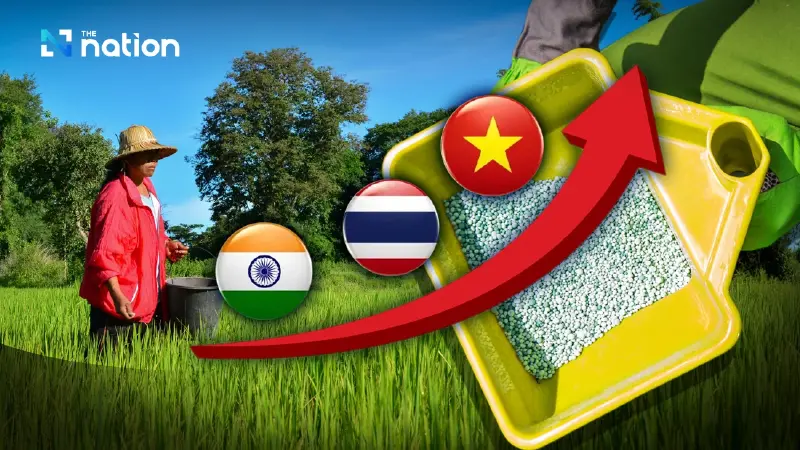


Surging urea prices driven by Hormuz Strait disruptions are squeezing rice farmers across Asia, threatening to cut yields and deepen food insecurity across the region
- Conflict in the Middle East has disrupted the Strait of Hormuz, a vital shipping route for over a third of global urea exports, causing fertilizer prices to more than double to a multi-year high.
- The price surge is forcing rice farmers across South and Southeast Asia to cut back on fertilizer use during the critical planting season, which threatens to reduce crop yields.
- This situation poses a risk to regional food security, with nations like the Philippines warning of a potential 20-50% drop in rice output and major exporter India facing pressure that could lead to export restrictions.
Surging urea prices driven by Hormuz Strait disruptions are squeezing rice farmers across Asia, threatening to cut yields and deepen food insecurity across the region.
Rice farmers across South and Southeast Asia are facing a sharp deterioration in their finances as escalating conflict in the Middle East drives fertiliser prices to multi-year highs, forcing many to cut back on inputs at precisely the moment they need them most.
With the critical May-to-August planting season now under way, two separate analyses from leading regional institutions warn that the stakes for food supplies could scarcely be higher.
According to World Bank data, the benchmark price for urea — the most widely used nitrogen fertiliser — surged to 857 dollars per metric tonne in April, shattering a four-year high of 726 dollars recorded in March and more than doubling the price seen at the same point last year.
The bank forecasts that overall fertiliser prices will rise 31 per cent in 2026 compared with 2025, with urea potentially climbing by as much as 60 per cent over the same period.
The immediate trigger is the effective closure of the Strait of Hormuz, through which roughly a quarter of global seaborne oil trade and more than a third of world urea exports pass.
Gulf states including Qatar and Saudi Arabia together account for 30 to 35 per cent of global urea exports, producing the fertiliser from natural gas.
Multiple production facilities in the region have sustained damage from Iranian strikes, while shipping disruptions have compounded supply constraints and pushed freight and insurance costs sharply higher.
Farmers Already Revising Their Plans
A report by Nikkei Asia found that rice farmers across India, Vietnam and Thailand are already bracing for the full force of the fertiliser shock as the planting season begins.
In Thailand, Vietnam and parts of Indonesia, stagnant paddy prices combined with surging fertiliser and fuel costs are discouraging investment in inputs and, in some cases, planting itself.
The FAO's chief economist noted that farmers from Punjab to the Mekong Delta are already revising their planting plans, with overall production costs expected to rise by 50 to 80 per cent when fertiliser, fuel and transportation increases are combined.
Vietnam, the world's second-largest rice exporter, is scaling back production as energy costs erode profit margins. Thailand and Bangladesh are facing similar pressures. The Philippines has issued some of the starkest warnings, with the government cautioning that domestic rice output could fall by 20 to 50 per cent without intervention.
India, simultaneously the world's largest rice producer and exporter at roughly 150 million tonnes annually, faces particular exposure despite its size. The country imports approximately 40 per cent of its fertilisers from Gulf states, and although the government subsidises input prices for farmers, a prolonged Hormuz disruption could test the fiscal limits of that support.
India has previously restricted rice exports when domestic supply concerns arose — a move that would significantly tighten global markets if repeated, given that no other country has the capacity to compensate. Vietnam, Thailand and Pakistan are each capable of exporting only between five and eight million tonnes per year.

A Different Kind of Shock
In a separate analysis, Qingfeng Zhang, senior director of the Asian Development Bank's Agriculture, Food, Nature and Rural Development sector office, examined what the broader energy crisis means for fertilisers and food security across the region.
Zhang argued that the current situation represents a fundamentally different kind of threat compared with previous crises.
Unlike the Russian invasion of Ukraine, which directly disrupted grain and fertiliser exports, today's shock is being transmitted primarily through energy costs, shipping disruptions and higher input prices rather than through an outright reduction in global food supplies.
"Asia and the Pacific now faces a different kind of shock to food security," he wrote, describing it as a broad, system-wide disruption rippling through interconnected food, energy and fertiliser markets rather than an immediate spike in prices at the checkout.
The distinction matters considerably for how governments respond. Fertiliser is available — the challenge is affordability. Farmers across emerging markets cannot readily pass higher input costs on to consumers, leaving many with little choice but to reduce usage and accept lower yields.
Zhang cautioned that if high costs persist through the planting season, reduced fertiliser application this year may translate directly into lower yields at the next harvest, converting what is currently a cost shock into a production shock.
The ADB identified import-dependent nations — including Cambodia, Laos, Myanmar and Sri Lanka — as acutely vulnerable, while larger economies such as India, Indonesia, Pakistan, the Philippines and Vietnam face mounting fiscal pressures from fuel and fertiliser subsidies alongside rising domestic food prices.
A Race Against the Planting Calendar
The timing of the crisis lends particular urgency to the policy response. May to August is the key transplanting and sowing window for farmers across India, Vietnam and Thailand, ahead of the monsoon season that governs the most important phase of the rice growing cycle.
Long-grain indica and jasmine varieties, which together account for roughly 90 per cent of global rice trade, are especially dependent on this seasonal rhythm.
Zhang stressed that acting before the planting season is essential to prevent a cost shock from escalating into a production shock. He pointed to India's Minimum Support Price — announced ahead of sowing and backed by large-scale government procurement — as a model that has helped maintain planting stability even as input costs rise.
Coordinating fertiliser procurement, keeping trade routes open and providing targeted financial support to the most vulnerable importing nations were identified as the most pressing near-term priorities.
Over the longer term, the ADB called for structural reforms to reduce the vulnerabilities repeatedly exposed by such crises, including diversifying fertiliser supply chains, improving input efficiency on farms, and accelerating the transition towards regenerative agricultural practices that reduce dependence on imported chemicals.
The World Bank currently projects that global food prices will rise by around 2 per cent in 2026, and significant grain reserves built up before the current crisis offer some reassurance.
However, as both the Nikkei Asia report and the ADB analysis make clear, the longer the disruption at the Strait of Hormuz persists — particularly if it extends beyond June — the greater the risk that what began as a cost shock evolves into something considerably more damaging to regional and global food security.
