
AIS Launches Southeast Asia's First 5G-Advanced Network


Thailand's largest mobile operator unveils next-generation 5G capabilities powered by carrier aggregation and AI, setting a new regional benchmark ahead of the eventual shift to 6G
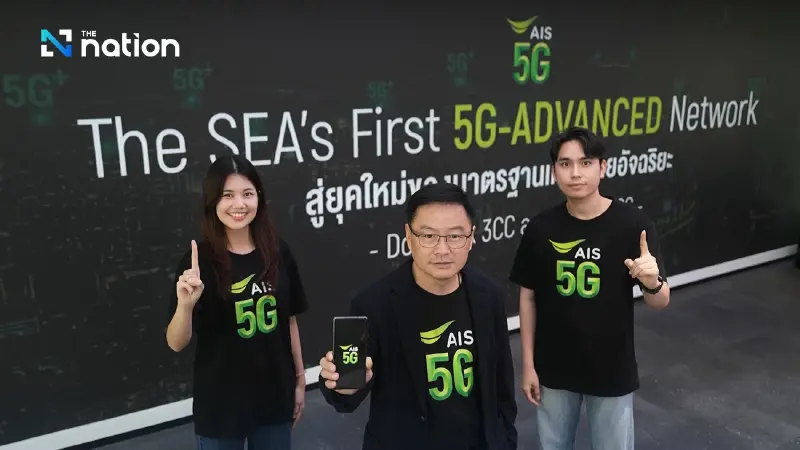
- Thailand's largest mobile operator, AIS, has launched Southeast Asia's first commercial 5G-Advanced network.
- The network uses Carrier Aggregation technology to deliver download speeds up to 1.5 times and upload speeds up to 2 times faster than standard 5G.
- It specifically enhances upload capacity to support the growing use of livestreaming and AI applications, with compatible devices displaying a "5G+" symbol.
- The upgrade also integrates AI for autonomous network management and is available to customers with compatible devices at no extra cost.
Thailand's largest mobile operator unveils next-generation 5G capabilities powered by carrier aggregation and AI, setting a new regional benchmark ahead of the eventual shift to 6G.
Advanced Info Service (AIS), Thailand's dominant mobile and digital infrastructure operator, has launched what it describes as Southeast Asia's first commercial 5G-Advanced network, elevating the country's connectivity standards to a new tier aligned with the 3GPP Release 18 global specification.
The announcement, made in Bangkok on Wednesday, centres on the deployment of Carrier Aggregation technology across both downlink and uplink channels — specifically Downlink 3CC (three-component carrier) and Uplink 2CC (two-component carrier).
By combining multiple frequency bands simultaneously, the technology is said to deliver download speeds up to 1.5 times faster and upload speeds up to twice as fast compared with standard 5G.
Devices connected to the enhanced network will display a "5G+" indicator on screen, distinguishing the service from conventional 5G connectivity.

Addressing the Upload Surge
A notable aspect of AIS's strategy is its focus on uplink performance — a shift driven by changing user behaviour. Wasit Wattanasap, head of Nationwide Operations and Support at AIS, pointed to the rapid growth of livestreaming and AI-assisted applications as key factors demanding greater upload capacity.
"Consumer behaviour has shifted toward high upload usage for livestreaming and interacting with AI," Wasit said at the launch event, noting that the trend, which originated strongly in the country's northeastern region, is now spreading to Bangkok, where even street traders regularly livestream whilst working.

To address what engineers describe as an "uplink bottleneck," AIS combines TDD (time-division duplex) frequency bands — which are naturally weighted toward downloads — with FDD (frequency-division duplex) bands such as 700 MHz and 2,100 MHz, which provide a more balanced upload-to-download ratio. This combination is what qualifies the network for the 5G-Advanced designation.
Uplink 2CC has already been deployed in Bangkok, the greater metropolitan region and the northeastern provinces, with nationwide coverage expected to be completed within the month. Downlink 3CC is currently live in the Sathon and Bang Rak districts of Bangkok, with broader expansion across the capital and its surrounding areas planned for later this year.

AI at the Core
Beyond raw speed improvements, AIS is integrating artificial intelligence into network management through what it calls an Autonomous Network architecture — a programme the company says it has been developing for six to seven years, with a target of reaching Level 4 autonomy, at which point AI handles the majority of network operations without human intervention.
The company is also applying AI to customer safety through its AIS Safe Connect service, which alerts users to suspicious incoming calls, and through a dedicated reporting channel for fraudulent numbers and SMS messages.

Device Compatibility and No Extra Cost
AIS confirmed that customers will not need to subscribe to new or upgraded packages to benefit from 5G-Advanced speeds, provided their devices are compatible. Most modern Android handsets already support the enhanced features and will display the 5G+ logo.
For iPhone users, AIS confirmed that 2CC downlink and uplink support has been available since the iOS 26.1 update in February, although the 5G+ logo and 3CC indicators may not yet appear on Apple devices.
Wasit acknowledged that bringing these capabilities to market requires close collaboration with chipset manufacturers, including Qualcomm and MediaTek, and handset brands – a process he described as taking close to a year of background testing and firmware alignment before features can be made available to consumers.

A Stepping Stone to 6G
AIS positioned the 5G-Advanced launch as an intermediate milestone on a longer trajectory towards sixth-generation networks.
Wasit noted that while 5G operates on frequency blocks of roughly 100 MHz, the eventual transition to 6G will require significantly larger, globally harmonised spectrum allocations — a debate already under way within the international standards community.
With a subscriber base of more than 46.8 million mobile users and a stated ambition to serve as Thailand's national digital infrastructure provider, AIS said it would continue expanding network capabilities across speed, stability, security and intelligence to support both consumers and the country's broader digital economy ambitions.
