
Price Hikes Hit Lunch Staples as Thai Workers Face Living Cost Crunch
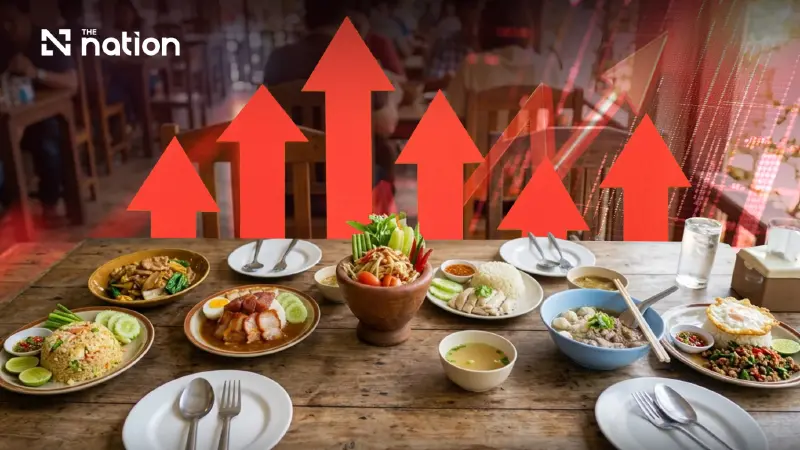


Thailand's TPSO warns of further retail food price rises as inflation and high energy costs force small restaurant operators to pass on expenses
- High energy and transport costs are forcing small food vendors in Thailand to raise prices on staple ready-to-eat meals like fried rice and noodles.
- The price hikes of 5-10 Baht per dish significantly impact urban workers, adding up to 600 Baht to their monthly expenses while wages remain stagnant.
- A government survey found that nearly 30% of staple dishes have increased in price, with officials warning that further hikes are likely as micro-vendors cannot absorb rising overheads.
Thailand's TPSO warns of further retail food price rises as inflation and high energy costs force small restaurant operators to pass on expenses.
Thailand’s urban workforce is facing an escalating squeeze on disposable income as the price of popular ready-to-eat meals climbs across the country, driven by stubborn energy costs and transport inflation.
A market survey conducted by the Trade Policy and Strategy Office (TPSO), under the Ministry of Commerce, revealed that prices have been adjusted upwards for 438 items across seven staple one-dish meals—including fried rice, noodles, and the ubiquitous Pad Kra Prow (basil stir-fry). The increases affect 28.53% of all surveyed items.
While menu prices have risen by a seemingly modest 5 to 10 baht per plate, the cumulative financial impact on consumers is substantial.
For urban workers relying on food stalls for two meals a day, a 5 baht increase adds roughly 300 baht to monthly outgoings, while a 10 baht hike burdens household budgets with an extra 600 baht per month. This burden is compounded by rising public transport fares and commuting costs.
The sharpest adjustments were found in the entry-level 40 and 50 baht price brackets. Many micro-vendors have introduced flat 10 baht increases—representing a sharp 20% to 25% price jump—affecting more than a tenth of the 1,535 items surveyed.
This trend deals a direct blow to salaried staff and low-income groups, whose wages remain flat while daily living costs escalate.
Inflationary Pressures Trickle Down
The widespread menu adjustments mirror official macroeconomic data. Thailand’s Consumer Price Index (CPI) rose by 2.42% year-on-year in June, marking the third consecutive month of expansion.
While core inflation has slowed marginally, persistent global fuel pressures linked to Middle East instability continue to feed through the supply chain. Within the food and non-alcoholic beverages sector, which grew by 1.03%, "ready-to-eat" items showed the most pronounced retail price spikes.
Restaurant operators are caught in a margins squeeze due to overheads spanning utilities, logistics, and raw ingredients. To avoid alienating cost-conscious customers, many small businesses are opting for phased 5 Baht increases rather than blanket hikes.
Furthermore, drops in wholesale prices for specific commodities—such as domestic pork, sticky rice, and select fresh vegetables—have failed to offset the rising cost of prepared food, as time-poor urban workers rely almost exclusively on ready-made meals.
Micro-Vendors Unable to Absorb Costs
Natiya Suchinda, deputy director-general of the TPSO, warned that retail food prices are likely to trend further upwards in the second half of the year.
"The majority of street food and one-dish stalls are micro-enterprises," Natiya explained. "Unlike mid-sized or large restaurant chains, these small vendors lack the purchasing power to secure bulk discounts on ingredients. When transport and fuel costs spike, they have no choice but to pass those expenses on to consumers. Once these retail prices adjust upwards, they rarely come back down."
While the Ministry of Commerce maintains its headline inflation forecast for the year at 1.5% to 2.5%, economists note that everyday food prices serve as a much more accurate barometer for consumer sentiment and real household purchasing power.
The TPSO downplayed concerns that the government's upcoming "Thai Help Thai Plus" economic stimulus package would exacerbate inflation, citing historical data from previous co-payment schemes which showed no significant correlation with structural price acceleration.
Nevertheless, protecting fragile household economies in a cooling retail environment remains a chief structural challenge for policymakers as purchasing power struggles to make a full recovery.
