
Japan Calls for ‘Level Playing Field’ to Protect Thailand's Automotive Hub in the AI Era
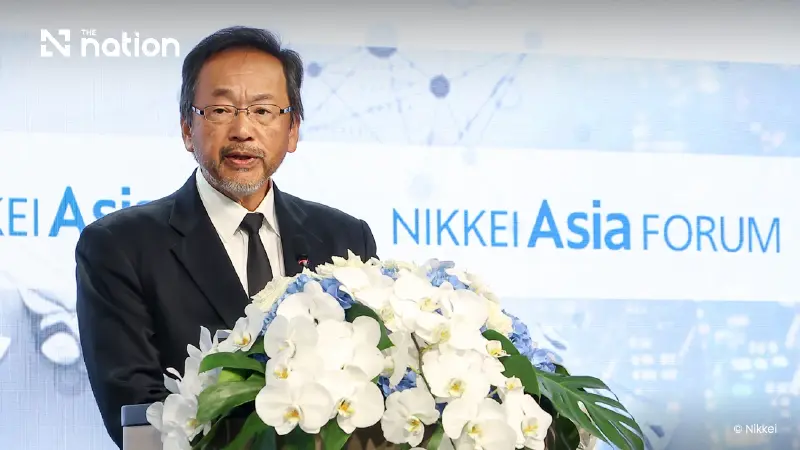


At the Nikkei Asia Forum, Japanese Ambassador Masato Otaka demands equal playing fields for auto manufacturing before detailing key energy stability pacts
- Japan's ambassador to Thailand, Masato Otaka, has called for a "level playing field" to protect the country's crucial automotive manufacturing sector.
- This appeal is a direct response to the disruption caused by artificial intelligence, which threatens Thailand's long-held status as a key automotive hub and export center.
- The ambassador warned that the rapid adoption of AI could create market distortions and other risks, making competitive fairness essential for balanced and continued industrial growth.
At the Nikkei Asia Forum, Japanese Ambassador Masato Otaka demands equal playing fields for auto manufacturing before detailing key energy stability pacts.
Japan’s top diplomat in Thailand has issued a strong appeal to safeguard the historical core of the bilateral economic relationship, calling for a strict "level playing field" as manufacturing faces unprecedented disruption from artificial intelligence.
Speaking at the inaugural Nikkei Asia Forum APAC 2026 in Bangkok on Thursday, Japanese Ambassador Masato Otaka focused the opening of his address directly on the automotive sector, demanding that regional industrial growth remain balanced, equitable, and protected before transitioning into details regarding emergency energy lifelines.
"With Japan and Thailand, we have to refer to the automotive industry," Ambassador Otaka remarked, underscoring the deep structural ties between the two nations. "Now, this partnership in automotives has been a tremendous success story for both Japan and Thailand. Thailand is an important export hub of cars, particularly pickup trucks. This, I hope, will remain so."
However, the ambassador noted that this vital hub status is under immediate pressure as emerging technologies rapidly rewrite global production standards.
While acknowledging the potential of AI and robotics to streamline supply chains, Otaka warned that the race to adopt these systems creates vast market distortions and raises profound ethical, social, and security risks.
"We are facing some challenges with the emergence of AI," the ambassador declared, stressing the urgent need to protect established manufacturing networks. "The essence is achieving an equal playing field, a level playing field. And of course, we have to make sure that the industry and the economy will continue to grow. Robust growth will have to be achieved at the same time."
Under an evolved "free and open Indo-Pacific" economic vision announced in May, Japan is working directly with Thailand and its Southeast Asian neighbours to engineer an economic system capable of preserving competitive fairness in the data era.
Extending the Energy Security Shield
Once establishing the automotive sector as the priority, Ambassador Otaka detailed the critical energy frameworks required to power these exact factories.
He noted that industrial productivity remains fundamentally tied to geopolitical stability, which has deteriorated sharply over the past few months.
"Since February this year, the escalating tensions surrounding the South China Sea have exposed the fragility of Asia's energy security," Otaka said. The diplomat revealed a stark shared dependency: Japan relies on the Middle East for over 90 per cent of its oil imports, while Thailand relies on the same region for roughly 50 per cent.
"Fluctuations in oil and LNG prices directly affect manufacturers, small and medium-sized enterprises, and households alike," Otaka pointed out, citing the threat of rising import costs and intense inflationary pressure.

To insulate industrial operators, Otaka announced that Tokyo and Bangkok expanded their strategic logistics agreements this month.
"Japan and Thailand have renewed and extended the memorandum of cooperation for LNG upstream investment in storage tanks this month, reaffirming both countries' commitment to strengthening energy security," he stated.
Mobilising the Ten-Billion-Dollar Power Fund
To provide operational teeth to these energy assurances, the ambassador highlighted the massive Power Asia initiative launched in April this year by Japanese Prime Minister Sanae Takaichi.
"Through financial support of up to 10 billion US dollars, this framework supports short-term crisis response such as fuel procurement, as well as mid- to long-term structural reforms including building reserve systems and energy diversification," Otaka explained.
Crucially, the ambassador noted that Japan’s financial and strategic backing is explicitly designed to maximise Thailand's physical layout. With its pre-existing networks of LNG receiving terminals, gas-fired power plants, and cross-border transmission lines, Thailand is perfectly positioned to serve as the wider region's primary grid anchor.
"This represents significant potential for Thailand to become a regional energy and industrial hub," Otaka concluded. "And we believe there is substantial room for Japan to cooperate by leveraging these strengths."
