
Energy and Climate Volatility is the Ultimate Test for Asia Growth
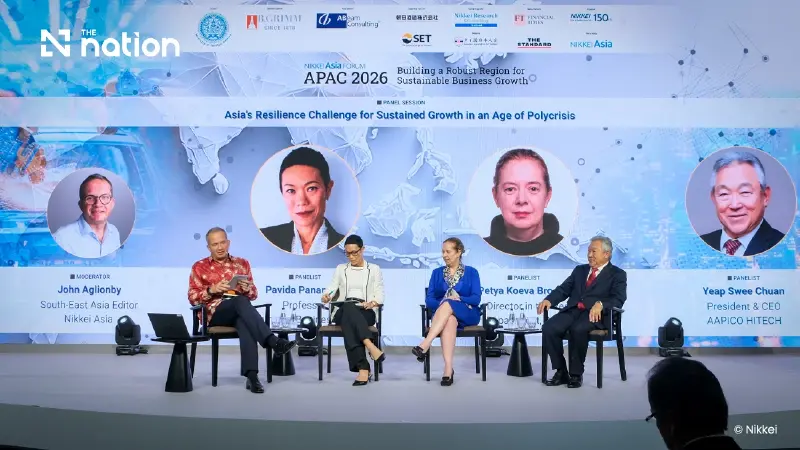


Nikkei Asia Forum panellists warn that energy shocks and green regulations have evolved from policy goals into immediate survival threats for business
- Experts warn that Asia's sustained economic growth is now entirely dependent on its ability to manage energy shocks and climate disruptions, which have become immediate survival threats for businesses.
- While necessary, stringent green regulations create severe financial and compliance burdens that disproportionately threaten the survival of smaller businesses within the region's supply chains.
- Energy and climate crises are acting as both "horizontal shocks" raising costs for everyone and "vertical shocks" that can halt specific industries, such as plastic or agricultural production.
- These pressures are forcing greater energy efficiency and a faster transition to renewables, with experts suggesting stronger intra-Asia trade and energy networks as a key defense against global volatility.
Nikkei Asia Forum panellists warn that energy shocks and green regulations have evolved from policy goals into immediate survival threats for business.
Asia’s ability to sustain its position as the engine of global growth hinges entirely on its capacity to convert unprecedented energy shocks and climate disruptions into structural advantages, global experts warned on Thursday.
Speaking at the inaugural Nikkei Asia Forum APAC 2026 in Bangkok, panellists addressing the session “Energy Resilience: Asia's Challenge for Sustained Growth in an Age of Polycrisis” argued that energy security and environmental sustainability have ceased to be secondary policy goals. Instead, they have become the primary determinants of day-to-day corporate survival and supply chain viability across the region.

The Double-Edged Sword of Green Regulation
While the panellists agreed that transitioning to alternative energy is non-negotiable, they highlighted a stark divide in how climate regulations impact large corporations versus small businesses.
Yeap Swee Chuan, president and CEO of AAPICO Hitech, Thailand’s largest automotive parts manufacturer, noted that while stringent environmental standards—such as Europe’s Carbon Border Adjustment Mechanism (CBAM) and Euro emissions targets—are overwhelmingly positive for regional health, their implementation creates severe friction for the supply chain baseline.
"Bigger companies are able to follow," Yeap explained. "But if you cannot follow, probably your business will be affected. You may have to close your business, the small businesses... They don't have the ability to dot the crosses to send it to the customer. And then the business will be cancelled, [even if] they are even cleaner than the big companies."
For heavy manufacturers, navigating this transition requires absolute precision. Yeap warned that compliance inflation makes manufacturing significantly more expensive, forcing regional operators to aggressively seek efficiencies to keep production viable.

Shocks as Catalysts for Efficiency
From a macroeconomic perspective, the International Monetary Fund (IMF) observed that these intense energy pressures are actively accelerating structural resilience, proving that market forces respond rapidly to crisis.
Petya Koeva Brooks, deputy director in the IMF's Research Department, pointed out that the global economy has historically used energy shocks to permanently alter consumption habits.
"Even if you look back at the oil prices in the 70s, the energy intensity that the global economy has is now half of what it used to be," Brooks revealed. "And now, even within the last couple of years, we've already seen a further decrease in that energy intensity... countries are really using this as an opportunity to move towards more renewable energy."
However, Brooks issued a strong warning against poorly executed state interventions. While using industrial policy tools to fast-track green transitions is justifiable, over-subsidising specific technologies can create massive fiscal burdens if those technologies become obsolete down the road.

The Vertical Threat of Climate and Energy Shocks
The nature of these disruptions has evolved from broad inflationary pressures into highly targeted industrial risks, argued Pavida Pananond, a professor at Thammasat Business School. Pavida stated that energy crises now manifest as both "horizontal shocks" affecting everyone's baseline utility costs and severe "vertical shocks" that completely halt specific upstream industries.
"Thailand is experiencing a shortage of plastic because that's the derivative of crude oil," Pavida noted, illustrating how geopolitical energy friction immediately impacts downstream manufacturing.
Similarly, climate change poses an immediate threat to regional macroeconomic attractiveness. In hubs like Bangkok, immediate concerns over flooding directly degrade infrastructure reliability, while wider climate events deliver volatile shocks to Southeast Asia’s vital agricultural and fisheries sectors.
To counter this, Pavida suggested that true climate resilience requires companies to diversify completely out of legacy sectors.
She highlighted emerging trends where traditional automotive parts manufacturers are successfully repurposing their underlying capabilities—such as sensor technologies—to supply green energy networks and drone components, effectively insulating themselves from fossil-fuel vulnerabilities.

Internal Engines for a Resilient Future
Ultimately, the panel concluded that Asia’s ultimate defence against external energy shocks lies in maximising its own internal market scale. Because Asia accounts for 60 per cent of global growth and contains 60 per cent of the world's population, expanding intra-Asia trade networks offers a direct route to reducing the region's heavy dependency on Western markets and volatile global energy supply lines.
By building unified regional networks and focusing on localised, cross-border energy grids, Asian economies can protect their manufacturing core. However, the transition remains highly delicate.
As a live audience poll during the session concluded, 77 per cent of delegates still believe that long-term sustainable growth depends on stable US-China relations—a reminder that while Asia can engineer internal energy resilience, it remains deeply tethered to global stability.
