
Falling durian prices push Malaysia towards overland exports to China
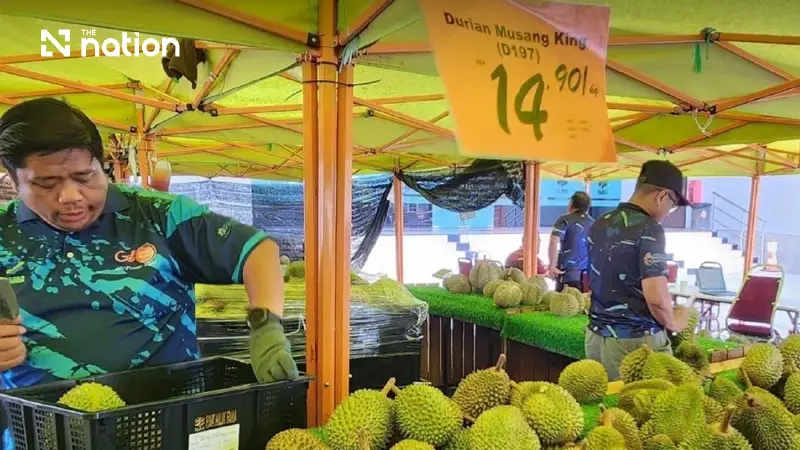


A bumper crop has halved prices and strained air-freight capacity, prompting officials to study lower-cost truck shipments into China and access to buyers beyond coastal cities.
- A massive durian surplus in Malaysia, resulting from a bumper crop and newly matured orchards, has caused prices to drop by roughly half, creating a glut in the market.
- To manage the surplus, the Malaysian government is proposing overland exports to China by truck, a method that could carry larger volumes and reduce logistics costs by up to 40% compared to air freight.
- The road export plan faces significant challenges, including a much longer transit time (75 hours vs. 4 by air) and the need for regulatory and phytosanitary approval from transit countries like Thailand and Vietnam.
- The extended journey has prompted research into shipping "pre-cut" durians harvested before they are fully ripe, a controversial move that critics fear could damage Malaysia's premium reputation for naturally tree-ripened fruit.
At one point during Malaysia’s 2026 harvest, a durian could be bought for under RM1.
The bargain reflected an industry struggling to clear a crop so large that prices have dropped to roughly half their 2025 levels, making this one of the sector’s most difficult seasons in years.
Black Thorn is selling for about RM20 per kg, while kampung varieties fetch between RM7 and RM10.
The abundance has encouraged durian parties around the country, but it has also exposed how far production has moved ahead of available export capacity.
Malaysia produces more than 550,000 tonnes of durians annually.
Years of rapid orchard development, together with farming techniques that can bring trees into production in about four years instead of eight to 10, have added heavily to supply.
Many orchards established during the durian boom of the past decade are now mature, helping to create the bumper 2026 crop.
The Federal Agricultural Marketing Authority is intervening to absorb part of the surplus.
It expects to have purchased 1,000 tonnes, valued at RM7 million or S$2.2 million, by the close of the peak season in August.
Overseas sales are rising, although they are not yet large enough to relieve the pressure at home.
Malaysia exported more than 4,000 tonnes of fresh, frozen and processed durian products in June 2026, up 40 per cent from 2,865 tonnes in June 2025.
Fresh shipments to China by air, however, remain limited to around 40 tonnes a day.
The Malaysian government is therefore discussing a road-export arrangement with the Chinese authorities.
Trucks could carry greater volumes more cheaply than aircraft and extend sales beyond China’s affluent coastal cities.
An official familiar with the proposal told The Straits Times that land transport could cut logistics expenses by as much as 40 per cent.
“This is one of the steps that we can take to overcome the glut issue,” the official said, requesting anonymity because the proposal has not been approved.
Regulatory clearance along the possible route remains a major hurdle.
“The Agriculture Department is reviewing the legal compliance and phytosanitary requirements imposed by the transit countries – Thailand, Vietnam and Laos – before exports via the overland route can be considered,” the department said in response to queries from The Straits Times.
The Ministry of Agriculture and Food Security is scheduled to meet Malaysian durian industry representatives on 17 July to discuss export-related problems.
A January test illustrated the sharp difference in travel time.
One tonne of Black Thorn durians left Malaysia through the Bukit Kayu Hitam border crossing, travelled by road through Thailand and reached China in about 75 hours.
An aircraft can reach the receiving cargo hub in China in roughly four hours.
The longer journey has prompted the Department of Agriculture and the Malaysian Agricultural Research and Development Institute to examine “pre-cut” durians for road transport.
Under this method, fruit is removed by cutting the stem before it is fully ripe instead of being left to mature and fall naturally.
Any proposal arising from the research would still need permission from Chinese regulators, the department said in a statement on 2 July.
Malaysian agencies are also studying post-harvest treatments, including ways to stop mould developing while the fruit is on the road.
China began accepting fresh Malaysian durians in August 2024.
The inaugural flight followed an agreement signed two months earlier that widened trade beyond durian products and whole frozen fruit.
The opening gave Malaysia access to a multibillion-dollar market in the world’s second-largest economy, where Thailand and Vietnam already supply most fresh imports.
Figures from China’s General Administration of Customs show that the country imported 156,000 tonnes of fresh durians in the first quarter of 2026, a year-on-year increase of 294 per cent.
Thailand and Vietnam accounted for the overwhelming majority.
Malaysia exported 42,994 tonnes of all durian products in 2025.
Singapore was the leading destination with 20,341 tonnes, followed closely by China with more than 18,370 tonnes.
Prime Minister Anwar Ibrahim plans to seek broader access for Malaysian fruit during his August visit to Beijing, where he is due to meet Chinese Premier Li Qiang.
Referring to the surplus, he joked: “I will ask him to buy a bit more, then the price will go up.”
The proposed road channel has split growers and exporters.
Advocates see cheaper freight and access to more Chinese consumers, particularly away from the coast.
Critics fear that using pre-cut fruit could weaken Malaysia’s premium reputation for durians that ripen naturally on the tree.
Penang exporter Steven Yam, who also runs omakase-style durian tastings, opposes the pre-cut approach.
“What sets Malaysian durians apart is that they are naturally tree-ripened and allowed to drop on their own.
That aroma and flavour cannot be replicated.
Malaysian durians have their own unique characteristics,” he said.
Yi Zhi Xiong, a China-based food-and-beverage wholesaler who attended one of Yam’s tasting sessions, visits Penang two or three times a year for the fruit.
“I prefer Malaysian durians because they have a special flavour,” he said.
Source: The Straits Times
