
Sihasak Champions 'Resilient Openness' to Shield Thai Trade from Global Splits
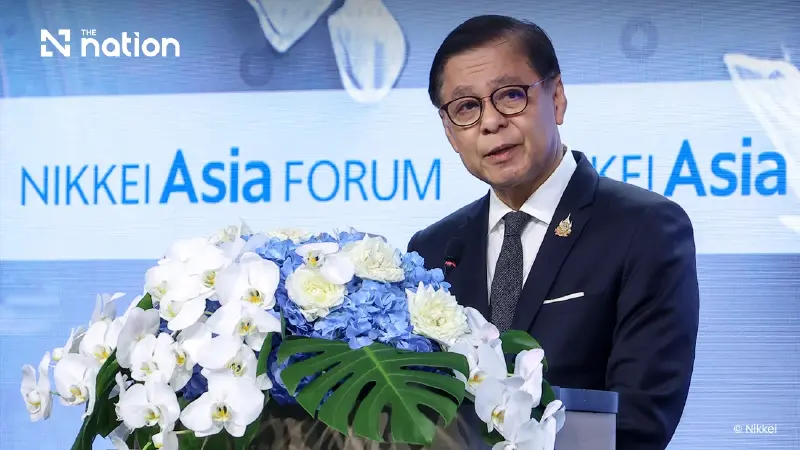


Foreign Minister Sihasak Phuangketkeow rejects isolationism, calling for smart integration and borderless co-creation to weather geopolitical risks
- Foreign Minister Sihasak Phuangketkeow has introduced a "resilient openness" strategy for Thailand, rejecting isolationism to navigate geopolitical risks and protect trade.
- The policy aims to keep Thailand open to trade and investment while diversifying partnerships and supply chains to reduce over-dependence on any single source.
- This approach is a direct response to the intertwining of economic policy and national security, seeking to manage risks through trusted networks rather than fragmenting into competing blocs.
- Implementation involves deeper regional integration beyond traditional supply chains, connecting energy, digital, financial, and innovation systems to foster cross-border collaboration.
Foreign Minister Sihasak Phuangketkeow rejects isolationism, calling for smart integration and borderless co-creation to weather geopolitical risks.
Thailand’s Ministry of Foreign Affairs has unveiled a comprehensive external strategy built around the concept of "resilient openness", rejecting block-based isolationism in favour of deeper regional economic integration and trusted trade networks.
Addressing the Nikkei Asia Forum APAC 2026 in Bangkok on Thursday, Deputy Prime Minister and Minister of Foreign Affairs Sihasak Phuangketkeow provided a detailed geopolitical analysis of how the region must adapt to an era where trade policy and national security have become entirely intertwined.
Sihasak challenged prevailing narratives of absolute de-globalisation, asserting that international commerce and digital connections continue to thrive, albeit under altered terms.
"We have seen how economic policies and business operations are being redesigned not just for efficiency but for resilience and trust," Sihasak observed, pointing out that "economics and security can no longer be treated separately".

In this environment, he argued, governments face a crucial strategic choice between letting risk fragment the region into competing blocks or managing those vulnerabilities through wider networks of trusted partners.
"Thailand firmly believes in the latter," Sihasak declared, defining the kingdom's core foreign policy position. "I believe the future of Asia should be built around the concept of resilient openness... remaining open to trade, investment, and ideas while diversifying market suppliers' partnerships. It means reducing excessive dependence without closing doors and building resilience with one another, not against one another."

Deeper Integration and Cross-Border Co-Creation
The foreign minister stated that Asia already possesses the foundational ingredients for sustained prosperity, including advanced manufacturing, growing consumer markets, and deep talent pools.
The pressing challenge is connecting these components through smarter integration and "co-creation".
Sihasak asserted that the next phase of integration must expand far beyond basic supply chains and transport corridors.

"We must also connect our energy system... digital networks, financial platforms, innovation ecosystems, and, again, talents," he said, adding that future growth will not come from producing more of the same but from combining distinct capabilities across borders.
To provide the stability required for these cross-border ventures, Sihasak emphasised that the Association of Southeast Asian Nations (ASEAN) must remain the definitive diplomatic anchor.
"Businesses need more than market access. They need predictability and confidence that political differences will be managed, rules will be respected, and economic connection to remain open," he stated.
Consequently, the foreign minister concluded that his ministry is systematically reshaping its foreign apparatus.
"The Ministry of Foreign Affairs is pursuing economic diplomacy strategies to open new opportunities, build confidence, and turn partnerships into sustainable, mutually beneficial outcomes," Sihasak said, reiterating the government's absolute commitment to making Thailand a trusted, hyper-connected regional business node.
