
Ekniti Targets 30% Investment-to-GDP Ratio to Redefine Thailand’s Competitiveness
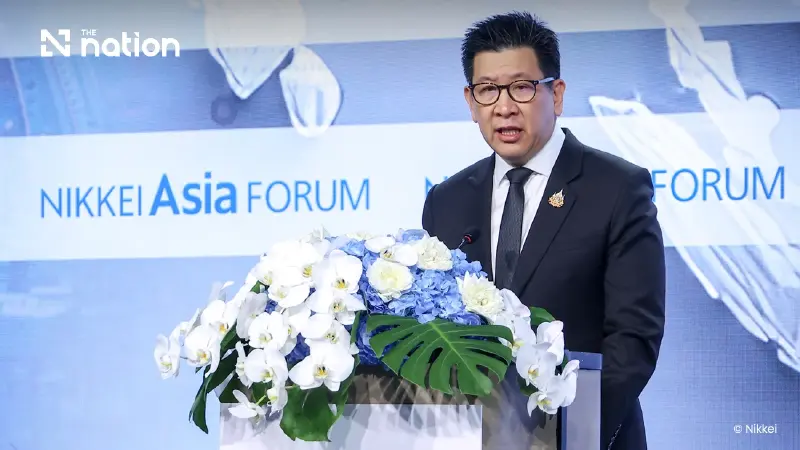


Deputy Prime Minister Ekniti Nitithanprapas rolls out a macro strategy to drive investments to 30% of GDP and accelerate green energy transitions
- Thailand has unveiled a strategy to position itself as a regional economic and energy hub, using a domestic "Five T’s" framework to boost investment and accelerate its green energy transition.
- To counter geopolitical fragmentation, the country is championing a foreign policy of "resilient openness," which aims to deepen regional integration and diversify partnerships without closing off to trade.
- The strategy is validated by international partners like Japan, which is collaborating with Thailand on energy security and recognizes its existing infrastructure as key to becoming a regional energy hub.
Deputy Prime Minister Ekniti Nitithanprapas rolls out a macro strategy to drive investments to 30% of GDP and accelerate green energy transitions.
The Thai government has set its sights on driving domestic investment to 30 per cent of gross domestic product (GDP) and propelling national growth past 3 per cent, utilising targeted public funding, green transitions, and a major regulatory overhaul to lift national productivity amid global fragmentation.
Delivering the opening remarks at the inaugural Nikkei Asia Forum APAC 2026 in Bangkok on Thursday, held under the theme "Building a Robust Region for Sustainable Business Growth", Deputy Prime Minister and Minister of Finance Ekniti Nitithanprapas outlined a rigorous macroeconomic agenda designed to convert record-breaking foreign investment inflows into tangible domestic wealth.
Converting Intentions into Reality
Addressing a room of international delegates, Ekniti pointed to a significant resurgence in corporate confidence in the Thai economy.
"Investment applications reached a record level of last year and remained strong in the first quarter of this year," the finance minister revealed, though he quickly noted that securing applications is only the first step for the administration.
"Our task is to turn investment intentions into operating businesses, stronger Thai suppliers, higher-value jobs, and higher incomes for the nation," Ekniti stated, declaring this transition to be "the backbone of our economic policies".

To systematically push the economy toward these ambitious targets, the government is focusing on five core operational pillars, widely known as the "Five T's" framework:
Target: Recognising that public resources are limited, Ekniti announced a decisive move away from broad-based financial aid. "We must move away from broad-based approaches and direct support to those who need it most, while helping SMEs and target key sectors grow," he said.
Transition: The state is accelerating its energy transition to align businesses with global standards and insulate them from price shocks. Ekniti detailed that on the supply side, the government is expanding clean energy generation and transmission grids, whilst on the demand side, it is backing cleaner transport and logistics systems.
Transformations: Major investments are flowing into people, infrastructure, technology, and deregulation. Under a cross-agency scheme called "Thailand's fast pass", government bodies are working together to shorten approval timelines and fast-track major projects.
Transparency: Pointing to fiscal discipline and accountable institutions, Ekniti stated that "Thailand's OECD accession process is central to this commitment", helping to raise standards and build an empowering business environment.
Together: The state has revived its public-private consultative mechanism to ensure that public policy and private capital move in absolute harmony.

The Road to the Top 20
By enforcing these five principles, the finance minister declared that the government has established concrete, long-term goals to redefine the country's economic baseline.
"We have reconvened our public-private consultative mechanism with clear goals to raise Thailand's potential growth above 3%, bring investment closer to 30% of GDP, and move Thailand into the world's top 20 [in] the global competitiveness rankings," Ekniti announced.
He concluded by noting that these policies will serve as the baseline for global discussions later this year when Bangkok hosts the IMF-World Bank Group annual meetings under the banner "Thailand's New Horizons", an event intended to inject a resilient Asian perspective into the international economic dialogue.

The Value of Connection
The overarching necessity of cross-border dialogue was echoed by Nikkei Asia president Nobuhisa Iida, who underscored the forum's role in sustaining Asia’s growth momentum through real-world collaboration.
Reflecting on an era marked by consecutive global crises, border tensions, and economic divisions, Iida noted that regional potential remains extraordinary if business leaders prioritise cooperation.
“Even in the age of AI, real business collaboration begins with knowing each other,” Iida stated, explaining why Bangkok was selected to host the inaugural event. “It begins when we meet, listen, exchange ideas, and build trust face-to-face."
