
Exclusive: Commerce Minister Suphajee Suthumpun Charts Thailand's Path Through the US Tariff Storm
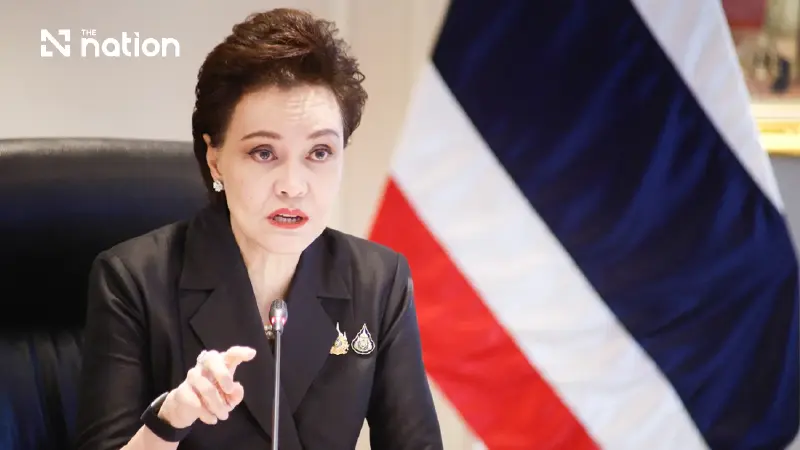


Minister Suphajee charts a collaborative path forward on tariffs while safeguarding domestic health, agriculture, and key industries
- Commerce Minister Suphajee Suthumpun explained that Thailand has declined to finalize a reciprocal trade deal with the US on current terms, holding out for a better agreement that does not compromise on "red line" issues affecting public health and local industries.
- Thailand is actively countering the US justifications for tariffs by presenting its own data to disprove claims of industrial overcapacity and highlighting its legal framework and new legislation being drafted to combat forced labor.
- The Minister argues the economic impact of the tariffs is less severe than suggested, as over 61% of Thai exports to the US are already exempt, and her team is continuously negotiating to expand this list of exempted products.
- Thailand's negotiating position is bolstered by its unique strategic partnership with the US, significant Thai private-sector investment in America, and a whole-of-government approach to secure a competitive tariff rate.
In a rare, informal gathering with editors and reporters from ten Nation Group titles, Commerce Minister Suphajee Suthumpun set out why Thailand has so far declined to conclude a reciprocal trade deal with Washington on the terms currently on the table – and why she believes the country holds a stronger hand than the headlines suggest.
Commerce Minister Suphajee Suthumpun convened editors and senior journalists from across the Nation Group on Monday evening for an unusually candid briefing on the state of Thailand's tariff negotiations with the United States, using the session to walk through, in granular detail, both the mechanics of Washington's tariff regime and the reasoning behind Thailand's cautious approach to date.
Flanked by Director-General of the Department of Trade Negotiations Chotima Iemsawasdikul, Director-General of the Department of Foreign Trade Arada Fuangtong, and other high-level officials from the ministry, the minister spent more than two hours—arriving straight from a Cabinet meeting and having skipped lunch—taking questions from editors of The Nation, Nation TV, Krungthep Turakij, Thansettakij, Post Today, Spring News, and other titles within the group.
From 36% to 12.5%: how Thailand got here
Suphajee began by tracing the origin of the dispute back to April 2025, when President Trump invoked the International Emergency Economic Powers Act (IEEPA) to declare that the United States was running unacceptable trade deficits with dozens of partners – Thailand among them, ranked 11th among countries with which the US recorded a trade surplus at the time.

Washington initially proposed a 36% tariff on Thai goods, tied to a wider negotiating framework it called the Agreement on Reciprocal Trade (ART), covering both tariff and non-tariff measures.
Under the previous government, Thailand's negotiating team – led at the time by then-Deputy Prime Minister and Finance Minister Pichai Chunhavajira – reached a Joint Framework Agreement committing Thailand to purchase more American agricultural products, energy and aircraft without fully concluding the more technical ART negotiations.
That commitment brought the rate down to 19% in August, conditional on ART being finalised. When the US Supreme Court subsequently ruled the use of IEEPA for this purpose unlawful, Washington pivoted first to a blanket, time-limited 10% tariff under Section 122 (capped at 150 days) and then to Section 301 – a mechanism that requires the US to justify tariffs against a specific country on specific grounds.
For Thailand, those grounds were twofold: an alleged failure to legislate against imports of goods made with forced labour and an allegation of "structural overcapacity" in three sectors – automotive and parts, machinery, and rubber products – which Washington's investigators put at below 60% utilisation.
Thailand pushed back hard on both counts, the minister said.
On forced labour, she confirmed Thailand does not yet have dedicated legislation – a bill is now being drafted by two committees under the Ministry of Labour and is expected to go to Parliament when the new session opens – but argued the country already has a robust legal framework against forced labour domestically.
On overcapacity, her team presented Washington with actual utilisation data of 75–95% across the three sectors in question, directly contradicting the sub-60% figure used by US investigators, which she said was drawn from a partial industrial sampling covering only around 14% of Thai factories, via outdated third-party data rather than Thailand's own numbers.
"We're not afraid of the facts," she told the group. "That's exactly why we have to keep negotiating on the other fronts too."

Why Thailand hasn't rushed to conclude ART
A central theme of the evening was Thailand's decision not to conclude ART on the terms other signatories have already accepted. The US Trade Representative's office, she said, has made clear it would like Thailand to settle on the same basis.
Suphajee declined to specify what she called the country's "red line" issues in the ART talks, saying only that they touch on public health, quality of life, and the interests of Thai farmers, businesses and consumers in ways that would provoke serious domestic backlash if conceded – precisely the kind of long-standing, sensitive issue, she noted, that has resisted resolution through several administrations.
She asked reporters not to press for specifics, arguing that public disclosure at this stage would weaken Thailand's negotiating position.
Instead, she argued Thailand has grounds to be treated on more favourable terms given the depth of the bilateral relationship: a Treaty of Amity and Economic Relations that Thailand holds uniquely in the region, its status as one of only three formal US strategic partners in the Asia-Pacific, existing Thai private-sector investment in the United States of US$19.3 billion with a further US$5.5 billion planned (US$25 billion in total), and continued adherence to the purchase commitments made under the previous government's framework agreement.
She also moved to correct what she described as a misreading of the bilateral trade data: roughly 30% of Thailand's reported surplus with the US, she said, is generated by American companies manufacturing in Thailand and repatriating profits – not a one-way flow of Thai-made goods – while suggestions that Thailand is simply relabelling Chinese-made electric vehicles for the US market do not hold up since Thailand does not currently export EVs made domestically to the United States at all.

The numbers behind the headline rate
According to figures the ministry shared with editors, the US imported some US$91.26 billion worth of goods from Thailand in 2025. Of that, US$56.2 billion — or 61.58% — already falls under general exemptions in Annex II Part A of the US tariff order, and the Ministry estimates that share rises significantly further once separate Section 232 exemptions are taken into account alongside the Section 301 list.
Ministry officials said the exempted list under Section 301 alone has grown from an initial 1,655 tariff lines to 2,120 — covering roughly half the total value of Thai exports to the US — spanning agriculture and food, electronics, industrial raw materials, aircraft and medical goods, and other categories such as used clothing and antiques.
The minister said her team continues to press Washington to add further product groups to that list, though she declined to detail which items remain under discussion, saying this was still live negotiating ground.
"By the numbers, this isn't hitting us anywhere near as hard as some of the commentary suggests," she said. "But we still want everything we can get."

"Team Thailand", not just the Commerce Ministry
Suphajee repeatedly stressed that the negotiation is being run as a whole-of-government effort she called "Team Thailand" — coordinated by Commerce but drawing in the Ministry of Foreign Affairs, the Ministry of Defence, and private-sector bodies including the Board of Trade, the Federation of Thai Industries and the Thai Bankers' Association, all of which she said have signalled willingness to support the negotiating position, including through continued private investment in the US.
Her stated goal, she said, is to conclude ART at an internationally competitive rate no higher than the 19% previously discussed under the earlier framework, with an expanded list of exempted goods — without conceding on the issues she regards as non-negotiable.

Fighting misinformation as much as tariffs
Much of the discussion turned to the difficulty of communicating complex, incremental negotiations to the public in an environment she described as increasingly shaped by "a society of opinion" rather than "a society of fact".
She cited two recent controversies as cautionary tales: reporting that mischaracterised a private feed-industry association's routine WTO-quota corn purchase agreement with its US counterpart as a government decision to import a million tonnes of GMO corn and criticism over her ministry's early, targeted marketing of smaller durians to export markets such as Japan – which she said was in fact a deliberate strategy, decided months ahead of the harvest, to pre-empt an oversupply in the wider regional crop that year, helping Thai export values reach record levels.
"I don't mind being criticised," she said. "What I mind is when the criticism is based on something that simply isn't true, and nobody corrects it."
She pointed to rice prices – which she said have risen from around US$334 a tonne in October, when she took office, to around US$497 a tonne now, among the highest of any major exporting country – as one concrete result she believes has gone largely unremarked in the noise around tariffs.
Describing her negotiating philosophy as one of incremental progress — "We're on about the fifth step of a nine-step staircase," as she put it — the minister said she was prepared to accept short-term criticism in exchange for outcomes she believes will hold up over time, adding that she had asked her officials not to rush any decision that would cost the country long-term advantage merely to avoid short-term criticism of being "too slow".
