
Thai shoppers cut basket sizes as retail confidence falls



Thailand’s retail confidence fell to 46.6 in July as spending per bill plunged 8.1 points, signalling shrinking household purchasing power.
Thai consumers continued to visit shops at almost the same frequency in July but sharply reduced the amount they were prepared to spend on each trip, pointing to weakening household purchasing power as the nationwide Retail Sentiment Index (RSI) fell 4.9 points to 46.6.
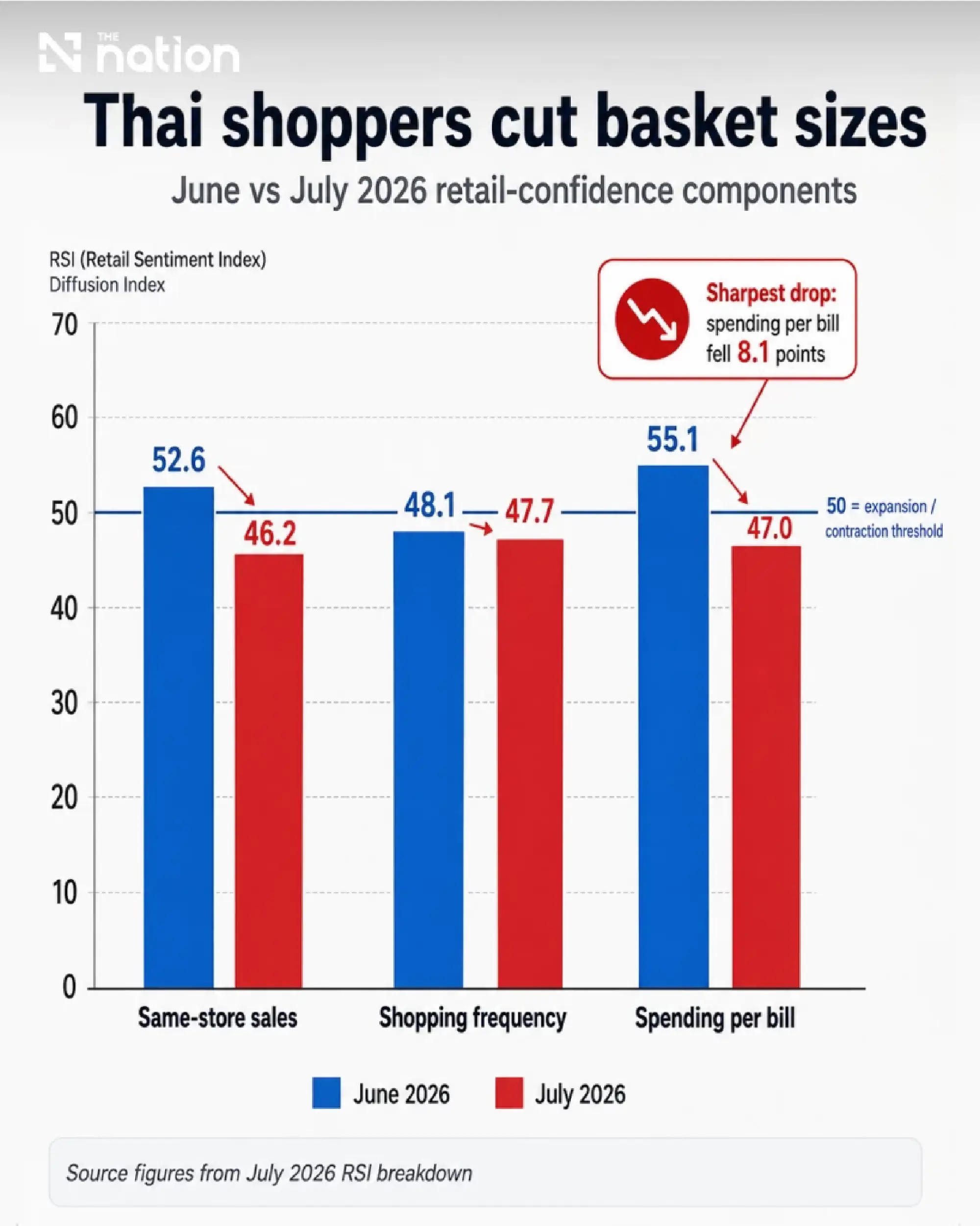
The spending-per-bill component recorded the steepest decline among the index’s main measures, falling by 8.1 points from 55.1 in June to 47.0 in July.
By comparison, shopping frequency edged down by only 0.4 points, from 48.1 to 47.7. Confidence in month-on-month same-store sales growth dropped by 6.4 points, from 52.6 to 46.2.
All three components ended below 50, the threshold separating expansion from contraction.
The divergence between spending and shopping frequency suggests that the decline in large retailers’ sales is not being caused primarily by consumers moving their purchases to independent or community shops benefiting from government support.
A significant shift between retail channels would normally be accompanied by a much steeper fall in visits to shopping centres and modern-trade outlets. Instead, consumers appear to be maintaining their usual shopping routines while spending less each time.

Shrinking baskets point to weaker purchasing power
The sharp fall in the spending-per-bill index reflects a contraction in basket sizes as households limit purchases to essential goods and remove less necessary items from their shopping lists.

Consumers are also switching to cheaper brands or retailers’ private-label products and avoiding discretionary and lifestyle purchases.
The pattern is a sign of financial strain rather than a simple change in shopping location. Although households still need to buy everyday goods, tighter budgets are reducing both the quantity and value of purchases made during each visit.
The deterioration in spending per transaction also explains why same-store sales confidence fell much more sharply than shopping frequency.
Stimulus spending concentrates on necessities
The government continued its Thais Help Thais Plus 60/40 stimulus programme in July, with total expenditure remaining close to June’s level at approximately 43 billion baht.
About 25.78-26 million people had used the entitlement, with average spending of roughly 1,600-1,700 baht per person.
The injection was not sufficient to compensate fully for the underlying weakness in household income.
In June, the programme’s first month, consumers accelerated their spending to avoid losing unused entitlements. By July, they had become more familiar with the scheme and began spreading their expenditure more evenly.
Most subsidised spending went towards everyday fast-moving consumer goods, food and beverages. Food-delivery platforms, which accepted the entitlement throughout the month, also absorbed part of the spending.
Once the support had been used for basic necessities, households had little personal spending power left for other product categories, limiting the programme’s wider economic impact.
Weather and household costs weigh on retailers
Heavy rainfall and flooding in several areas added to the pressure in July by reducing visitor numbers at medium-sized and large shopping centres.
High household debt and elevated living costs continued to restrain spending on non-essential goods, including fashion, electrical appliances, home-decoration products and innovation-related items.
These categories generate a substantial share of profits for large department stores, but sales remained weak.

Department stores, restaurants and lifestyle retailers have started recovering from their lowest levels earlier in the year, but their confidence indices remained below 50, within a range of 40-46 points.
The improvement was also concentrated largely in Bangkok and surrounding provinces.
Confidence among construction-materials, home-improvement and maintenance retailers recovered to 45-48 points after falling below 30 in May and June.
The sector remained highly volatile, however, because of its dependence on government budget disbursement and the continuing slowdown in the property market.
Tourism provides limited regional support
Tourism helped lift confidence slightly in some parts of the country.
The southern Gulf coast and eastern provinces benefited from foreign visitors, while the North and Central regions received support from domestic travel during extended holiday periods.
Despite those improvements, retail confidence remained below the 50-point benchmark in every region.
The Northeast faced additional pressure as tourist numbers declined for a fourth consecutive month from April 2026.
The overall RSI is forecast to remain subdued at between 47 and 50 during the third quarter of 2026.
The outlook indicates that most retail operators remain cautious about business conditions, with underlying household purchasing power yet to show clear signs of a sustained recovery.
Source: Thansettakij
