
Trade Finds a Way: IMF-World Bank Panel Champions Openness Over Isolation
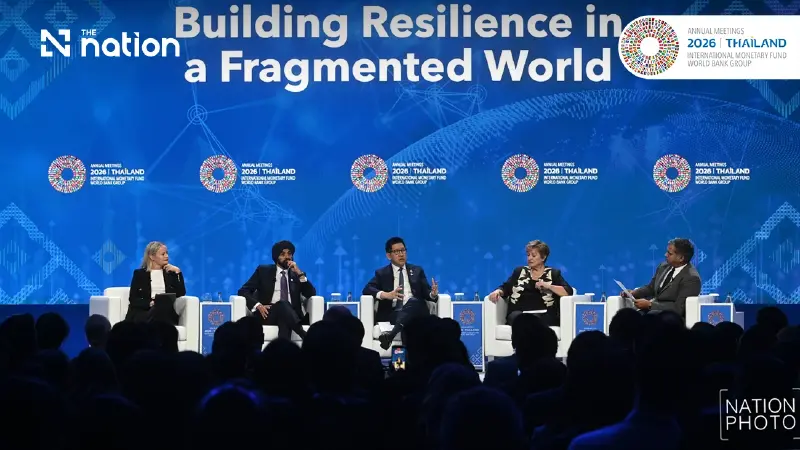


IMF, World Bank, Thai and Finnish finance chiefs reject isolationism, calling for broader trade links and sound finances to face global shocks
- Economic leaders from the IMF, World Bank, Thailand, and Finland rejected isolationism, advocating for cooperation and diversified trade to build resilience in a fragmented world.
- The IMF's Managing Director likened trade to water, noting its ability to flow around obstacles, but warned that fragmentation could cost up to 7% of global GDP and erodes opportunities for cooperation.
- Panelists highlighted that developing countries are increasingly trading among themselves and nations are actively diversifying supply chains to enhance security, proving that openness and resilience can coexist.
- Finland's finance minister argued against "over-securitisation," stating that economies should use targeted measures to protect critical sectors without abandoning the overall model of an open economy.
IMF, World Bank, Thai and Finnish finance chiefs reject isolationism, calling for broader trade links and sound finances to face global shocks.
The world's economic leaders agreed on Tuesday (October 13) that the answer to a fragmented global economy is to diversify and cooperate, not to retreat behind closed doors, and that sound public finances remain the best protection against the next shock.
The consensus emerged at "Building Resilience in a Fragmented World", the flagship event hosted by Thailand's Ministry of Finance on the second day of the IMF-World Bank Annual Meetings, which run from 12 to 18 October.
Chaired by the BBC's economics editor, the panel brought together Kristalina Georgieva, managing director of the International Monetary Fund (IMF); Ajay Banga, president of the World Bank Group; Ekniti Nitithanprapas, Thailand's Deputy Prime Minister and Finance Minister; and Riikka Purra, Finland's Deputy Prime Minister and Finance Minister.
The panellists agreed on several points. Trade and capital have rerouted around obstacles rather than collapsing. Emerging economies have held up because of the policy buffers they built. Private capital must supplement strained public budgets. Complacency is now the biggest danger.
The chair noted that the global economy had weathered trade barriers and an energy crisis in the Gulf far better than expected six to eight months ago and asked how long that resilience could last.
The IMF: 'Don't take this resilience for granted'
Georgieva said the IMF had never been at the pessimistic end of forecasts.
"We have not predicted a recession when the trade war started," she said. "Trade is like water. You put an obstacle; it goes around it."

She argued that the foundation of resilience is "strong policies and buffers in emerging markets" and that the private sector, "more agile, more adaptable", now drives growth almost everywhere. But she warned against letting guard down.
"After so many shocks to which we have been resilient, complacency may be settling down," she said. "Don't take this resilience for granted. We have to work for it."
The Fund's earlier research put the cost of fragmentation at up to 7 per cent of global GDP.
"The good news is we didn't get that far. The bad news is we are still climbing," she said.
The most underappreciated cost, she added, is the "opportunity cost of foregone cooperation": duplicated effort, slower scientific discovery and eroded trust. Security concerns are legitimate in a world where "unthinkable events" have happened, she acknowledged, but she insisted that macroeconomic stability comes first.
"When your fiscal position wobbles, when you allow inflation to run out of control, then whatever you do in other ways on security... most likely won't be enough," she said.
She urged "courage and commitment to macroeconomic and financial stability as the first line of defence", noting that in some large advanced economies deficits and debt are rising while higher interest rates make debt servicing "a very heavy burden".
Countries face two choices, she said, diversification or self-sufficiency, and she made clear which she backs.
Completing the European single market and integrating its energy grid could cut energy prices by more than 10 per cent, she said, while removing non-tariff barriers in Asia could add about 1.8 per cent to GDP over time.

The World Bank: jobs, capital and trade among developing nations
Banga highlighted how the developing world is adapting. Over two decades, developing countries' share of global trade has doubled from about 20 per cent to 40 per cent, and half of that is now traded among themselves.
"The old model of developed country and developing country is also changing to developing countries trading among themselves and building their own chains," he said.
Yet intra-regional trade remains thin outside Southeast Asia: about 50 to 55 per cent in ASEAN, but in the low teens in South Asia and lower still in Africa and Latin America.
Roughly 100 regional and bilateral trade deals have been signed in the past decade.
"It's not that we don't have the deals, we're not executing them," he said.
Private capital mobilised for emerging markets reached $112bn last year, up from $32bn three years ago. But the gains are lopsided.
Flows to upper-middle-income countries such as Argentina, India and Gabon have risen fourfold, and to lower-middle-income countries threefold, while for the poorest, fragile and conflict-affected states they have "flatlined".
With 1.2 billion young people in emerging markets set to turn 18 over the next 12 to 15 years, he said jobs are the central challenge, and public money alone will not suffice.
"You need three legs of the stool. You cannot rely only on public finance," he said, pointing to public, philanthropic and private capital. Investors, he added, look for infrastructure, both physical and human, and for good governance.
"If it takes 61 permits to open a hotel in this country versus seven in that country, where will my money go?" he asked.
He also announced that the Bank had launched a new strategy for micro, small and medium-sized enterprises, which create about 75 per cent of jobs worldwide.
Finally, he pointed to a "mutual reliance" framework with the Asian Development Bank, under which each institution accepts the other's due diligence and procurement controls. "1 plus 1 equals 3," he said.

Thailand: 'We build a bridge over the wall'
Ekniti said countries and companies are shifting from "efficiency first" to "security first" and diversifying markets to build resilience. Fragmentation hits through three channels: trade, finance and investment.
On trade, Thailand, a net energy importer that sourced about half its energy from the Middle East, has switched suppliers in the past seven to eight months to West Africa and Latin America.
"Even though you build a wall, we will build a bridge over the wall," he said.
On finance, fiscal discipline has paid off. Over the same period, Thailand's 10-year bond yields rose by only 60 basis points, against 120 basis points for comparable US bonds.
On investment, foreign direct investment applications rose 47 per cent in the first half of 2026, while private investment grew by more than 10 per cent for two consecutive quarters after red tape was cut.
AI-related exports rose 40 per cent in the same period. He described the world as "K-shaped", with large economies and firms thriving and small ones struggling, and said middle powers such as Thailand can act as "trusted connectors".
One example is the potential to link hydropower-rich neighbours with energy-hungry Singapore.
Trade within ASEAN is about 22 per cent of the total, against around 60 per cent within Europe, and he called for closer links in digital economies.
He said the point is to "turn capital into capabilities", through a "skillbridge" programme that links foreign investors to Thai universities and requires technology transfer in return for investment incentives.

Finland: small economies are not victims
Purra said Finland, which "prospered through deep integration" in global value chains, has seen the shift to economic security expose long-standing dependencies.
Economies that neglected their own defence, and middle-sized economies that relied on larger allies, may struggle most, she said. But she rejected a victim narrative.
"I strongly disagree that small nations have the role of a victim to play here," she said.
Small states, she argued, have learned to adapt under pressure. She said Russia had forced Finland to "anticipate security threats", adding: "We are not easily shocked. So we are resilient by definition."
Her prescription was "targeted measures" focused on critical choke points, "without compromising growth and overall openness", and aiming to cut exposure to coercion rather than seek total autonomy, which she called neither possible nor efficient.
"Over-securitisation is self-defeating for the open economy model," she said.
Finland draws strength from energy resilience, with Europe's lowest electricity prices because 95 per cent of its power is low-carbon, and from niches such as Arctic expertise, telecoms and cybersecurity.
She warned that EU-level subsidy races could disadvantage smaller members and distort markets.

A closing call for trust
Concluding the session, Banga reminded the audience that "young people are not going to wait for us to figure this out". The aim, he said, is to give them faith in the future.
Georgieva drew attention to the fabrics that decorate the meeting rooms, each woven by a different Thai community. They bring "ordinary people in the high corridors of economic power", she said, and delegates owe them results.
"We cannot possibly disappoint them," she said. "To everybody that comes to the meetings, leave your trade war, your cold war, your hot war outside. In this room, we work together for these people."
Ekniti, whose country is hosting the meetings for the second time since 1991, picked up the theme in his final remarks. "We need to build trust globally, and we need to build trust at home locally," he said.
He explained that 36 or 37 communities across Thailand had made the textiles so that they would feel part of the international event and promised that "we will make them better off".
