
Hong Kong optical fair attracts 12,000 buyers from 101 markets


The 34th Hong Kong International Optical Fair drew about 12,000 buyers from 101 countries and regions, with AI eyewear and senior vision care in focus.
- The 34th Hong Kong International Optical Fair attracted approximately 12,000 buyers from 101 countries and regions.
- Key areas of commercial interest for buyers were artificial intelligence (AI) powered products, such as smart eyewear, and optical goods for the 'silver economy' of older consumers.
- The majority of international buyers came from mainland China, Taiwan, Japan, Korea, the United States, and Southeast Asian markets.
- The event enabled exhibitors to secure new international partnerships and generate significant sales, with some companies expecting orders worth up to US$1 million.
The 34th Hong Kong International Optical Fair concluded on Friday (November 6), attracting around 12,000 buyers from 101 countries and regions, as artificial intelligence (AI) and products for older consumers emerged as key areas of commercial interest.
Organised by the Hong Kong Trade Development Council (HKTDC) and co-organised by the Hong Kong Optical Manufacturers Association (HKOMA), the three-day event was held under the theme “Bright Eyes • New Horizons”.
Buyers from outside Hong Kong came mainly from mainland China, Taiwan, Japan, Korea and the United States, alongside Southeast Asian markets including Indonesia, Malaysia, the Philippines, Thailand and Vietnam.
Smilely Lam, acting executive director of the HKTDC, highlighted the growing commercial potential of AI-powered products and the silver economy, which focuses on the needs of older consumers.
“The rapid advancement of artificial intelligence and growing demand driven by the silver economy are creating new growth opportunities for the optical industry,” Lam noted.
She explained that the exhibition brought together smart technology, health management and fashion, giving manufacturers opportunities to reach new customers, build international partnerships and strengthen Hong Kong's position as a global trading hub.

AI glasses attract international interest
Smart eyewear was a major focus of the exhibition, with manufacturers presenting products featuring real-time translation, voice interaction, navigation and health monitoring.
These developments are extending the role of eyewear beyond conventional vision correction into everyday activities, professional applications and healthcare.
David Chen, founder and chief executive officer of Shenzhen Muedo Technology Co., Ltd., introduced two new smart eyewear models: one fitted with a 13-megapixel camera and another featuring an integrated display with app-based controls.
Chen reported enquiries from buyers in India, Japan and the United States, with factory visits being arranged to explore potential partnerships.
Muedo expects the exhibition to generate approximately US$1 million in sales. Since first participating in 2023, the company has used the fair to expand into export markets in Europe, Southeast Asia and the United States.
Addressing privacy concerns surrounding camera-equipped glasses, Chen highlighted a physical camera cover that users must slide open before taking photographs.
The mechanism is designed to give people nearby a visible indication when the camera is being used.

Silver economy creates demand for specialised eyewear
Products designed for older consumers also attracted attention as manufacturers responded to demand for age-friendly vision care, functional lenses and assistive devices.
Hong Kong-based Rayke Intelligent Technology Limited presented new hearing glasses for older people alongside smart eyewear developed for children.
Lisa Chen, general manager of Rayke Intelligent Technology Limited, reported enquiries from more than 30 distributors, retailers and brand owners across Hong Kong, Taiwan, Germany, Japan, the Philippines, Korea, Italy, the United Kingdom and Vietnam.
The response reflected commercial opportunities in smart eyewear for older consumers and children, with the company expecting the fair to generate approximately US$100,000 in sales.

International brands explore new business opportunities
Beyond emerging technology, the fair's Brand Name Gallery brought together approximately 200 established and emerging eyewear brands, featuring products ranging from fashion frames to specialised and technology-driven designs.
Participating brands included BIG HORN and LOOMINELITE from Hong Kong; Ouieike and PARZIN from mainland China; Classico from Taiwan; Minima and Sabine Be from France; ByWP and STEPPER EYEWEAR from Germany; Modo and Off-White from Italy; nimome and VR&VERGT from Korea; TIJN from the Netherlands; Brevno from Russia; and Umbro from the United Kingdom.
Kevin Ching, founder and creative director of Hong Kong eyewear brand BIG HORN, introduced sports sunglasses specifically designed for pickleball players.
Having participated in the gallery for more than a decade, the company has also expanded its creative partnerships, including a collaboration with a Japanese lifestyle brand that incorporates distinctive patterns into the temples of its frames.
“Cross-industry collaboration has become an important trend in our business development,” Ching observed.
BIG HORN established contact with more than 10 potential buyers from mainland China, Egypt, Indonesia, Korea and the Philippines. The company expects the fair to generate approximately HK$1 million in orders.

Global buyers expand sourcing networks
The exhibition attracted established optical retailers and suppliers from several international markets.
Participants included Australia's The Optical Company, Canada's Optical London Drugs, France's Optical Factory, Indonesia's Grand Optik, Malaysia's Skyline Optical, Singapore's Capitol Optical, Spain's Protecfarma and Vision Plus from the United States.
Frian Lin, director of Malaysian distributor Skyline Optical Trading, identified two potential original equipment manufacturers (OEMs) from mainland China producing titanium and TR90 plastic frames.
The company has developed longstanding relationships with European and American eyewear brands through the Hong Kong fair, with annual procurement linked to the event valued at approximately US$1 million.
Lin expects the new supplier contacts to help broaden the company's sourcing network.
Spanish eyewear company Grey Sunglasses has similarly used the exhibition to establish manufacturing relationships in mainland China.
Cristian Hurtado, project manager of Grey Sunglasses, reported that the company sources OEM sunglasses, eyewear cases and acetate materials through these partnerships, with annual procurement worth approximately €65,000.
Egyptian optical wholesaler and retailer Kayan Optics, meanwhile, returned to the exhibition for its third consecutive year.
Its chief executive officer, Ahmed Mansy, confirmed an additional US$15,000 order for Nyx Vision lenses from an established supplier in Jiangsu, mainland China. The lenses are designed to reduce glare and visual fatigue during night driving and in LED-lit environments.
Kayan Optics also purchased more than 7,000 optical lenses from another mainland Chinese supplier, with the transaction valued at approximately US$14,000.

Design competition highlights creativity and technology
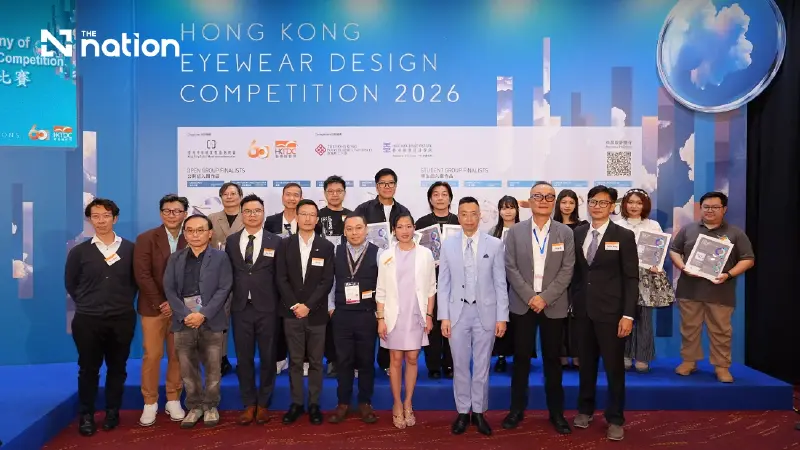
Emerging design talent was another feature of the event, with the 26th Hong Kong Eyewear Design Competition recognising innovative approaches to eyewear.
Jointly organised by the HKTDC and HKOMA, the competition adopted the theme “Mix & Match”, encouraging designers to explore the relationship between fashion, personal expression and technology.
Entries were divided into an Open Group and a Student Group, with a new Technology Concept Award introduced in the Student Group.
Cheng Wai-ho won first place in the Open Group with “Audio Reactive Chroma”, a design incorporating a spectral colour sensor that detects selected colours and synchronises the frame colour with the wearer's clothing. The concept also integrates audio-recording capabilities.
In the Student Group, Lee Sum-yau claimed first place with “Paris Fantasy”, drawing inspiration from the architecture and romantic atmosphere surrounding the River Seine in Paris.
The inaugural Student Group Technology Concept Award went to Lo Hoi-pui for “Adal-EYE”, an AI-inspired concept allowing eyewear to transform into jewellery, combining technological innovation with adaptable fashion styling.
The awards were presented on the opening day, while winning and shortlisted designs remained on display throughout the exhibition.
Online business matching continues after the fair
Although the physical exhibition has concluded, international sourcing activities will continue through the HKTDC's EXHIBITION+ hybrid model.
The Click2Match online business-matching platform will remain available until November 13, allowing exhibitors and buyers to arrange meetings and pursue further commercial discussions.
Buyers attending the exhibition could also use the Scan2Match feature of the HKTDC Marketplace App to scan exhibitors' QR codes, save supplier information, browse product details and interactive floor plans, and submit enquiries.
These digital services allow buyers and exhibitors to maintain contact after the event, extending business opportunities beyond the three-day exhibition.
