
High-speed rail contract heads for key EEC policy test
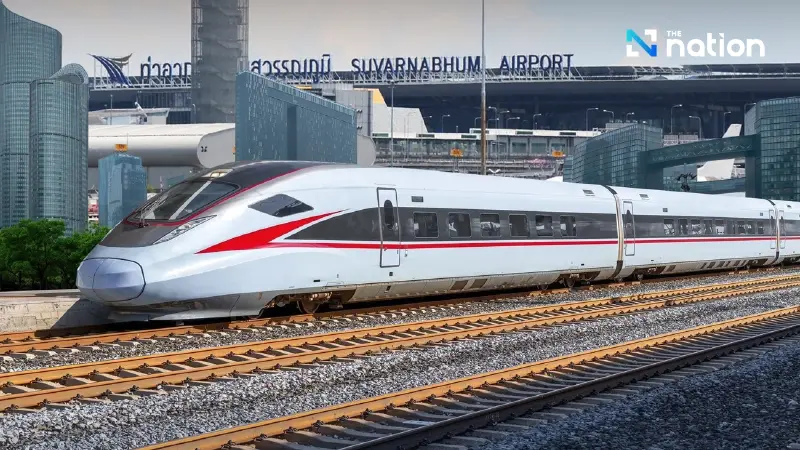


Thailand’s long-delayed three-airport high-speed rail project faces a key EEC review as contract talks with Asia Era One continue
Long-delayed rail project heads back to EEC scrutiny
Thailand’s high-speed rail project linking Don Mueang, Suvarnabhumi and U-Tapao airports is moving back towards a key policy decision after eight years of delays, negotiations and changes of government.
The project has passed through seven administrations since the Cabinet under the first Prayut Chan-o-cha government approved it on March 27, 2018.
It later moved into the public-private partnership bidding process, with the State Railway of Thailand naming Eastern High-Speed Rail Linking Three Airports Co Ltd, led by the CP Group and now known as Asia Era One Co Ltd, as the winning bidder. The consortium requested 117.226 billion baht in state co-investment.
The PPP contract was signed on December 22, 2018, during the second Prayut government.
However, before a notice to proceed could be issued, the Covid-19 pandemic disrupted the project, prompting the private partner to seek relief measures. The Cabinet later approved relief measures, including amendments to the PPP contract, on October 19, 2021.
Negotiations continued under the Srettha Thavisin government in 2024 without a final agreement, while issues also emerged over investment promotion certificates.
Talks then carried into the Paetongtarn Shinawatra government, with the Cabinet approving the contract amendment in principle on October 11, 2024.
The issue remained unresolved under the first Anutin Charnvirakul government, which raised concerns that the proposed contract amendment could conflict with PPP principles.
Negotiations continued under the second Anutin government, while the contract amendment agenda was withdrawn from the Eastern Economic Corridor Policy Committee meeting on May 20, 2026.
Attorney-General clears amended draft
SRT acting governor and deputy governor Anan Phonimdang said the Office of the Attorney-General had considered the amended draft contract and sent it back to the SRT.
The agency had previously raised 18 observations, all of which the SRT said it had answered. One key issue involved a review of Cabinet resolutions, which the government had required the private partner to consider.
The SRT has also held talks with Asia Era One to explain the conditions and principles related to amending the Cabinet resolutions.
The company has been asked to review the details, and the SRT is waiting for its formal response before reporting to the EEC Policy Committee and later submitting the matter to the Cabinet.
Anan said the amended contract had now effectively passed the Attorney-General’s review without objection, and the next step would be to compile the report for the EEC Policy Committee while waiting for the private partner’s response.
Financing model remains the main policy concern
A source from the Eastern Economic Corridor Office said the Transport Ministry’s opposition to amending the contract remained an important issue, particularly the proposal to shift the state payment model to a “build-pay” structure.
The source said the payment model was critical because it directly affected the private partner’s ability to secure financing.
The proposed change had been sought by the private side to support loan approval from financial institutions.
During talks between the public and private sectors on May 8, 2026, the private partner was said to have acknowledged the government’s policy position and was asked to return to discussions with financial institutions on alternative ways to manage financial risk.
Once a clearer conclusion is reached, the company is expected to return to talks with the SRT to find a new solution that fits the government’s policy conditions.
A Transport Ministry source said Deputy Prime Minister and Transport Minister Phiphat Ratchakitprakarn had confirmed that there was no policy to amend the PPP contract, especially on changing the payment terms to a build-pay model.
After the Attorney-General approved the revised draft, the source expected the SRT to bring the information for discussion at the EEC Policy Committee meeting on June 5, 2026.
Asia Era One faces 160-billion-baht guarantee requirement
Under the amended contract terms on project guarantees, Asia Era One would be required to place additional guarantees or bank guarantees worth a combined 160 billion baht on top of the original contract framework.
The guarantees are intended to ensure construction is completed within five years.
The company must submit the guarantees to the SRT within 270 days after signing the amended contract.
The amount includes 125.93254 billion baht for civil works, 14.81349 billion baht for systems work, 748.25 million baht for train-operation quality, and 10.671 billion baht for the right to manage the Airport Rail Link.
Once the amended contract is signed, the private partner must immediately pay the first instalment of the Airport Rail Link management-right fee, worth 1.5 billion baht, with the remaining amount to be paid in seven instalments.
The original guarantees required from the private partner are divided into two parts: a 4.5-billion-baht contract guarantee throughout the 50-year contract term and a 149.65-billion-baht shareholder guarantee, also covering the 50-year contract.
However, the private partner would not need to place the new guarantee immediately on the day the amended contract is signed.
It would have 270 days to arrange the guarantee, or could place it immediately when seeking to draw state support. State payments and the return of the private partner’s guarantee would then proceed together.
Initial estimates suggest the build-pay principle would involve state support for civil works being paid in five instalments of 25 billion baht each.
When the private partner completes and delivers each civil-works phase, the government would return the corresponding bank guarantee immediately.
